
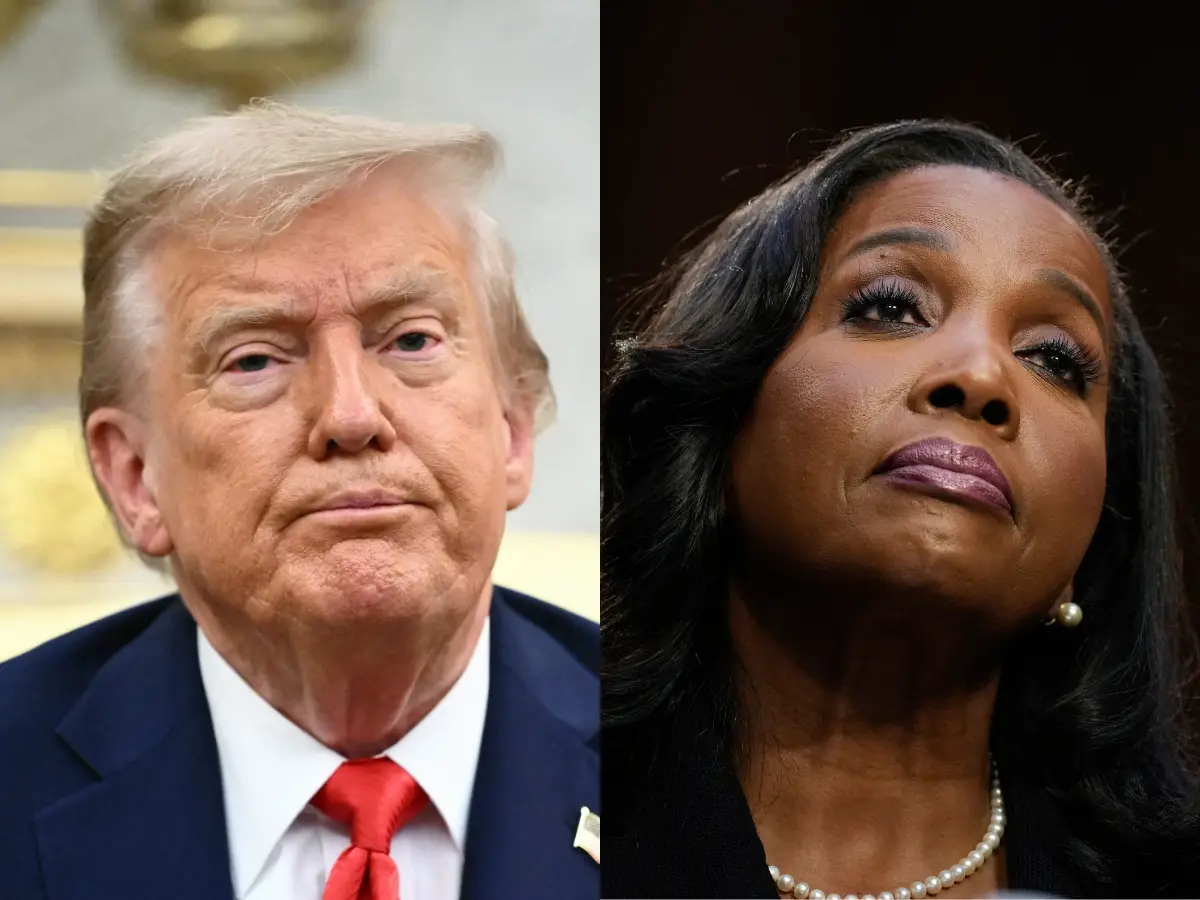
&imwidth=800&imheight=600&format=webp&quality=medium "Explained | Why Trump fired Fed Governor Lisa Cook — and why she says he can't. Here's what US Constitution says")
US President Donald Trump on Monday (Aug 25) said he has fired Federal Reserve Governor Lisa Cook, posting a letter in which he told Cook that he was removing her from her position "effective immediately". The action, as per reports, is based on allegations by a Trump loyalist that the Fed governor had obtained mortgages on two homes while allegedly claiming they were her primary homes. The allegations have not been proved, and just last week, after they came to light, Cook said she had no "intention of being bullied" into stepping down. Responding to Trump's letter, Cook said Trump "has no authority" to fire her and that she would continue to "carry out my duties to help the American economy as I have been doing since 2022."
What did Cook say about her firing?
In a statement shared by her attorneys with CNN on Monday night, Federal Reserve Governor Lisa Cook said, "President Trump purported to fire me ‘for cause’ when no cause exists under the law, and he has no authority to do so". "I will not resign. I will continue to carry out my duties to help the American economy as I have been doing since 2022," added the statement.

Why did Trump fire Cook?
Trump, in the full text of his letter to Cook, stated that he found "sufficient cause" in the allegations against her to fire her. However, reports suggest that Cook's ignoring Trump's demands for lower interest rates could be behind the move. Furthermore, as per the Guardian, Cook's — a Joe Biden appointment — removal would allow Trump to bring in a replacement that would essentially give him more control of the federal policy.
Trending Stories
)
AI kill switch explained: Why shutting down a dangerous AI may not be as simple as pressing a button
)
US ships in Indian Ocean ‘will be attacked’ if war resumes, warns Iran
)
SNL UK takes aim at Ed Sheeran with AI Princess Diana sketch
)
Trump says he'll build an 'AI Force' and appoint a czar, for 'high IQ' people only
)
‘0% chance’: Nvidia CEO Jensen Huang dismisses AI extinction fears by 2030
&im=FitAndFill=(700,400))
What TSMC's 2nm technology means for Apple
)
'Were you here to sell chickpeas?': Wasim Akram criticises Babar Azam's captaincy
)
Sikh bus driver assaulted, bus stolen and rammed into cars in England; video surfaces
)
Mark Carney mimics Trump in hilarious moment over C$70 billion clean-energy investment; room erupts in laughter
&im=FitAndFill=(700,400))
Top 10 countries in mathematics: See the world’s best performers in 2026
)
Apple reportedly building AI server with M8 Ultra chips, may use Nvidia technology
)
TIFF 2026: Theja Rio’s Angh wins Platform Prize, puts Nagaland story on global stage
)
BTS' fans question iHeartRadio’s treatment of group after brief festival set
)
Inside the lethal rebirth of India’s super Sukhoi
)
Samsung raises Galaxy S26 prices by Rs 20,000: Here’s what each model now costs
)
Operation Sindoor’s hidden naval dimension | MoD reveals Indian Navy Special Forces joined May 7 strikes
)
Bessent meets China’s He Lifeng to prepare for Trump-Xi summit
)
Trump defends AI amid growing alarm, announces new 'AI force' and promises an 'AI czar'
)
S Jaishankar, former Army chief among high-profile names issued Delhi SIR notices
)
Iran sets 7 conditions to end war with US: What are Tehran’s demands?
)
Trump announces ‘AI Force’ as debate grows over AI risks and regulation
)
Arvind Kejriwal, family members, Delhi CM Rekha Gupta get SIR notices
)
AI actress Tilly Norwood glitches mid-interview, switches from English to Chinese | Watch
)
Saudi vs Houthis: Houthis claim missiles & drones used in attack on key Saudi sites
)
Ed Sheeran addresses Macklemore's removal, Gaza conflict during Philadelphia concert: 'I cannot hide how I feel'
)
Saudi Arabia exits China-led mBridge digital currency platform amid Saudi-Houthi conflict
)
'Lot of things to learn from experienced players': Jayasuriya backs Rohit, Virat for 2027 ODI World Cup
)
Chancellor Friedrich Merz vows to stay on as exit polls signal major poll setback
)
North Korea's nuclear tests triggered 1,399 earthquakes: Earth is still shaking | Gravitas
)
Several petrol pumps, other businesses to refuse UPI payments above Rs 2,000 from Oct 16: Is it legal?
)
Trump wants to rename ‘Artificial Intelligence’, gives 3 options: Which one would you pick?
)
AUS vs ZIM, 3rd ODI: Ellis stars as Australia edge Zimbabwe by one wicket in last-over thriller
)
West Indies Squad for India Series: Hetmyer included for T20Is, Holder rested
)
China now makes advanced memory chips without the machines it was banned from buying
)
Trump in ‘deciding mode’ on Iran, says ‘very big things’ going to happen soon
)
Harry Brook targets long reign at top of T20I rankings after Sri Lanka sweep
)
Microsoft executive called AI training the ‘largest theft of labour in human history’
This is the latest retaliatory measure taken by Trump against his political enemies since returning to the White House. While Cook is not a politician, she is a senior Fed policymaker who has repeatedly ignored Trump's calls for rate cuts.
What are the mortgage fraud allegations against Cook?
The attack on Cook was led by Trump loyalist Bill Pulte, who was appointed by the POTUS to lead the US Federal Housing Finance Agency. He alleged that the federal officer had claimed two different properties as her primary residences while obtaining mortgages in 2021. On X, Pulte wrote, "How can this woman be in charge of interest rates if she is allegedly lying to help her own interest rates?" while referring the case to the Department of Justice for investigation.
Following this, on Wednesday, Trump on his social media account demanded that Cook "must resign, now!!!". However, Cook, in a statement, said, "I do intend to take any questions about my financial history seriously as a member of the Federal Reserve and so I am gathering the accurate information to answer any legitimate questions and provide the facts."
Also read | Trump reveals he talked to Putin recently, says Russian prez doesn't want to meet Zelensky because...
Does Trump have the power to fire Cook under the US Constitution?
Donald Trump's firing of Lisa Cook is unprecedented. This is the first instance of a president firing a central bank governor in the American central bank's 111-year history.
But the real question is: Can Trump fire her? In his letter, Trump cites the Federal Reserve Act, saying it "provides that you may be removed, at my discretion, for cause," adding, "I have determined that there is sufficient cause to remove you from your position."
The Federal Reserve Act of 1913 stipulates that a president can only remove a Fed governor "for cause." This has been interpreted by courts as requiring sufficient proof of wrongdoing, such as neglect of duty or malfeasance. However, it must be noted that the allegations against Cook are just that "allegations" which remain unproven. The Federal Reserve is an independent agency, and in the Supreme Court case Humphrey's Executor v. United States (1935), it was established that the President's power to remove officials is not unlimited. With Cook rejecting the firing, the case is expected to lead to a legal challenge that may go to the Supreme Court.

