Explained | What is 'Axis of Resistance' in West Asia, posing concerns of Israel-Hamas war spillover?

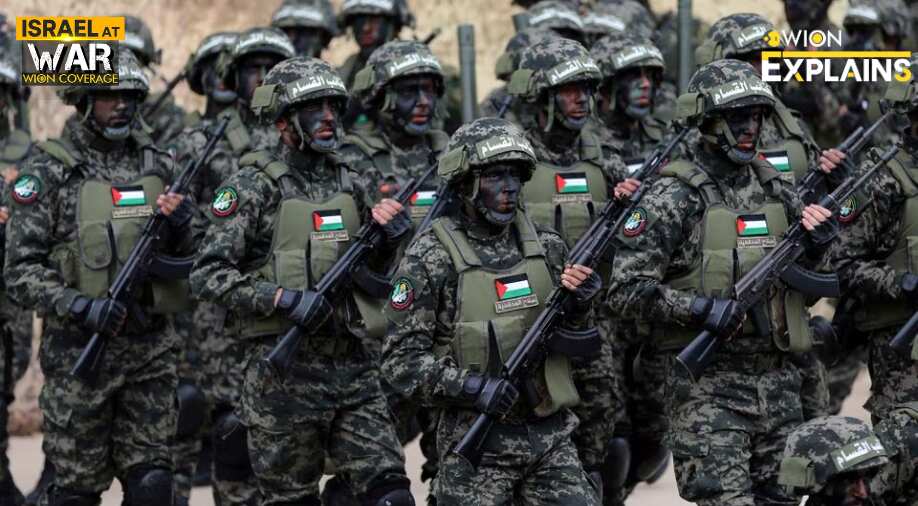
Palestinian Hamas militants take part in a rally marking the 31st anniversary of Hamas' founding
With the Israel-Hamas war ongoing for weeks, an "Axis of Resistance" is seen raising concerns of a spillover in an extended West Asian region. How a number of militant groups and governments in West Asia make their moves will determine the future course of the conflict in the region that started on October 7 after Hamas terrorists launched an attack within the Israeli territory.
The term "Axis of Resistance" isa coalition of various Sunni and Shia Muslim groups and governments in the Middle East.
It includes Hezbollah in Lebanon, Shia militias in Syria, Houthi rebels in Yemen, Hamas and Palestinian Islamic Jihad in Gaza, and other Iran-backed groups in Iraq.

These groups have varying levels of closeness to Iran and often share a common resistance to Western powers and Israel.
The ties shared by these groups are also dynamic in nature. For instance, the relationship between Hamas, a Sunni Islamist group, and Iran has been complex with their cooperation not always smooth.
Iran funds and provides weapons to the Hamas militant group, a move that Israel has been criticising for long.
)
Extreme warming in Indian Ocean added 695 billion tons of ice to Antarctica ice sheet
)
'Now Trump is copying us': Shivakumar links US $5,000 plan to Congress guarantees
&im=FitAndFill=(700,400))
Why European Meteor missiles use ramjet engines compared to standard US solid rockets
)
China's property crisis deepens as investment plunges nearly 20%
)
1,200 Indian and US troops begin high-altitude and desert drills
)
Spanish officer sent home from NATO base over affair with 'Russian spy' | Gravitas
)
Imran Khan’s sons accuse Asim Munir of holding ‘personal grudge’ against imprisoned father
)
2026 El Niño will create new extreme weather patterns. Worse, no one can predict them
)
Russia proposes to build 360 kmph Ivolga FG trains in India: What happened on sidelines of BRICS
)
US Treasury yields cross 5% as Scott Bessent warns of ‘global issues’ impacting bonds
)
Trump's name cannot return to Kennedy Center, US judge rules
)
Saudi turns to Israel for intelligence help as Houthi attacks intensify: Report
)
'She married her brother': Ilhan Omar faces criminal probe over immigration fraud claims
)
'Definitely feel bad for yourself': Kuldeep Yadav opens up on India Test snubs
)
West Bengal IPS officer Bushra Bano transferred after objections to ‘Assalamualaikum’, ‘Inshallah’
)
Ex-CIA officer caught with gold bars worth $40 million seeks plea deal | Gravitas
)
‘We are sharing some difficult news’: Oracle begins fresh round of job cuts
)
471 years ago, a prophecy warned of 'immortal lone brain'. Some think it was about AI
)
3 wild dogs, 1 epic journey: African brothers trek 4,000 km through Zambia to find a partner
)
Delhi schools receive bomb threats in Punjabi, security checks find nothing suspicious
&im=FitAndFill=(700,400))
New OTT releases this week (September 14-20, 2026): Lust Stories 3, Waiting Hai, Irumudi- 5 new titles coming on Netflix, Prime Video and more
)
Who is Kalyan Bainsla, accused in the Gurugram hit-and-run case involving woman biker?
)
Trump Calls AI Security Concerns A 'Hoax' | Verdict
)
800 million years old - Scientists discover 'fingerprints' of supercontinent Gondwana in ancient rocks
)
India’s imports from Russia jump 57% in five months; China remains top import source
)
Bitter Zelensky snubs Trump for playing politics with Ukraine war | Gravitas
)
Amid AI safety fears, OpenAI, Anthropic and Google move to create standards body
)
‘US military task force aiding Saudi Arabia forces with intel, planning support’: Official
)
Top military commanders from US, Israel, and 7 Arab nations held secret meeting on Iran War
)
IND vs AFG, 2nd T20I: Reddy, Samson shine as India defeat Afghanistan by 7 wickets to clinch series
)
Elephants hide behind trees, stage surprise attack on poachers targeting rhinos in South Africa
&im=FitAndFill=(700,400))
Why Chinese PL-15 air-to-air missiles use dual-pulse motors compared to European interceptors
)
UPI rule change: 0.4% MDR on merchant payments above ₹2,000; consumers unaffected
)
A big shift in modern air power & control
)
What is Hyrox, in news for athlete who soiled herself, but kept running and using common equipment?
)
Saudi Arabia discovers 110 million tonnes of Uranium-rich ore in Madinah region
Also Read |15 anti-Israel protesters jailed over anti-Israel riot at Russian airport
Tensions between Hamas and Iran arose when the Palestinian militant group supported protesters against Syria's President Bashar Assad.
It is worth noting that Iran already backs the Syrian government. However, despite these occasional differences between Hamas and Iran, both share anti-American and anti-Israeli sentiments.
Ghattas, who is also a distinguished fellow at the Columbia Institute of Global Politics reportedly said, "It is important to remember that Hamas is not a proxy of Iran in the way that Hezbollah is."
"Hezbollah has become an extension of [the] Iranian Revolutionary Guards Quds Force," Ghattas said. "Hamas keeps its own separate identity and it has other backers, aside from Iran," he added.
Also Read |'Felt like end of world': Survivors share tragic story as Israeli strikes rock Gaza refugee camp
"Their agendas still align in an anti-American, anti-Israel worldview, and they come together again when necessary," Ghattas pointed out.
'Unity of Fronts'
All the groups in the "Axis of Resistance" reportedly have increased coordination to present a united front against Israel, especially in the wake of the Israeli counterattack on Hamas targets in beseiged Gaza territory.
The leadership of Hamas and Hezbollah have been discussing the ensuing war in Israel. One such instance was when Hezbollah leader Hassan Nasrallah reportedly met top Hamas officials in Beirut.
The meeting was followed by a statement that was about a shared goal between the groups. It was to achieve "a real victory for the resistance in Gaza and Palestine".
Calling the attack by Israel "treacherous and brutal," the statement also showed its support for "our oppressed and steadfast people in Gaza and the West Bank."
Hezbollah leader Nasrallah earlier also talked of what was dubbed a "unity of fronts." The vision behind these Iran-backed groups is reportedly to come under one umbrella and form a resistance group against Israel.
NPR while quoting experts is of the opinion that even when the Hezbollah leader did not speak of the "unity of front," they were already closer to forming a sort of coalition against Israel.
Mohanad Hage Ali, a Beirut-based senior fellow at the Carnegie Middle East Center, told NPR that the "unity of fronts" of Iranian-backed proxies is "a kind of NATO for militant groups" in the region.
Watch |Israel-Palestine war: Hope rises among kin of hostages
"Over the past couple of years, Iran has been working to coordinate its proxies in what it describes as a 'unification of fronts,' surrounding Israel on all fronts," Ghattas said and added, "It is a more logistically coordinated operation, rather than each group doing its own thing."
According to Ghattas, the coordination is ongoing between Hezbollah and Hamas, Iran's proxies in Lebanon and Gaza.
Iranian-backed proxy groups are working together in terms of planning and training in a bid to challenge common adversaries, as per experts.
Paul Salem, president of the Middle East Institute in Washington, reportedly told NPR, "It's quite likely that Hezbollah knew of the preplanning [for the Oct. 7 attacks] and probably participated in training and planning with Hamas, and all of them sort of are part of this Iranian proxy force deployment that you have in Lebanon, in Syria, in Yemen, in Iraq and in Gaza as well."
The Iranian regime and its Quds Force are all included in the Axis of Resistance. Islamic Jihad in Palestine get most of its budget from Tehran. And, Iran-backed Popular Mobilisation Forces (PMF) in Iraq are also part of this resistance axis.
The origin of the "axis of resistance" reportedly came after former US President George W. Bush used the term "axis of evil". At the time, he was referring to Iran, Iraq, and North Korea, in his 2002 State of the Union address.
However, there are debated reports about the origin of the term "Axis of Resistance" in relation to Iran and its proxies active across the Middle East.
(With inputs from agencies)