
&imwidth=800&imheight=600&format=webp&quality=medium "China jumps in to take credit for Thailand-Cambodia ceasefire despite violations — What exactly is it's role? Has it sidelined Trump's US?")
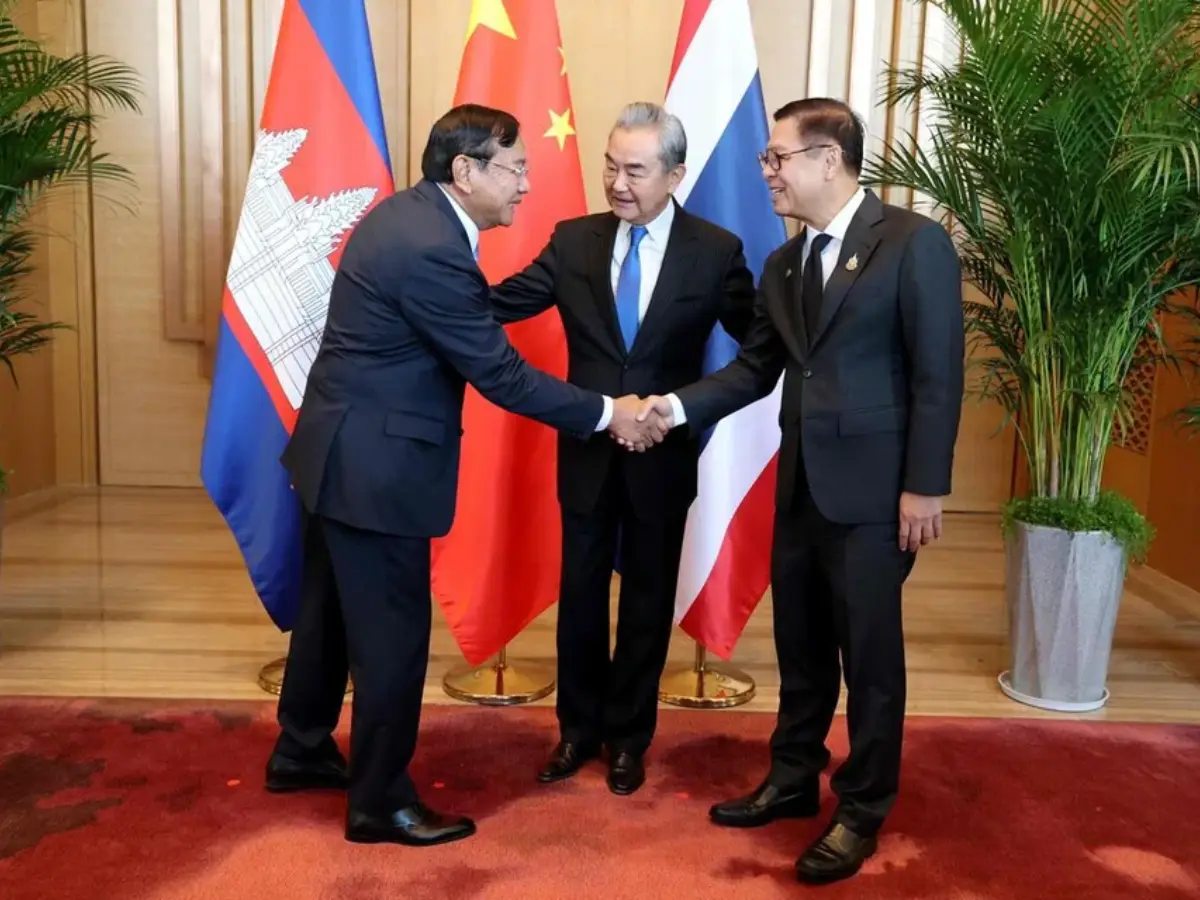
After US President Donald Trump claimed credit for ceasefire between Thailand and Cambodia, China has jumped in to take the credit for peace between the two Southasian nations. Without naming Trump or US, China highlighted that its efforts to promote peace and dialogue is a genuine process which does not “impose on others or overstep its bounds.” Chinese government-run tabloid The Global Times said in an editorial that China does not adopt a condescending approach when mediating between two nations. The Chinese statement came after its foreign minister Wang Yi hosted his Cambodian and Thai counterparts for three-way talks on Dec 29. The development took place in the aftermath of renewed clashes between the two countries and Trump's failed attempt to bring peace via a phone call.
The Global Times wrote, “Unlike many past mediations dominated by the West, China does not adopt a condescending approach, impose political conditions or seek geopolitical advantages." In a separate bilateral meeting Thai foreign minister Sihasak Phuangketkeow, Yi said, “China’s efforts to promote peace and dialogue never impose on others or overstep its bounds." This is seen as Beijing's taunt at the US as President Trump has repeatedly said that he used “trade and tariff to put pressure” on warring countries and bring peace.
China's interests in Thailand-Cambodia

China has multiple strong interests in wanting a lasting ceasefire between Thailand and Cambodia:
- Beijing wants to protect its extensive strategic investments and economic corridors in both countries.
2. China, which is already dealing with tensions with Japan over Taiwan, does not want regional instability. In its neighbourhood, China is already concerned about the civil war in Myanmar.
Trending Stories
)
Pakistan puts Pak Rs 70 lakh bounty on UN terrorist Masood Azhar; move draws skepticism in Delhi
)
Iran, India agree to deepen humanitarian and political ties, President Pezeshkian says
)
Israeli minister calls to strip Gaza film directors of citizenship
)
Plane carrying prominent figure crashes at Libya’s Misrata airport: Report
&im=FitAndFill=(700,400))
Why European Meteor missiles use ramjet engines compared to standard US solid rockets
)
‘Let’s go’: Newly declassified videos show dramatic rescue of US Air Force officers downed in Iran
)
China thinned Himalayan troop presence in 2025, India defence report says; terms border situation 'stable'
&im=FitAndFill=(700,400))
New OTT releases this week (September 14-20, 2026): Lust Stories 3, Waiting Hai, Irumudi- 5 new titles coming on Netflix, Prime Video and more
)
‘Want to reset ties with India, have engagement based on mutual interests,’ says Bangladesh minister
)
Delhi’s balancing act: BRICS serves as a stage for West Asia diplomacy
)
Russian drone hits Warsaw-bound train near Polish border, Zelensky accuses Moscow of ‘deliberate’ targeting
)
Natural caffeine sources gain popularity; matcha & botanicals offer calm energy
)
Saudi Arabia discovers 110 million tonnes of Uranium-rich ore in Madinah region
)
Trump says Canada eager to reach a deal, it could come ‘fairly soon’ if Ottawa treats US farmers better
)
Liam Neeson sparks romance rumours after holding hands with Stella Stocker at TIFF 2026
)
Indian importers urge Bangladesh to lift export ban on 'Hilsa' fish ahead of Durga Puja
)
800 million years old - Scientists discover 'fingerprints' of supercontinent Gondwana in ancient rocks
)
Humans may lose control of AI: Anthropic CEO calls for slowdown, Altman, Musk back him
)
'Huge destructive power': North Korea calls its latest missile launches 'live-fire drill' even as US dismisses 'immediate threat'
)
Women's Asia Cup 2026: India denied trophy once again despite winning the title
)
Crude oil prices jump more than $107 per barrel following Houthi attacks on Saudi
)
Russia proposes to build 360 kmph Ivolga FG trains in India: What happened on sidelines of BRICS
&im=FitAndFill=(700,400))
Why Chinese PL-15 air-to-air missiles use dual-pulse motors compared to European interceptors
)
Practical Magic 2 breaks Spidey spell over North American box office
)
Turkish Airlines plane flies through a storm three times, triggering severe turbulence
)
China discovers vast gold and silver 'mine' in the Pacific with unheard-of deposits
)
Ganesh Chaturthi 2026: Devotees throng the iconic Lalbaugcha Raja pandal in Mumbai
)
Orlando Bloom addresses Pirates of the Caribbean comeback and reunion with Johnny Depp
)
Veteran Bollywood actress Nafisa Ali shares health update as Stage 4 cancer progresses, starts targeted therapy
)
Did China give Iran intel before US base strike that killed 3 troops? Trump says, 'You’re right...'
)
Video of Pakistani lawmaker struggling to read English tribute to Jinnah goes viral - WATCH
)
Did India risk its US trade deal despite softer stance at BRICS?
)
First naval drone battle? Ukraine says Sargan 3000 sank Russian unmanned boat
3. Beijing is also seeking to establish its influence in South-east Asia to challenge US engagement in the region. It is aiming to repeat what it did in 2023. China played a pivotal role in brokering the historic March agreement between Iran and Saudi Arabia to restore diplomatic ties, ending a seven-year rift.
4. While the US played a more diplomatic role, Beijing is getting involved in ground efforts like helping with landmine removal operations and providing support to the ASEAN Observer Team monitoring the ceasefire.
Thailand-Cambodia ceasefire and violations
Thailand's military has accused Cambodia of violating a newly signed ceasefire agreement on Dec 29. The Royal Thai Army claims that over 250 unmanned aerial vehicles (UAVs) were detected flying across the border from Cambodia late Sunday (December 28) night. Thailand warned that it might reconsider the release of 18 Cambodian soldiers detained in Thailand since July, depending on the continuation of these violations. Cambodia downplayed the incident with Foreign Minister Prak Sokhonn calling the drone sightings a "small issue" and stating that both sides had witnessed similar activities along the border.
Thailand and Cambodia on Saturday (Dec 27) announced that they have agreed to an “immediate” ceasefire. The recent clashes killed at least 47 people, while about a million were displaced. Both sides have agreed to freeze the movement of troops and allow civilians living in the border regions to return to their homes as soon as possible.
What triggered Nov-Dec clashes?
The fresh clashes were triggered after a Thai soldier was injured by a landmine, allegedly placed near disputed border area by Cambodia, in November. Cambodia denied the claims, but the Thai soldier died later prompting Thailand to launch an air strike. Earlier this year, both sides exchanged fire near the disputed border area and a Cambodian soldier was killed. Intense clashes erupted thereafter that continued for approximately a week. Trump stepped in using trade as a negotiation tactic and a ceasefire was declared. The Southeast Asian nations - Thailand and Cambodia - dispute the colonial-era demarcation of their 800-kilometre (500-mile) border. Both countries also claim the land surrounding the 11th-century Preah Vihear Temple as their own.

