

&imwidth=800&imheight=600&format=webp&quality=medium "A Mecca defence pact that leaves more questions than answers")
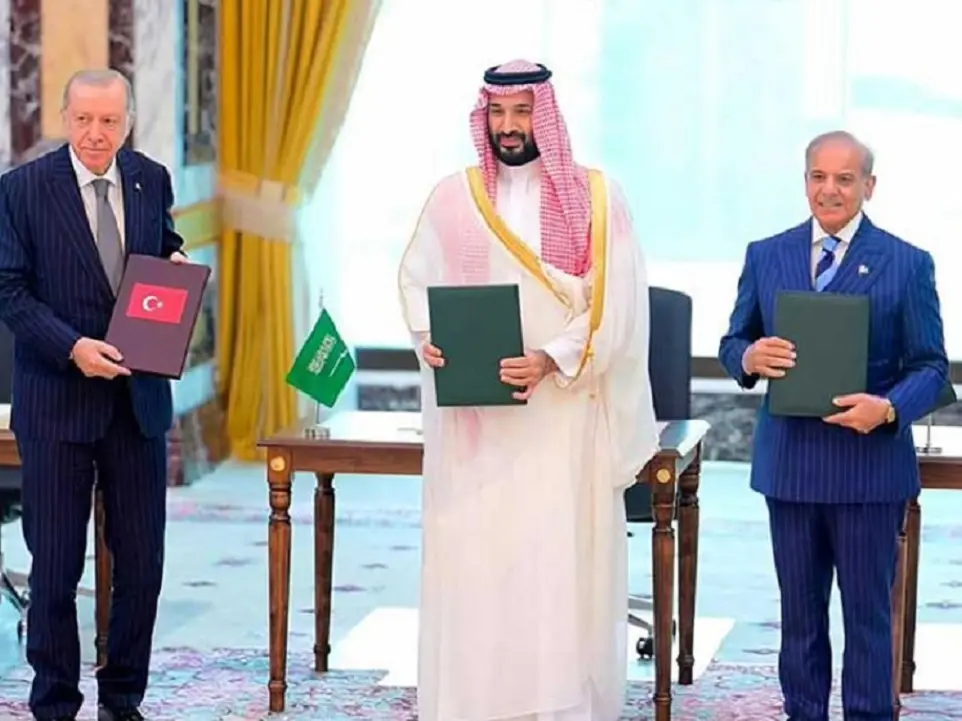
New Delhi: The decision by Saudi Arabia, Turkey and Pakistan to sign a joint defence agreement in Mecca rather than in any of their capitals was never merely logistical. By gathering Crown Prince Mohammed bin Salman, President Recep Tayyip Erdoğan and Prime Minister Shehbaz Sharif for both the signing, the three governments converted a military compact into a claim of broader Islamic legitimacy. The text itself, however, remains strikingly thin on operational detail.
Supporters describe the pact as a pragmatic instrument of collective deterrence at a time of regional instability. Pakistan already has several thousand troops, aircraft and air defence systems in the kingdom under a bilateral arrangement from September 2025; the trilateral document simply widens the political umbrella. Turkey brings the weight of a large NATO army and advanced technical capabilities, while Saudi Arabia supplies the geographic and financial centrality. Pakistani officials have since suggested that six or seven other Muslim-majority states may seek to join, framing the arrangement as open-ended rather than exclusive.
Also Read: ‘Rise up, young patriots!’: American singer Mary Millben says US donors funding CJP, backs Modi govt
Yet the absence of a named adversary is both the pact’s selling point and its principal weakness. Without a clear definition of the threat it is meant to address, the threshold for activation remains opaque. Pakistani Defence Minister Khawaja Asif has insisted that any Pakistani role will be supportive and that Saudi forces will conduct direct combat. What “supportive” covers, reconnaissance, air defence, logistics or something broader, has not been spelt out.
The same ambiguity surrounds the nuclear question. Pakistan is the only nuclear-armed party; the published text is silent on whether its deterrent is included, and no official has ruled the possibility out. In the absence of explicit language, speculation fills the gap.
Trending Stories
&imwidth=180&imheight=135&format=webp&quality=medium)
China's counter-surveillance industry booms amid heightened espionage fears | Gravitas
&im=FitAndFill=(700,400)&imwidth=180&imheight=135&format=webp&quality=medium)
Navratri 2026: 9 days, 9 forms of Goddess Durga and 9 colours- Check the complete list
&imwidth=180&imheight=135&format=webp&quality=medium)
Trump accuses Houthis of driving up oil prices before US midterms, warns of consequences
&imwidth=180&imheight=135&format=webp&quality=medium)
Russian woman and Bihar boy's love story goes viral after she reaches India to marry him
&imwidth=180&imheight=135&format=webp&quality=medium)
US Midterms 2026: In Alaska, cost-of-living anxiety meets strangest ballot in high-stakes Senate race
&imwidth=180&imheight=135&format=webp&quality=medium)
Arijit Singh 9-city India stadium tour to start from January: Check venue and ticket prices
&imwidth=180&imheight=135&format=webp&quality=medium)
F1 set to return to Africa for first time since 1993
&imwidth=180&imheight=135&format=webp&quality=medium)
'Don't ever mess with nature!': Trump’s tiger attack post triggers social media backlash as victim's family issues heartbreaking tribute
&imwidth=180&imheight=135&format=webp&quality=medium)
CMs Vijay-Naidu meet in Vijayawada, discuss water sharing, river-linking
&imwidth=180&imheight=135&format=webp&quality=medium)
Air India Flight from Frankfurt diverted to Jaipur after hijack alert, probe on
&imwidth=180&imheight=135&format=webp&quality=medium)
1,500 drones illuminate Mumbai sky as Cordelia Cruises unveils second ship, Cordelia Sky
&imwidth=180&imheight=135&format=webp&quality=medium)
Delhi Police arrest Cockroach Janta Party's Saurav Das, Ashutosh Ranka, Ajinkya Shinde in Jantar Mantar case, to be produced before court
&imwidth=180&imheight=135&format=webp&quality=medium)
Pakistan to chair UN-backed global Borrowers’ Platform as its own debt burden mounts, triggers sarcastic reactions on social media
&imwidth=180&imheight=135&format=webp&quality=medium)
France accuses Musk of ‘online harassment’ of European leaders, warns of poll interference
&imwidth=180&imheight=135&format=webp&quality=medium)
'Turn approver, resign, we'll forgive you': Rahul Gandhi claims receiving messages from CEC Gyanesh Kumar
&imwidth=180&imheight=135&format=webp&quality=medium)
MI5 chief warns Russia is UK’s ‘aggressor number one’ as Iran and AI threats grow
&imwidth=180&imheight=135&format=webp&quality=medium)
At least 80 newborns die at Madhya Pradesh Hospital over six months, BJP MLA demands probe
&imwidth=180&imheight=135&format=webp&quality=medium)
Trump reconsidering calling off Nidal Hasan's execution livestream. Here's why
&imwidth=180&imheight=135&format=webp&quality=medium)
‘My president, I mean my husband’: Trump's new press secretary Katie Zacharia's first briefing goes off the rails in 14 minutes
&imwidth=180&imheight=135&format=webp&quality=medium)
‘How many people did she illegally bring from Somalia?’ Trump targets Ilhan Omar, questions her net worth
&imwidth=180&imheight=135&format=webp&quality=medium)
Marco Rubio to visit India next week, focus on energy cooperation and strategic ties
&imwidth=180&imheight=135&format=webp&quality=medium)
US politicians mistakenly use Indian, Russian warship images for Navy's birthday posts
&imwidth=180&imheight=135&format=webp&quality=medium)
'Ouch!!! That must hurt': Kangana Ranaut hails Kamal Haasan's sharp reply to Elon Musk over Starlink row
&imwidth=180&imheight=135&format=webp&quality=medium)
Girl 'dead' for 8 hours wakes up at her own funeral, dad insists she wasn't breathing
&imwidth=180&imheight=135&format=webp&quality=medium)
Sidhu Moose Wala’s younger brother wins hearts by recreating late singer’s signature move at Toronto Hologram Show
&imwidth=180&imheight=135&format=webp&quality=medium)
UK school ditches technology, shifts from screen to pen and paper for learning
&imwidth=180&imheight=135&format=webp&quality=medium)
Durga Puja 2026: Kolkata roads get a splash of colours
&im=FitAndFill=(700,400)&imwidth=180&imheight=135&format=webp&quality=medium)
New OTT releases this week (October 12-18, 2026): Sacrifice, Koffee with Karan S9, Roadies Rebirth- 6 titles coming on Netflix, JioHotstar and more
&imwidth=180&imheight=135&format=webp&quality=medium)
Inside Aneet Padda's 24th birthday bash with rumoured boyfriend Ahaan Panday and Alia Bhatt
&imwidth=180&imheight=135&format=webp&quality=medium)
New Cold War: Why is China buying more gold? Explained
&imwidth=180&imheight=135&format=webp&quality=medium)
Netanyahu wants to join Saudi's war on Houthis, but Crown Prince denies: Report
&imwidth=180&imheight=135&format=webp&quality=medium)
Anupam Kher joins Ranbir Kapoor's Ramayana as Jatayu, new poster unveiled
&imwidth=180&imheight=135&format=webp&quality=medium)
Measles kills again: 6 dead in Pennsylvania as America faces its worst outbreak in decades | Gravitas
&imwidth=180&imheight=135&format=webp&quality=medium)
CJP slams 'Coward Sarkar' as Saurav Das, Ashutosh Ranka sent to 5 days' judicial custody over Jantar Mantar protest
&imwidth=180&imheight=135&format=webp&quality=medium)
Cornell University suspends fraternity parties over 2024 gang rape allegations
Turkey’s posture adds a further layer of uncertainty. Ankara has so far limited its public commitments to air defence and technical assistance, and its parliament had not ratified the agreement two months after the Mecca ceremony. If the political weight of the pact rests disproportionately on Islamabad and Riyadh, the arrangement risks becoming less trilateral than bilateral in practice.
Domestic considerations in Pakistan also deserve scrutiny. The country hosts a large Shia minority whose security has repeatedly been tested by sectarian violence. Field Marshal Asim Munir’s reported remarks to Shia clerics in Rawalpindi, warning that loyalty to foreign causes would not be permitted to create disorder at home, were widely read by community leaders as signalling an uncompromising line. Whether a Saudi-led defence framework can remain insulated from Pakistan’s own sectarian tensions is an open question that officials have so far declined to address in detail.
Financial context is equally difficult to separate from the security one. Saudi deposits arrived shortly before Pakistani aircraft reached the kingdom in April; the Mecca pact followed weeks later. No official has linked the money to the military commitments, yet the sequence invites scrutiny of the conditions under which Pakistan’s resources are being committed abroad.
Also Read: After flydubai co-pilot attack, Air France bans Pakistani, Muslim-majority crew on Israel flights
The Mecca agreement has succeeded in projecting unity and resolve. What it has not yet done is define the precise circumstances in which that resolve would be tested, or how the three capitals would share the political and military costs. Until those questions are answered, the pact remains more a declaration than a doctrine. The ongoing Houthi attacks have only raised more questions, especially on Islamabad's commitment, given it faces several challenges at home, including separatist one in restive Balochistan province.
