
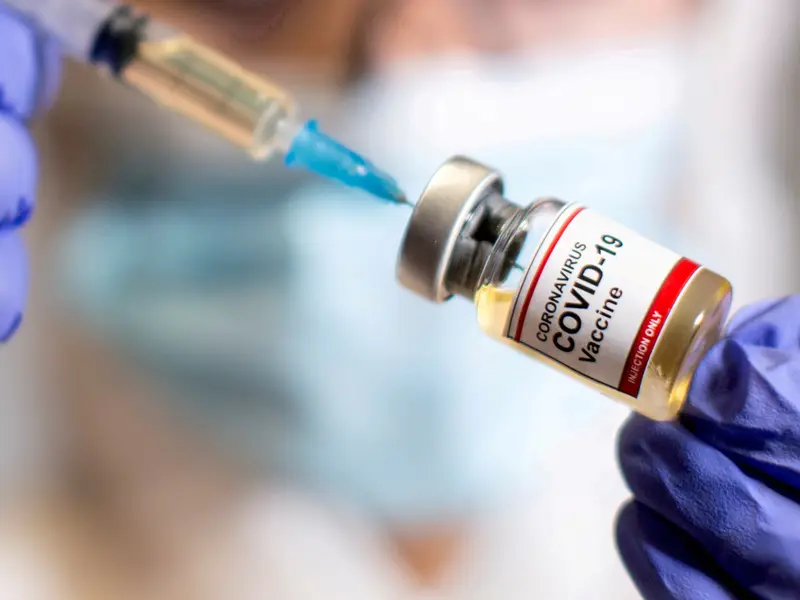
The US Food and Drug Administration (FDA) has announced that future coronavirus vaccine approvals will focus only on older adults and those with health conditions that increase the risk of serious illness.
The move marks a significant change in vaccine policy, which until now encouraged wide public access, including for healthy individuals and children.
Under the new approach, updated Covid-19 vaccines are likely to be available this autumn only for people aged 65 and older, and for those over 6 months old who have conditions such as diabetes, asthma, obesity, cancer, or are pregnant.

According to FDA estimates, more than 100 million Americans would still qualify under these revised guidelines.
Healthy under-65s may no longer get free Covid shots
Trending Stories
)
US vs China over South China Sea: Washington backs Philippines, Beijing hits back
)
Delhi gets first late-September rain in 7 years, mercury dips 5.1°C below normal
)
50MP vs 48MP cameras: iPhone 18 Pro Max and Pixel 11 Pro XL compared
)
‘Anti-social elements spreading false rumours’: LPU issues statement amid massive unrest over alleged rape
)
LPU students go on rampage, vandalise campus amid widespread protest: What's happening
)
Trump asked Xi to pressure Iran. China did not say yes — here’s what Beijing wants
)
US Treasury Secretary Scott Bessent hails global crackdown on Iranian banks and airlines
)
Jerry Maguire star Jonathan Lipnicki makes rare red carpet appearance
)
Venezuela's oil heartland eyes US revival
)
3 males killed, four others injured in shooting after fight at strip club in Detroit
)
Russia backs India at UNGA, but flags limits on UNSC seat expansion
)
South Africa probes string of murders targeting women
)
Building collapses after blast in Athens: 4 Americans, British man among 6 killed; cause not known
)
'Victory for low-budget consumers': Raghav Chadha hails 30-day telecom recharge rules
)
Kendall Jenner, Jacob Elordi’s Milan Fashion Week appearance has fans talking; his reaction steals the show
)
Beyond metros: How Tier-2 and Tier-3 cities could drive India’s next AI wave
)
Tesla builds first Cybertruck with its own refined lithium: Elon Musk's $1 billion Texas bet pays off
)
IndiGo flight suffers tail strike in Bengaluru while landing; DGCA to probe incident
)
‘Terror suspects arrested near UK air base were looking to do big damage’: Trump
)
Russian envoy claims US tactics to contain India were revealed in ‘Freudian slip’
)
‘Olympic inclusion is our major target’: WPA President Ishaun Singh on pool’s global ambitions
)
Nations League: Spain sink England at Wembley; Modric shines for Croatia
)
Why has Iran released no proof of life of Mojtaba Khamenei? Araghchi reveals...
)
Bank unions defer 3-day strike from tomorrow after talks with IBA, committee set up
)
'What kind of confession is this?': Pakistan PM Shehbaz Sharif’s 'terrorists would be roaming New York' remark goes viral, raises alarm online. Watch
)
Iran ready for ‘doomsday war’ if US resumes attacks, but open to diplomacy: Araghchi
)
Beyond BrahMos: India targets Rs 50,000 crore in defence exports with unmatched price edge
)
Sri Lankan Tamil migrant worker gets death sentence in Saudi Arabia, help sought from India
)
Muslim marriage cannot shield sex with minor wife from prosecution under POCSO: Delhi HC
)
99.9% more powerful - Scientists find boy who can recall memories from just 3 months of age
)
'FIRST LOOK from inside Noah’s Ark': Researchers share video from inside mysterious mound in Turkey
)
UNSC reform momentum grows: Russia, Portugal, Mauritius push for India's permanent seat bid
)
Man arrested after his 22-year-old girlfriend dies at homestay in Guwahati; police suspect murder over suicide claim
)
Afghanistan says 28 fighters killed in clash near Pakistan border, Islamabad denies
)
Ceuta migrant crisis: Protesters take to streets as Spain grapples with migrant challenge
)
Powerful Autumn storm threatens major coastal flooding across the US Northeast
)
Jaishankar at UNGA: Goodwill and friendship can't coexist with terrorism
It remains unclear whether healthy people under 65 will be allowed to get vaccinated, or whether insurers will cover the cost if they are. Some experts warn that if the recommendation is not extended to include these groups, they might have to pay out of pocket.
“If they do not make it permissive, meaning that individuals who are not in a risk group or who are under 65 years of age want to be vaccinated, it’s likely now that payers will not pay for that vaccine,” said infectious-disease expert Michael Osterholm, as per The Washington Post. “Therefore, in a sense, it’s the equivalent of taking away a vaccine from someone,” he added.
CDC could make room for broader access
It will be up to the Centres for Disease Control and Prevention (CDC) to decide who should get the vaccine, within the limits of what the FDA allows.
FDA to demand stronger data for healthy groups
In a New England Journal of Medicine article, FDA Commissioner Marty Makary and vaccine regulator Vinay Prasad explained that vaccine makers will now need to carry out full clinical trials before the FDA approves Covid vaccines for healthy people aged 6 months to 64 years.
“The FDA will approve vaccines for high-risk persons and, at the same time, demand robust, gold-standard data on persons at low risk,” wrote Makary and Prasad. “These clinical trials will inform future directions for the FDA, but more important, they will provide information that is desperately craved by health care providers and the American people,” they added.
For now, the agency says it will “encourage” vaccine manufacturers to conduct these trials after they receive approval for high-risk groups, a costly and time-consuming process.
Also read: India says COVID situation 'under control' as global cases rise: Is the new variant more dangerous?
Most adults fall under high-risk category
The CDC has said that around 74% of American adults have at least one condition that puts them at a higher risk of serious COVID-19 outcomes. The policy change, therefore, still leaves a majority of adults eligible.
The FDA’s new direction follows a wider shift in the pandemic response, with most people now having some level of immunity from previous infections or vaccinations. Covid is also causing fewer severe cases overall, although it still poses a danger to vulnerable individuals.
Vaccine policy now in political spotlight
The Trump administration has raised questions recently about how vaccines are tested for safety, adding uncertainty about whether updated jabs will be available on time in the autumn. Robert F. Kennedy Jr., who now heads the Department of Health, has publicly challenged current vaccine practices and called for changes in the testing process.
Kennedy, a long-time critic of vaccinations, has falsely claimed the Covid vaccine is “the deadliest ever made”. However, he now insists his aim is to improve vaccine data quality. His department has since indicated plans to re-examine how coronavirus vaccines are developed and approved.
