‘People buried under rubble’: Philippines quake death toll rises to 26, over 147 injured; rescuers search for survivors

&imwidth=600&imheight=450&format=webp&quality=medium "‘People buried under rubble’: Philippines quake death toll rises to 26, over 147 injured; rescuers search for survivors")
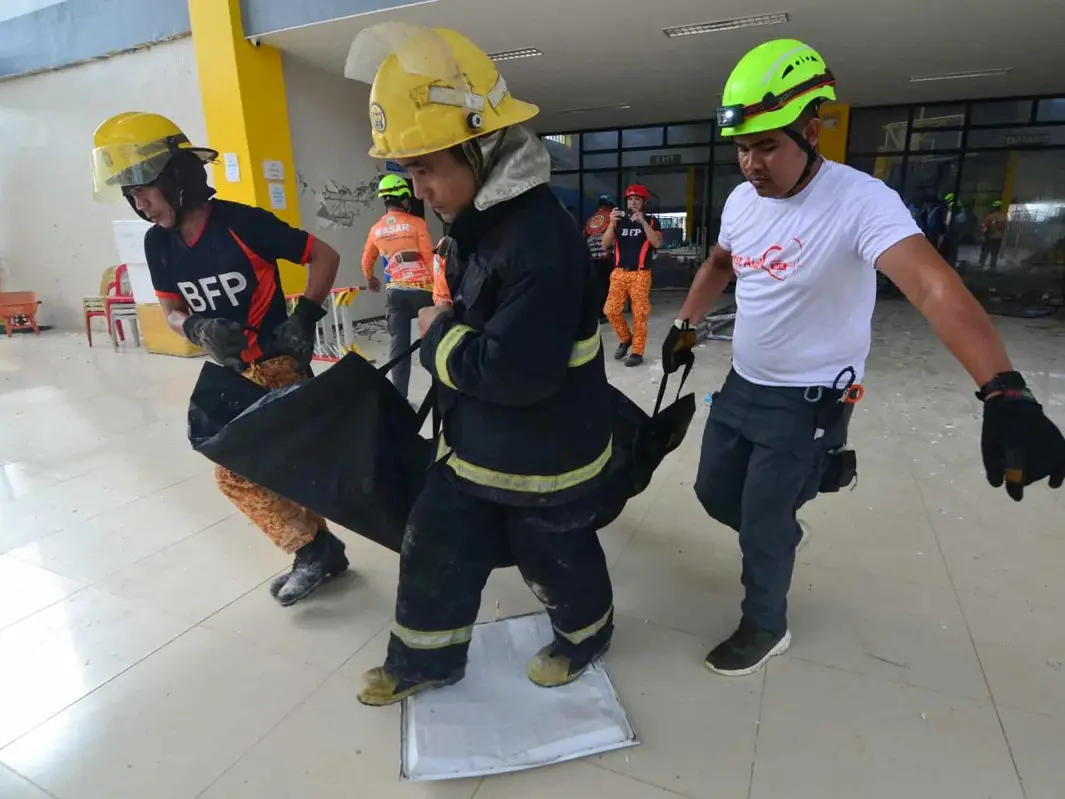
Rescuers carry a bag containing a dead body retrieved from an indoor arena in San Remigio town, Cebu province, central Philippines, on October 1, 2025, after a powerful 6.9-magnitude earthquake jolted the central Philippines. Photograph: (AFP)
At least 26 people have been killed and 147 injured after a 6.9-magnitude quake struck the central Philippines, toppling buildings and triggering landslides. Rescuers warn more victims may be trapped under rubble as aftershocks continue to rattle Cebu and nearby areas.
The powerful 6.9-magnitude earthquake that struck the central Philippines late Tuesday (Sep 30) has killed at least 26 people and injured 147, the national disaster agency said Wednesday (Oct 1). The shallow quake hit off the northern coast of Cebu at 9:50 pm local time (1359 GMT), toppling buildings, triggering landslides, and plunging several towns into darkness. The US Geological Survey initially measured the tremor at magnitude 7.0 before revising it down.
Death and destruction
The National Disaster Risk Reduction and Management Council (NDRRMC) in its latest bulletin reported that at least 22 structures were damaged or destroyed across the region. Among the dead are three coastguard members killed when the roof of a sports centre collapsed during a basketball game in San Remigio. In Bogo, nine adults and four children were killed after being buried in landslides or crushed by debris.
According to reports, several village roads were damaged by the quake, which caused power lines to trip, resulting in power outages across Cebu and the nearby central islands. However, power was restored shortly after midnight in Cebu and four other major central islands, said National Grid Corp in its advisory.
Trending Stories
)
)
)
&im=FitAndFill=(700,400))
)
)
)
)
)
)
)
)
)
)
)
)
)
)
)
)
)
)
)
)
)
)
)
)
)
)
&im=FitAndFill=(700,400))
)
)
)
&im=FitAndFill=(700,400))
)
379 aftershocks rock the Philippines
Rescuers warned that more people may still be trapped. "There could be people beneath collapsed buildings," provincial rescue officer Wilson Ramos told AFP, adding that aftershocks and darkness hampered overnight operations. According to the Institute of Volcanology and Seismology, the region was being rocked by 379 aftershocks.
Cebu Governor Pamela Baricuatro urged residents to remain calm, avoid damaged buildings, and stay alert for further tremors. The Philippines sits on the Pacific "Ring of Fire," where earthquakes are frequent and often deadly.

