Mysterious structures uncovered beneath the Amazon show millions of humans once lived here

&imwidth=600&imheight=450&format=webp&quality=medium "Mysterious structures uncovered beneath the Amazon show millions of humans once lived here")
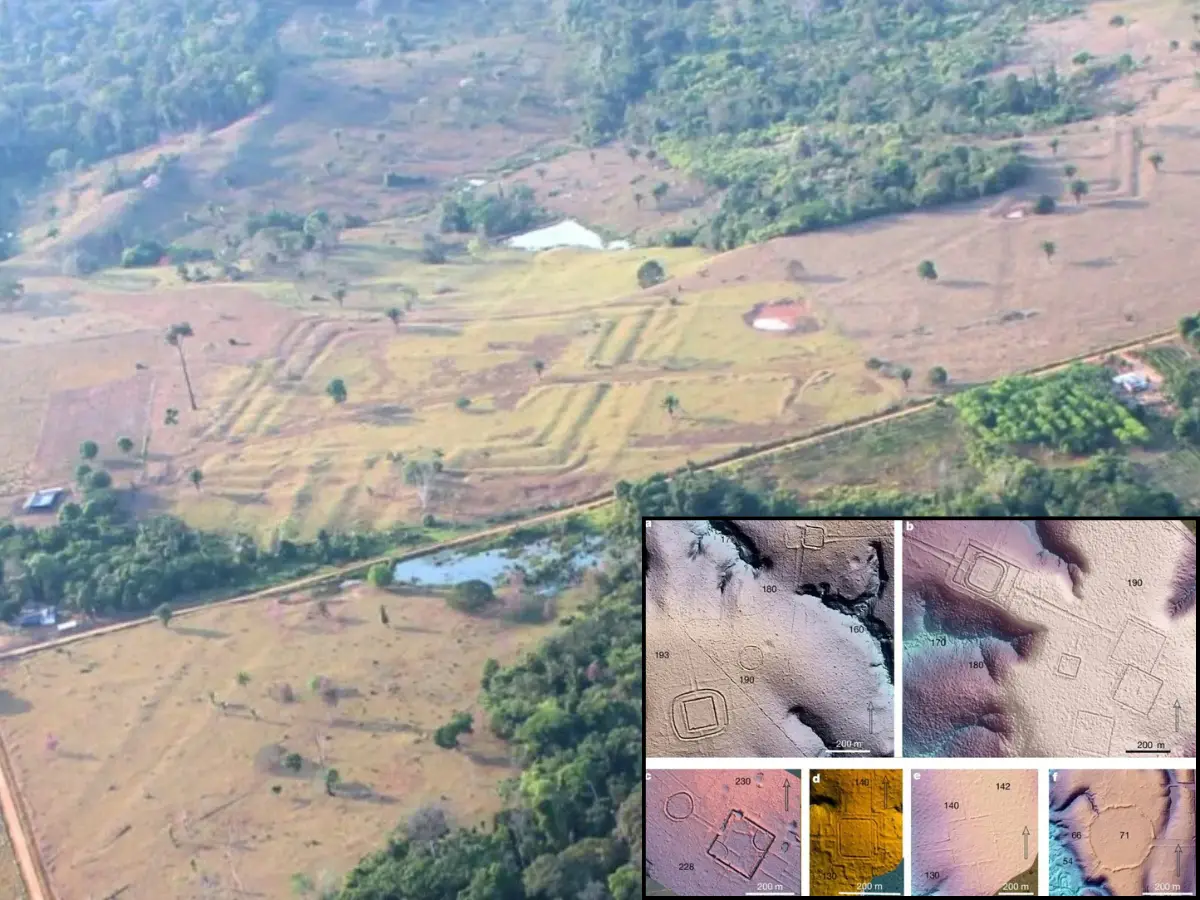
Researchers used lidar to map the Amazon and came across geometric shapes from 1,500 years ago. Photograph: (University of Helsinki)
A patch of the Amazon was likely once home to nearly 3 million people, according to new findings. The dense rainforest supported human life nearly 1,500 years ago. Over 400 geometric earthworks have been found under the thick forest.
Scientists have discovered evidence of a lost civilisation that inhabited the Amazon rainforest, quashing the belief that the region has also been claimed by wilderness. Researchers state in the study published in Nature that more than 400 well-preserved earthwork monuments, ceremonial sites, and roads have remained hidden beneath the dense Brazilian rainforest. They claim that there could be 20,000 to 30,000 earthworks spread across the region.
The team led by archaeologist Martti Pärssinen of the University of Helsinki in Finland believe that this is proof of an interconnected, multicultural civilisation that called the Amazon its home between 600 BCE and 850 CE. According to the researchers, 1.5 million to 3 million people could have lived in the region at the time. They have named them Aquiry, the indigenous Iñapari name for the Acre River, an Amazon River tributary that runs alongside these sites.
Geometric works and ditches in the Amazon
The Aquiry comprised a diverse network of communities connected by shared traditions. Pärssinen said that not much is known about them as they left no written records, and everything else that belonged to them no longer exists. However, the signs are present in the "monumental earthworks, geometric spaces delineated by ditches that could be meters deep, linked together by straight roads, where people may have gathered for ceremonies and political events."
Also Read: Hobbit-like creature that went extinct 50,000 years ago could still be alive, scientist claims
“The research shows that the human impact on the Amazon’s environment has been far greater than previously believed,” Pärssinen said in a statement. “This has direct implications for our understanding of the region’s biocultural history.”
Trending Stories
)
)
)
)
)
)
)
)
)
)
)
)
)
)
)
)
)
)
)
)
)
)
)
)
)
)
)
)
)
)
)
)
)
)
&im=FitAndFill=(700,400))
)
)
)
)
Nearly 400 new earthworks found in Amazon
The team used lidar, or “laser imaging, detection, and ranging,” to map the ancient structures of this civilisation. They surveyed 4,497 square kilometres of the rainforest, with laser pulses firing from an aircraft. Some of them penetrated the dense forest and bounced off, which allowed scientists to reconstruct what lay beneath. They found 432 earthworks, 396 of them for the first time.
Also Read: 4.4-million-year-old half human, half ape skeleton holds clues to mystery of humans walking on land
“We flew long, roughly [280-mile] 450-kilometre straight transects, mapping a strip about one kilometre wide every [6 miles] ten kilometres,” Juha Hyyppä, a professor at the Finnish Geospatial Research Institute, explained in a statement. “This allowed us to cover as large a continuous area as possible."
Study co-author Alceu Ranzi, a geographer with the University of Acre, said they found large geometric shapes, known as geoglyphs, and straight roads that sometimes connected them. "These geoglyphs could be quite complex—including pentagrams and octagons as well as circles inscribed into precise squares," he said. Radiocarbon dates showed that the earthworks were made roughly 2,500 years ago. Between 1.25 and 3 million years ago, Aquiry people lived along a 3 per cent patch of the Amazon.
The researchers said that a lot of questions remain unanswered about this civilisation. How did they survive for 1,500 years in the southwestern Amazonia, and why did they disappear?

