Which came first—the black hole or the galaxy? Webb discovery questions a key theory of galaxy formation

&imwidth=600&imheight=450&format=webp&quality=medium "Which came first—the black hole or the galaxy? Webb discovery questions a key theory of galaxy formation")
James Webb spots a cosmic puzzle from the early universe Photograph: (NASA, JSWT)
Researchers say the object could represent one of the clearest examples yet of a supermassive black hole forming without first emerging from a stellar collapse process.
For decades, astronomers have worked on the assumption that galaxies came first. In the conventional picture, stars form within galaxies, exhaust their fuel and collapse into black holes, which gradually grow by consuming surrounding matter and merging with other black holes. Yet a new discovery by NASA’s James Webb Space Telescope is challenging that sequence, offering evidence that some supermassive black holes may have formed before the galaxies around them.
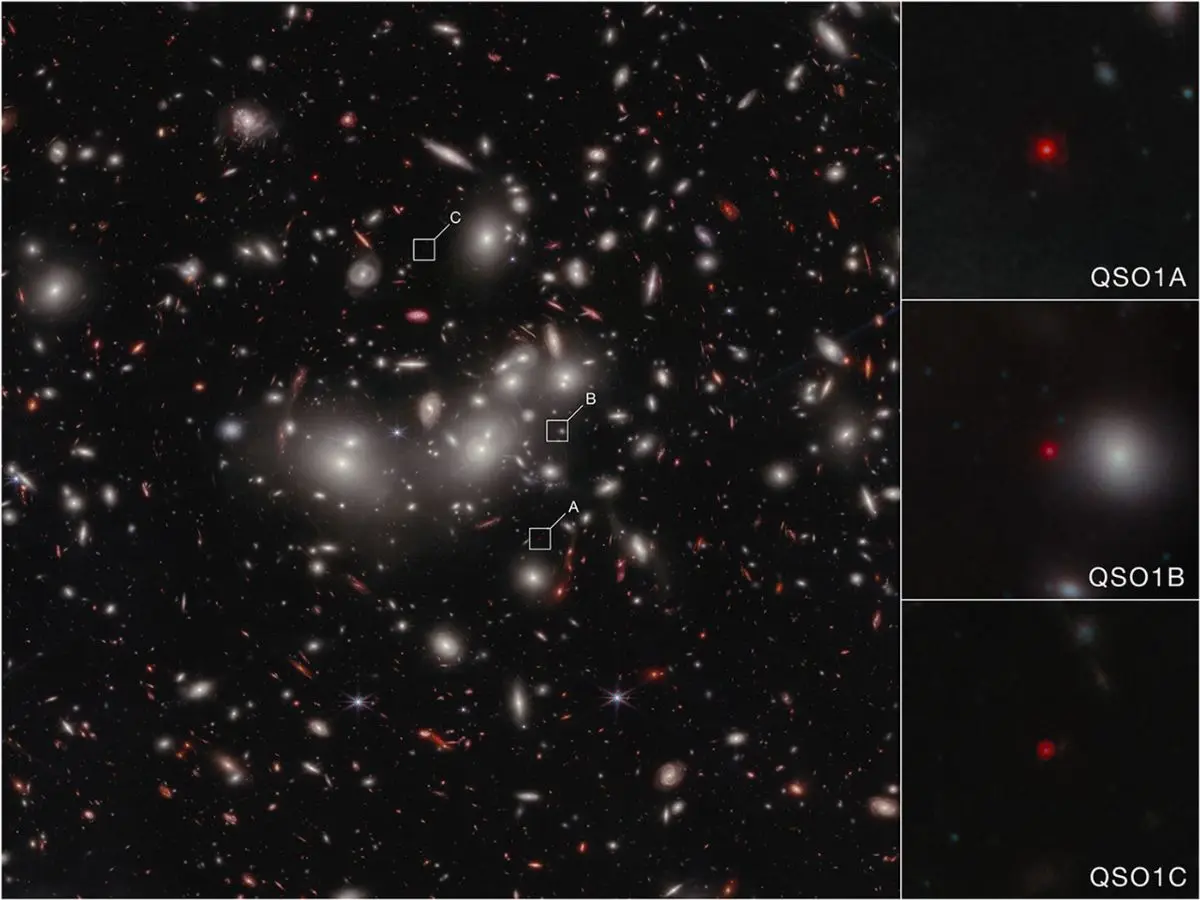
The findings, published in Nature and the Monthly Notices of the Royal Astronomical Society, centre on a distant object known as Abell2744-QSO1, or QSO1, a ‘Little Red Dot’ that existed just 700 million years after the Big Bang. Researchers say the object could represent one of the clearest examples yet of a supermassive black hole forming without first emerging from a stellar collapse process.
A Tiny Object With an Enormous Black Hole
QSO1 is only about 1,300 light-years across, but its light has travelled for more than 13 billion years to reach Earth. The object is magnified by the gravitational lensing effect of the galaxy cluster Abell 2744, also known as Pandora’s Cluster, making it easier to study than many similar early-universe objects.
Initial observations suggested that QSO1 consisted largely of hydrogen and helium gas orbiting a black hole estimated to be tens of millions of times the mass of the Sun. However, researchers needed a direct way to confirm that estimate.
Trending Stories
&imwidth=280&imheight=210&format=webp&quality=medium)
&imwidth=280&imheight=210&format=webp&quality=medium)
&imwidth=280&imheight=210&format=webp&quality=medium)

&imwidth=280&imheight=210&format=webp&quality=medium)
&imwidth=280&imheight=210&format=webp&quality=medium)
&imwidth=280&imheight=210&format=webp&quality=medium)
&imwidth=280&imheight=210&format=webp&quality=medium)
&imwidth=280&imheight=210&format=webp&quality=medium)
&imwidth=280&imheight=210&format=webp&quality=medium)
&im=FitAndFill=(700,400)&imwidth=280&imheight=210&format=webp&quality=medium)
&imwidth=280&imheight=210&format=webp&quality=medium)
&imwidth=280&imheight=210&format=webp&quality=medium)
&imwidth=280&imheight=210&format=webp&quality=medium)
&imwidth=280&imheight=210&format=webp&quality=medium)
&imwidth=280&imheight=210&format=webp&quality=medium)
&imwidth=280&imheight=210&format=webp&quality=medium)
&imwidth=280&imheight=210&format=webp&quality=medium)
&imwidth=280&imheight=210&format=webp&quality=medium)
&imwidth=280&imheight=210&format=webp&quality=medium)
&imwidth=280&imheight=210&format=webp&quality=medium)
&imwidth=280&imheight=210&format=webp&quality=medium)
&imwidth=280&imheight=210&format=webp&quality=medium)
&imwidth=280&imheight=210&format=webp&quality=medium)
&imwidth=280&imheight=210&format=webp&quality=medium)
&imwidth=280&imheight=210&format=webp&quality=medium)
&imwidth=280&imheight=210&format=webp&quality=medium)
&imwidth=280&imheight=210&format=webp&quality=medium)
&imwidth=280&imheight=210&format=webp&quality=medium)
&imwidth=280&imheight=210&format=webp&quality=medium)
&imwidth=280&imheight=210&format=webp&quality=medium)
&imwidth=280&imheight=210&format=webp&quality=medium)
&imwidth=280&imheight=210&format=webp&quality=medium)
&imwidth=280&imheight=210&format=webp&quality=medium)
&imwidth=280&imheight=210&format=webp&quality=medium)
&imwidth=280&imheight=210&format=webp&quality=medium)
&imwidth=280&imheight=210&format=webp&quality=medium)
&imwidth=280&imheight=210&format=webp&quality=medium)
“Before now, all of the mass measurements of black holes in the early universe have been indirect, based on assumptions from what we know about them in the local universe,” said Francesco D’Eugenio of the University of Cambridge. “We didn’t know if those assumptions really apply to the distant universe.”
Webb Maps the Motion of Gas
Using the Near Infrared Spectrograph (NIRSpec) aboard Webb, scientists mapped the motion of hydrogen gas around the black hole. The gas displayed Keplerian motion, orbiting the central object in the same way planets orbit the Sun.
“This is important because it tells us that most of the mass of QSO1 is concentrated in the black hole at the centre,” said researcher Ignas Juodžbalis. “If the mass were more distributed, as it would be if there were a lot of stars, the gas would not have this perfect Keplerian rotation.”
The observations enabled the first direct measurement of a black hole mass within the universe’s first billion years. Researchers calculated the object’s mass at roughly 50 million times that of the Sun.
A Challenge to Existing Theories
Perhaps the most striking result is that the black hole accounts for at least two-thirds of QSO1’s total mass, far higher than in nearby galaxies, where black holes typically represent only a tiny fraction of the host galaxy’s mass. The surrounding gas was also found to be almost entirely hydrogen and helium, with a metallicity below 0.5 per cent of the Sun, making QSO1 one of the most chemically pristine galactic environments ever observed.
“It seems that we have found a black hole that does not have a substantial host galaxy and that has predated stellar processes,” said Juodžbalis. “This is very exciting because it is evidence for primordial black holes or direct collapse black holes, which have been theorised but not confirmed.” Calling the discovery “a paradigm shift”, co-author Roberto Maiolino said: “It’s a total revisiting of the classical scenarios of how black holes form and grow.”