UAE's Hope captures first-ever images of auroras on Mars


Representative: This NASA photo obtained June 16, 2019 shows an image of an aurora taken on June 13, 2019 aboard the International Space Station, by NASA astronaut Christina Koch.
United Arab Emirates’ Hope probe which arrived on Mars earlier this year recently captured striking images of auroras lighting up the Martian sky.
Scientists hadbeen privy to the existence of Martian auroras for some time now, but the phenomena hadn’t been captured until now. Using its Emirates Mars Ultraviolet Spectrometer instrument, Hope captured the auroras at a wavelength of 103.4 nanometres.
This region of the electromagnetic spectrum has wavelengths that fall short of visible light, but still longer than x-ray radiation. Martian auroras cannot be perceived by humans. Like auroras on Earth, the Martian ones are also created by electrically charged particles called ions sent by the Sun.

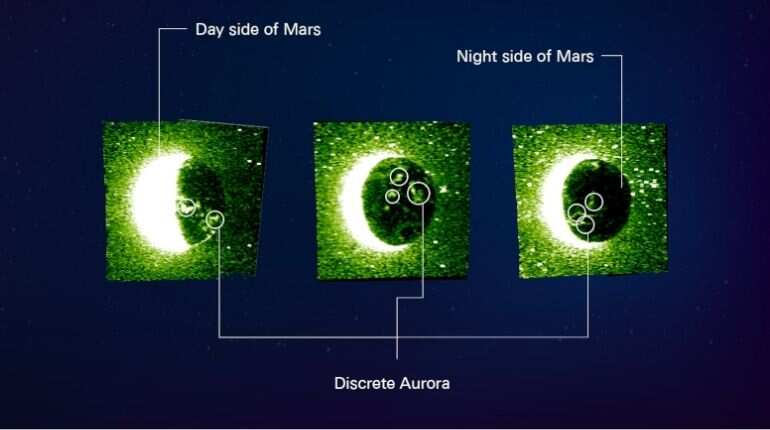
Once these ions reach the Martian atmosphere, they go deeper into the planet’s thin atmosphere, propelled by magnetic fields. These fields are created by deposits of magnetised minerals in Mars’ crust. The auroras are then created after the ions expel oxygen atoms into the sky.

India’s tank-carrying Gajraj transport jet reaches new heights near China frontier: Decoding IAF's latest feat

Ramayana: Part 1 post-credit scene explained: Sunny Deol's Hanuman entry, Raghav Juyal as Meghnad steals the show

Delhi Kia showroom fire: Woman falls trying to escape, shocking viral videos raise fire safety concerns | WATCH

Pakistani astronaut to become first foreigner to travel to China's space-station

Israel elections: Netanyahu opposition leader Eisenkot claims expecting President Herzog to hand them mandate soon

With a begging bowl in hand, Bihar officer protests 8 months without salary

First handshake? Radio signal with all hallmarks of alien technology detected in China

IPL 2027: 'He should not be captain', says ex-MI player Ambati Rayudu on Hardik Pandya

Gold nears interim bottom despite recent correction, says World Gold Council

US announces $20 million bounty, offers possible relocation for details on Iran's nuclear sites, scientists

Pakistan says it will consider issuing visa to Punjab CM Bhagwant Mann if he wishes to visit

Ramayana Part 1: Are Ravana's throne and Surpanakha's chariot real or VFX? Art director reveals

Salman Khan reacts to Ramayana's Rs 4,000 crore budget: 'I just don’t think...'

Robert Pattinson as the Next 007? Actor reportedly auditions for James Bond

Ramayana advance booking: Rs 150 cr collected before release, what it means for day 1

Ramayana: Beyond Ranbir and Yash, Ravie Dubey's Lakshmana steals the spotlight; netizens call it a 'standout performance'

Nvidia CEO Jensen Huang had a romantic relationship with alleged Chinese spy, Alice? US intelligence memo raises alarm

Meet top 5 Indian bowlers fastest to 150 wickets in ODIs

Ramayana Part 1: Rakul Preet Singh shares BTS pictures as Surpanakha, says she is proud to be 'an Indian'

NASA livestream shows UFO near Dragon, researcher claims it almost collided with ISS

Cornell faculty pass 75-50 no confidence resolution against university administration over alleged gang rape case

Ventilator 2: Priyanka Chopra reunites with Rajesh Mapuskar for Marathi sequel, set for 2027 release

Bengal CM Suvendu Adhikari threatens jail for factory blockades, confirms Singur investment talks with Ashok Leyland

Manish Malhotra's Diwali party 2026: From Aishwarya-Abhishek to Kareena-Saif, a look at Bollywood's star-studded bash

IND vs NZ: Rohit Sharma becomes leading six-hitter against New Zealand in ODIs

'Culture of Diwali gift adding to vehicular pollution', says SC as AQI remains in 'very poor' category

Watch: IAF makes aviation history with highest-ever IL-76MD landing at 13,629 feet in Ladakh

Mahadev app co-founder Ravi Uppal arrested in Dubai days after kingpin Sourabh Chandrakar’s extradition

IND vs NZ: Virat Kohli sets new record for most ODI runs against New Zealand

'It’s my last decade as an actor': Ranbir Kapoor hints at career shift, reveals directorial debut plans in 2-3 years

Top Pentagon planner faces court-martial over alleged Iran, Ukraine war leaks | GRAVITAS

Adam Driver confirms he won't reprise his Adam Sackler role in HBO's Girls

Trump’s 250-foot triumphal arch faces 14-day halt after federal judge blocks construction

Bengaluru man kills wife, 6 members of her family for interfering in their marital disputes
In a statement last week, the UAE said that this occurrence “provide(s) an unprecedented perspective on these uniquely Martian aurorae”.
Mars once had a rich and thick atmosphere which allowed liquid water to thrive on its surface. Then, the planet was kept in place by a global magnetic field, like the one on Earth.
The dynamo effect persisted on Mars, caused by molten liquid in the core of planet revolving around another solid core in the opposite direction of the planet’s rotation just like Earth.
But over time, Mars lost most of its atmosphere, which scientists believe was a result of the planet’s core cooling more quickly than Earth’s. It caused the planet to resemble the deserted wasteland of today.
The UAE is set to make its scientific data from the ongoing Mars probe public in September.