There is a 'steam world' with water vapour in outer space. Is it habitable?

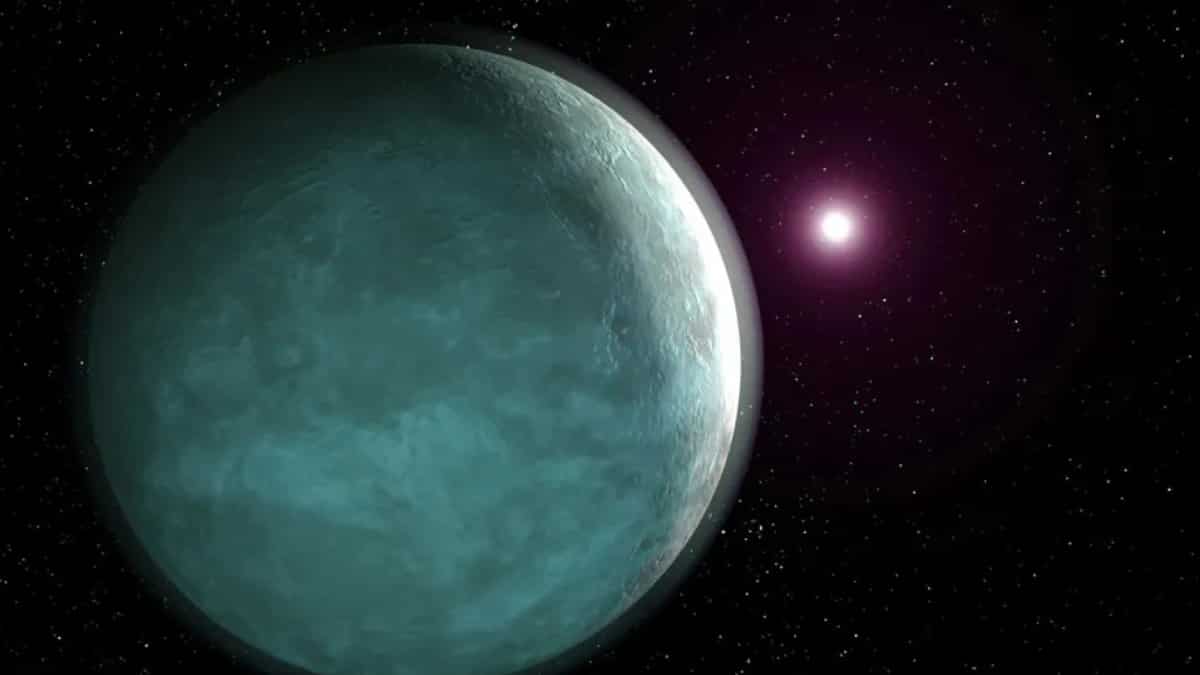
An artist's impression of the exoplanet GJ 9827 d.
Using the James Webb Space Telescope, scientists looked into the exoplanet GJ 9827 d in the constellation Pisces and found that this super-Earth has an atmosphere that is saturated with water vapour.
The telescope was used by the Canadian-led international study to gather data on the atmosphere of GJ 9827 d which is around 98 light-years away from Earth.
Here's what scientists found in the exoplanet's atmosphere

In the study, it was found that the atmosphere of the planet has a high concentration of heavy molecules, which included a good amount of water vapour. Because of this, the astronomers believed that it was a “steam world”.
At the start of the year,with the help of data collected by the Hubble Space Telescope, IREx researchers stated that they had found water in the atmosphere of GJ 9827 d, which made it the smallest exoplanet with a confirmed atmosphere.
Also Read:Exoplanet discovery:Barnard's star, the nearest single star to Earth, has a tiny planet Barnard b
)
'He will always be ahead': India coach Gambhir says Sooryavanshi won't walk into team ahead of Samson
)
'Gangsta' crab shoves knife blade at man and his dog in Florida - Watch
&im=FitAndFill=(700,400))
Which country has the most F-35s outside America?
)
Andhra Pradesh police pose as FBI to get X to remove tweets
)
Godfather of AI Geoffrey Hinton gives US lawmakers a one-year warning on AI
)
UNGA 2026 theme explained: What does ‘Restoring trust, managing transformation: A United Nations that delivers for all’ mean?
)
US F-16 fighter jet crashes in Michigan during training mission, pilot ejects safely
&im=FitAndFill=(700,400))
Meet top 5 Indian batters with fastest T20I centuries
)
Laura Wolvaardt sets new world record for most WT20I runs in a year
)
Ganpati Visarjan: Alia Bhatt and Ranbir Kapoor bid adieu to Bappa, watch viral videos
)
Who is Khalilur Rahman? All you need to know about 81st UN General Assembly President
)
North Korea's last nuclear test in 2017 set off 1,399 earthquakes over 8 years, each stronger than previous
&im=FitAndFill=(700,400))
New Friday OTT releases (September 18, 2026): Lust Stories 3, You+Me, Best of the Best- 8 new titles coming on Netflix, Prime Video and more
)
Xi-Trump summit may boost military links
)
Pentagon revives mandatory testosterone testing for male troops aged 30 and above
)
Asian Games 2026: Shafali stars as India thump Japan by 8 wickets to book semis berth
)
Marathi film Gondhal is India's official entry for Oscars 2027
)
The Verdict | When precision fails: US commits war crime in Minab school strike, UN finds
)
Shivakumar attends 79th Kalyana Karnataka Utsav in Kalaburagi
)
Three labourers killed as DU student loses control of his car, rams into them on Dwarka Expressway
)
US-North Korea tensions explode, Kim Yo Jong warns of 'more offensive' response
&im=FitAndFill=(700,400))
From Abhishek Sharma to Sahil Chauhan, 5 batters with fastest T20I hundreds
)
Ukraine plans record $109 bn defence spending, nearly two thirds of budget amid Russia war
)
Drone strikes cooling tower at Russia's Kursk Nuclear Plant, IAEA confirms
&im=FitAndFill=(700,400))
Suriya and Jyothika say ‘I do’ again after 20 years! See their dreamy wedding pics
)
Cristiano Ronaldo returns to Portugal squad for Nations League under new coach
)
Trump bans CNN, MS NOW and Politico from White House over ‘FAKE NEWS’
)
Spain Floods: Deadly floods hit Spain as torrential rains trigger widespread flooding
)
How did an Australian river with 500 crocodiles pass the Olympic test? Here's how
)
Hong Kong extends newborn cash support scheme by three years
&im=FitAndFill=(700,400))
Meet top 5 bowlers in latest ICC T20I rankings
)
India ‘deeply concerned’ as Houthi strikes hit Saudi civilian & energy sites
)
A first in 100 years: New cat species discovered in Bolivia is incredibly tiny
)
Africa is splitting, and a lot sooner than estimated, giving way to a new ocean
)
Indian activist-lawyer Prashant Bhushan's post brings focus on ‘conflict of interest’ appointments of ex-govt officials at Reliance, Adani groups
&im=FitAndFill=(700,400))
Meet top 5 batters in the latest ICC T20I Rankings
)
‘Will go to any extent’: Pakistan vows to defend Saudi Arabia amid Houthi attacks
)
Former India player Diana Edulji wants Smriti Mandhana to replace Harman as skipper at the earliest
)
India seeks to build a full semiconductor supply chain
These major findings opened new ways for scientists who are searching for life outside our Solar System.
Till now, the detection of atmospheres near smaller planets closer to Earth was an elusive goal.
“For now, all the planets we’ve detected that have atmospheres are giant planets, or at best mini-Neptunes,” stated lead study author Piaulet-Ghorayeb.
“These planets have atmospheres made up mostly of hydrogen, making them more similar to gas giants in the solar system than to terrestrial planets like Earth, which have atmospheres dominated by heavier elements," he said.
The observations were made by Piaulet-Ghorayeb and her team with the help of a Canadian instrument on JWST, the Near-Infrared Imager and Slitless Spectrograph (NIRISS).
With the help of transmission spectroscopy, the scientists observed the starlight which passed through the atmosphere of the planet as it transited (passed in front of) its host star, GJ 9827.
Also Read:Ceres, largest object in asteroid belt, shows signs of habitability near Ertunet Crater
The new JWST observations were then combined with preliminary HST observations to provide strong evidence about how the planet’s atmosphere led to the observed spectral features and it did not occur because of the contamination from the system’s star.
It was observed that the exoplanet GJ 9827 stands different from others because of the composition of its atmosphere.
Piaulet-Ghorayeb combined JWST/NIRISS and HST data and showed that the atmosphere of GJ 9827 d is filled with heavier molecules and a quite large amount of water vapour, which is not the situation in the case of the hydrogen-dominated atmospheres of the larger planets.
With the combination of data from JWST's Near-Infrared Imager and Slitless Spectrograph (NIRISS) with earlier HST data, Piaulet-Ghorayeb and her team showed that the atmosphere of the planet is significantly different from those of larger planets.
"It's closer in molecular weight to the carbon dioxide or nitrogen-rich atmospheres that we are currently looking for on smaller rocky planets, where we would eventually look for life," she said.
(With inputs from agencies)