IIT Bombay's Daksha satellites to unravel mysteries of the Universe

&imwidth=600&imheight=450&format=webp&quality=medium "IIT Bombay's Daksha satellites to unravel mysteries of the Universe")
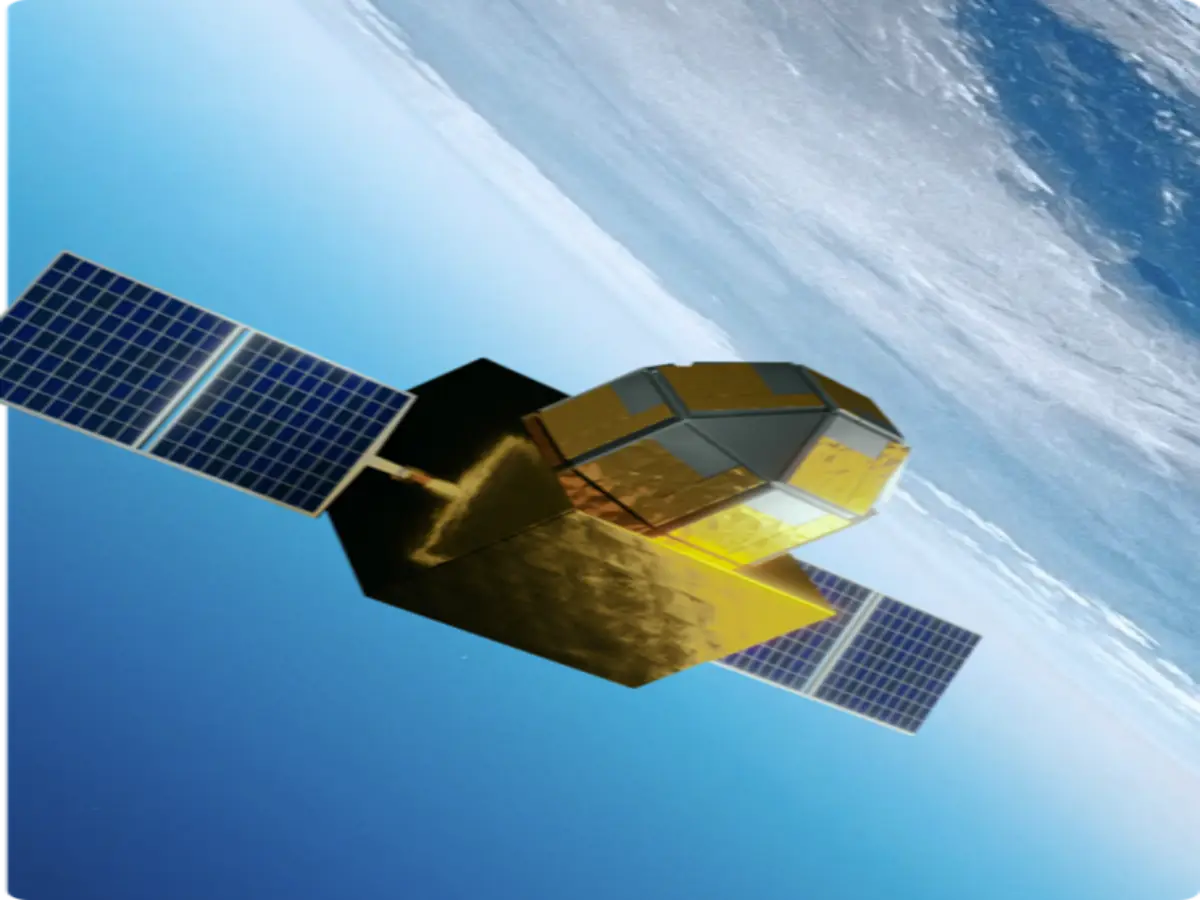
Artist's impression of a Daksha satellite orbiting the Earth. Photograph: (Daksha, IIT Bombay)
Gamma-Ray Bursts are the most energetic explosions known in the universe and they release intense gamma radiation, it could be caused by the collapse of a massive star.
A team from IIT Bombay is making progress in building a pair of scientific-use satellites that can help track and unravel some interesting high-energy phenomenon in our universe.
Titled Daksha, the proposed space mission could help better humanity's understanding of Exploding Stars, Gamma-Ray Bursts, Solar flares, High-altitude lightning, among others. The data that would be generated from this future mission would enhance research in Astrophysics, Solar studies, Atmospheric sciences.
Exploding stars or Supernovae refer to massive explosions that mark the death of a star. Gamma-Ray Bursts are the most energetic explosions known in the universe and they release intense gamma radiation, it could be caused by the collapse of a massive star. Gamma-Ray Bursts emit more energy in a few seconds than the Sun in its entire life, and such phenomenon could affect life on Earth if it occurred nearby. Such varied explosions also created all the heavy elements like gold and uranium in the universe.
Solar flares are a sudden burst of energy from the Sun's surface. These high-energy particles travel at very high speeds and have the potential to disrupt satellite communications, GPS, space missions, astronaut missions etc. High-altitude lightning is unlike conventional lightning, and it takes place in earth's upper atmosphere and the region near space.
According to Dr. Varun Bhalerao, an astrophysicist at IIT Bombay, Daksha is meant to study all the above phenomenon and offer a wide-angle view of space. He explained that existing space telescopes operated by foreign space agencies have a zoomed in view of a certain region in space, but Daksha can offer a wide view and more coverage.
Outlining the journey so far, Dr. Varun says, "back in 2018, Indian space agency ISRO invited Indian scientists and academia to propose space telescope ideas, and ours happened to be ranked highly, which got us some seed funding for creating a proof of concept". With that, we made detectors and sensors with the right kind of sensitivity, and now we are waiting for further steps such as approvals from ISRO and the Indian cabinet, the country's apex decision-making body, he told WION.
Elaborating on the payloads or scientific equipment that would be mounted on the twin Daksha satellite, Dr. Varun said that each satellite would carry a 150kg science payload that would be developed by his team, and the satellite structure, solar panels, other standard components would be provided by ISRO.
Trending Stories
)
)
)
)
)
)
)
)
)
)
)
)
)
)
)
&im=FitAndFill=(700,400))
)
)
)
)
)
)
)
&im=FitAndFill=(700,400))
)
)
)
)
)
)
)
)
)
)
)
)
He emphasized that the twin Daksha satellites could continuously look out for any high-energy activity that is occurring in our Universe, and the payloads are sensitive enough to capture activity that is billions of light years away.
"In terms of volumetric coverage, India's Daksha will be 5 times better than the NASA-ESA Fermi satellite, and 13 times better than NASA's SWIFT satellite. This means, even if a specific type of explosion or high-energy event in space is far away or too faint to be captured, we can capture it because of our equipment sensitivity and wide field of view, as opposed to the zoomed in view of other space telescopes," Dr. Varun explained to WION.
