
&imwidth=800&imheight=600&format=webp&quality=medium "Black hole probe needs 100 years, $1 trillion and fictional technology. But there is an even bigger problem")
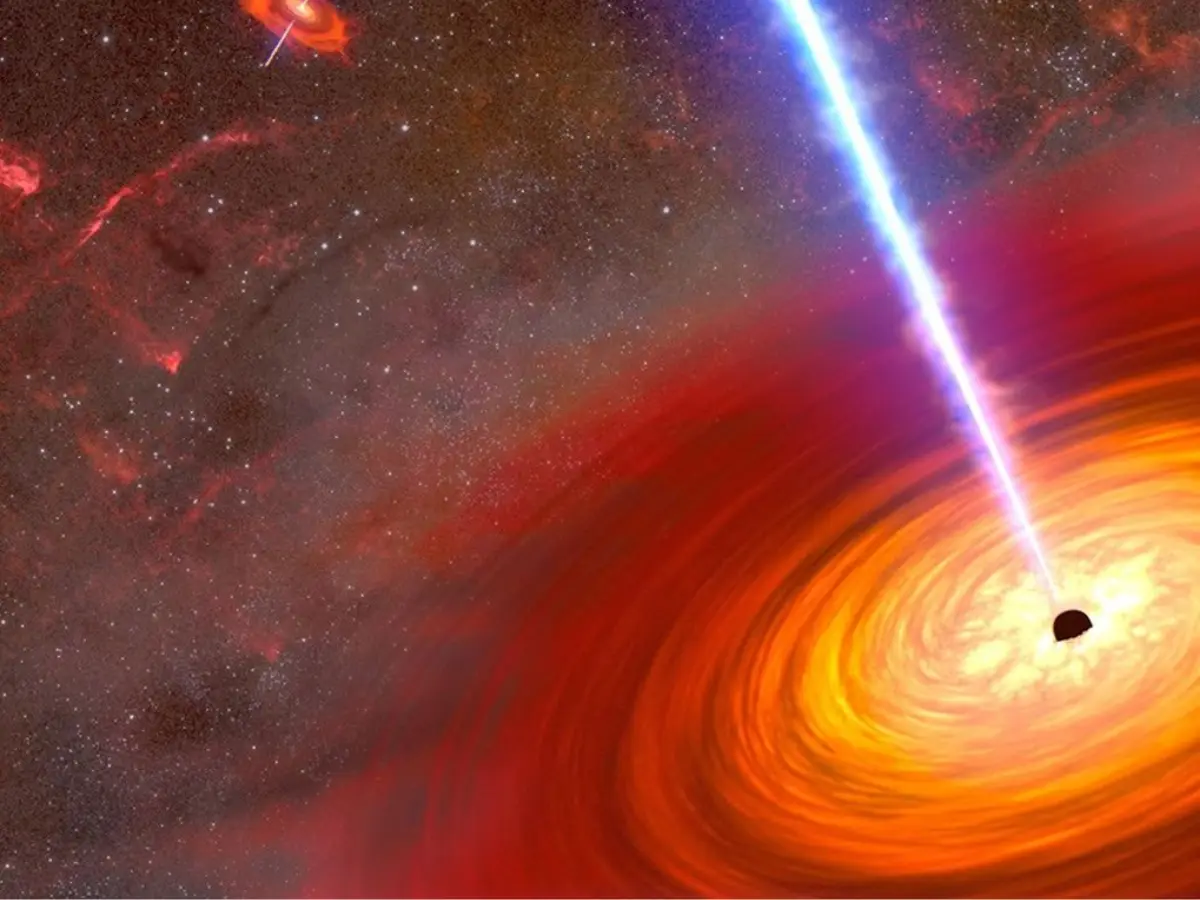
A scientist wants to send a probe to a black hole, although he knows that his idea cannot be put into force right now since it is based on a technology that doesn't exist. He has come up with a plan to send a spacecraft right into the heart of a black hole to study these mysterious giants hogging our universe. It involves building the tiniest spaceship, no bigger than a paper clip, with lasers pushing it through space almost at the speed of light. Humans have not been able to build anything that can move at such speeds. Although Professor Cosimo Bambi, of Fudan University in Shanghai, is hopeful that this can be done in the future. He told Daily Mail that it is fully possible to develop this technology, all it needs is "time, money, and motivation." His ambitious project would come at a huge cost, as the lasers alone would require more than $1 trillion. He has published his proposal in the journal iScience, in which he argues that sending a spacecraft directly into the heart of a black hole could reveal secrets about the fabric of spacetime.
Nanocraft can steer right through a black hole

For the experiment, scientists need to identify a black hole located at a distance that can realistically be covered by a man-made spacecraft. For the probe itself, Bambi advocates building a nanocraft. As the name suggests, it would be much smaller than traditional spacecraft that burn fuel and are quite big to reach anywhere near the speed of light. The nanocraft would be nothing but a small chip stuck to a large sail, which would be blasted off from Earth with the help of lasers, with photons that will accelerate the craft to a third of the speed of light. The problems with his plan are plenty, but the biggest one is finding a black hole we can practically visit. He says that such a black hole should exist within 20-25 light-years from the Solar System. Travelling at that speed, the nanocraft will take 70-80 years to reach it, and about 20-25 years for the data to reach Earth.
Problems with finding a black hole close to Earth
Trending Stories
)
Trump-Xi Summit: Trade, Taiwan and the red lines shaping US-China talks | Race To Power
)
US judge questions Trump’s decision to ban CNN, MS NOW and Politico from White House
)
Afghan woman cyclist who disguised herself as a boy to escape Taliban, wins Asian Games medal
)
Trump signs Greenland security deal with Denmark, paving way for two new US military bases
)
IND vs JPN T20I: How an overturned wide became point of difference between India's win and a tie
)
IIT Bombay CCTV footage emerges: Sahil Wakode seen looking at phone in examination hall
)
Cyclone Arnab: Landfall expected before midnight tomorrow as IMD issues orange alerts across six states
)
NBA player Steven Adams shares hilarious GTA VI theory
)
TMC revives impeachment push against CEC Gyanesh Kumar after report of internal dissent
)
WION Iconic Tourism Summit 2026: Union Minister Shekhawat on 'experiential travel', peace diplomacy
)
ICC plans T20I expansion and fewer ODIs in 2027–2031 FTP cycle: Report
)
'AI got into my speech': Prince Harry jokes after teleprompter failure at event in New York
)
WION Iconic Tourism Summit: Seychelles envoy says India partnership is important for Seychelles
)
Scientists detect first radio signals directly from faraway planet
)
China to test supersonic jet that moves at Mach 2, double the speed of sound
)
WION Iconic Tourism Summit: 'Hanuman Ansh' Director on blockbuster success
)
Open AI, Anthropic CEO urges caution over rapid AI development at UN Security Council, call for 'extreme care'
)
Bomb scare in New York amid UNGA: Suspicious suitcase found near UN headquarters
)
Hours before Xi-Trump meeting, US announces visa curbs targeting birth tourism: What is it?
)
WION Iconic Tourism Summit: Is India's travel boom outrunning its airports, airlines and hotels?
)
WION Iconic Tourism Summit and Awards 2026: Key voices to discuss India’s tourism future
)
Trump-Xi state dinner 2026: Who is invited? Full guest list of tech CEOs, business leaders and officials
)
American manufacturing is reshoring faster than its factory floors can absorb
&im=FitAndFill=(700,400))
New OTT releases this week (September 21-27, 2026): Shaque: Trust No One, Hunkkaar, Don’t Be Shy- 5 new titles coming to Netflix, Prime Video and more
)
WATCH | China President Xi Jinping lands in US as Trump greets him ahead of high-stakes summit
)
Australian PM Anthony Albanese calls OpenAI AI incident 'unacceptable' after restricted data access
)
'What kind of confession is this?': Pakistan PM Shehbaz Sharif’s 'terrorists would be roaming New York' remark goes viral, raises alarm online. Watch
)
WION Iconic Tourism Summit: How local tourism MSMEs must upskill for AI integration
)
Elephants hide behind trees, stage surprise attack on poachers targeting rhinos in South Africa
)
'Putin is patient zero': Zelensky slams Russian president at UNGA, accuses him of using fighters from 47 countries
&im=FitAndFill=(700,400))
National Film Awards 2026: Kartik Aaryan, Mammootty, Yami Gautam, Randeep Hooda and other key winners
)
El Niño 2026 heats up to become strongest in 1,000 years
)
Israeli envoy to US Yechiel Leiter’s son critically injured in West Bank ramming attack
&im=FitAndFill=(700,400))
Trump welcomes Xi Jinping in rare airport gesture: Photos from Chinese President's arrival in US
)
Anne Hathaway to run in supporting race for Nolan's epic
)
Xi-Trump meeting: China’s human rights red line and past protests explained
Another problem is the cost of the mission. He admits that, based on the current technology, it would cost one trillion GBP, "so it is definitely beyond the budget of any scientific experiment." However, he cites the trend of the past 20 years and the future economic environment to state that this amount would reduce to around $1 billion in 20-30 years. The total timeline from the launch to getting the data from it is 100 years. Considering that the nano technology needed doesn't even exist today, it cannot even be put into action until it becomes a reality. But everything still boils down to finding a black hole that is near us. "If the distance of the closest black hole exceeds 40-50 light years, I am afraid we have to give up," Bambi says. The closest black hole to Earth is Gaia-BH1, which is 1,560 light-years away.
Black holes are a cosmic mystery. All we know about them is that their gravitational force is the strongest one seen in the entire universe. No one knows what lies inside them. Bambi says if humans succeed in detecting a black hole closer home in the next 5-10 years, then the world should just go for it and send a probe deep inside. It will be the perfect laboratory to test Einstein's theory of general relativity.

