
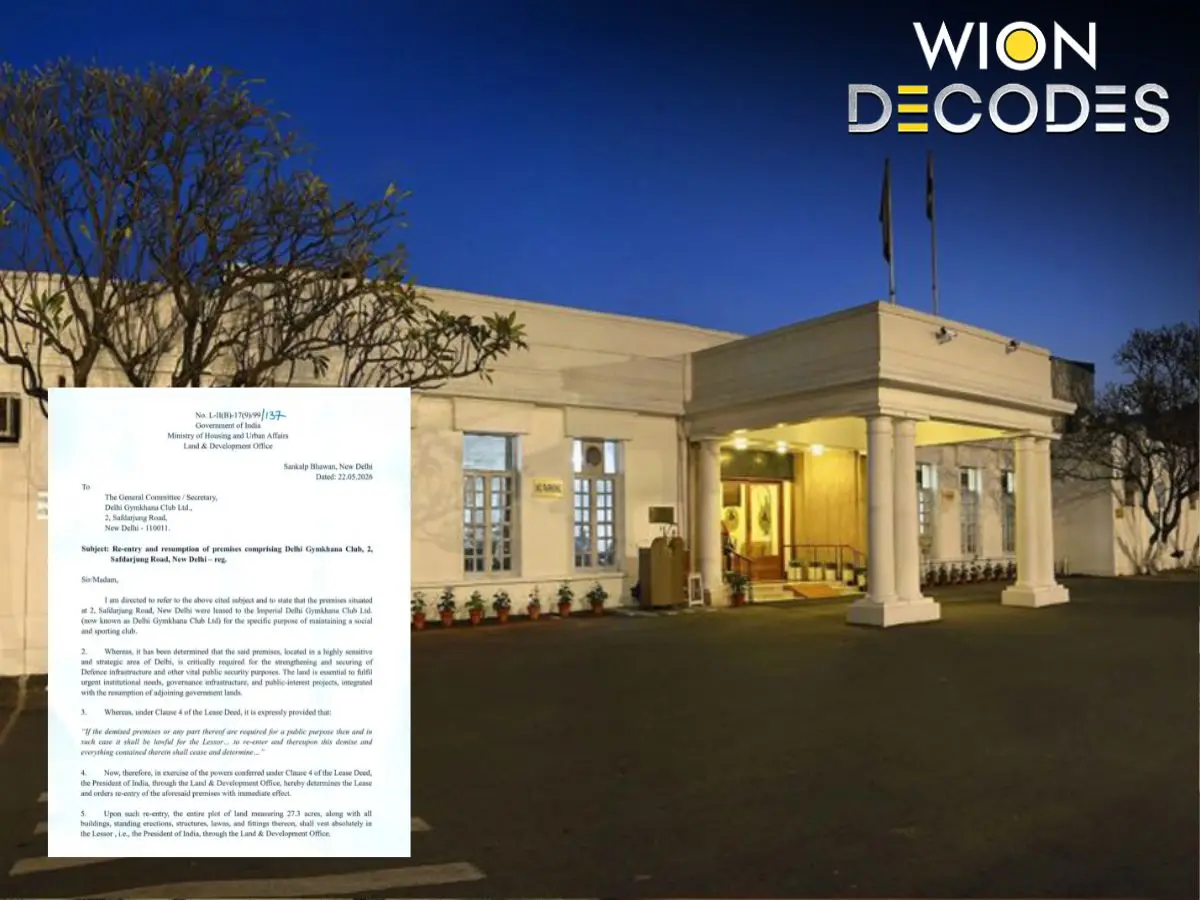
&imwidth=800&imheight=600&format=webp&quality=medium "WION Decodes | Exclusive Delhi Gymkhana Club ordered to vacate prime Lutyens’ Delhi land: The history, politics & controversies")
The Union government has ordered the Delhi Gymkhana Club, one of India’s oldest and most exclusive private institutions, to vacate its sprawling premises in the heart of the national capital within two weeks. The move marks the culmination of a years-long battle over the control and functioning of the elite club, while also reflecting the Narendra Modi government’s broader challenge to entrenched power circles and colonial-era institutions.
In a notice issued by the Land and Development Office under the Ministry of Housing and Urban Affairs, the Centre directed the club to hand over the property by June 5. The government said the land was urgently required for 'institutional needs, governance infrastructure and public-interest projects', including defence and security-related purposes. According to reports, the 27-acre property lies adjacent to the Prime Minister’s residence and is considered strategically significant.
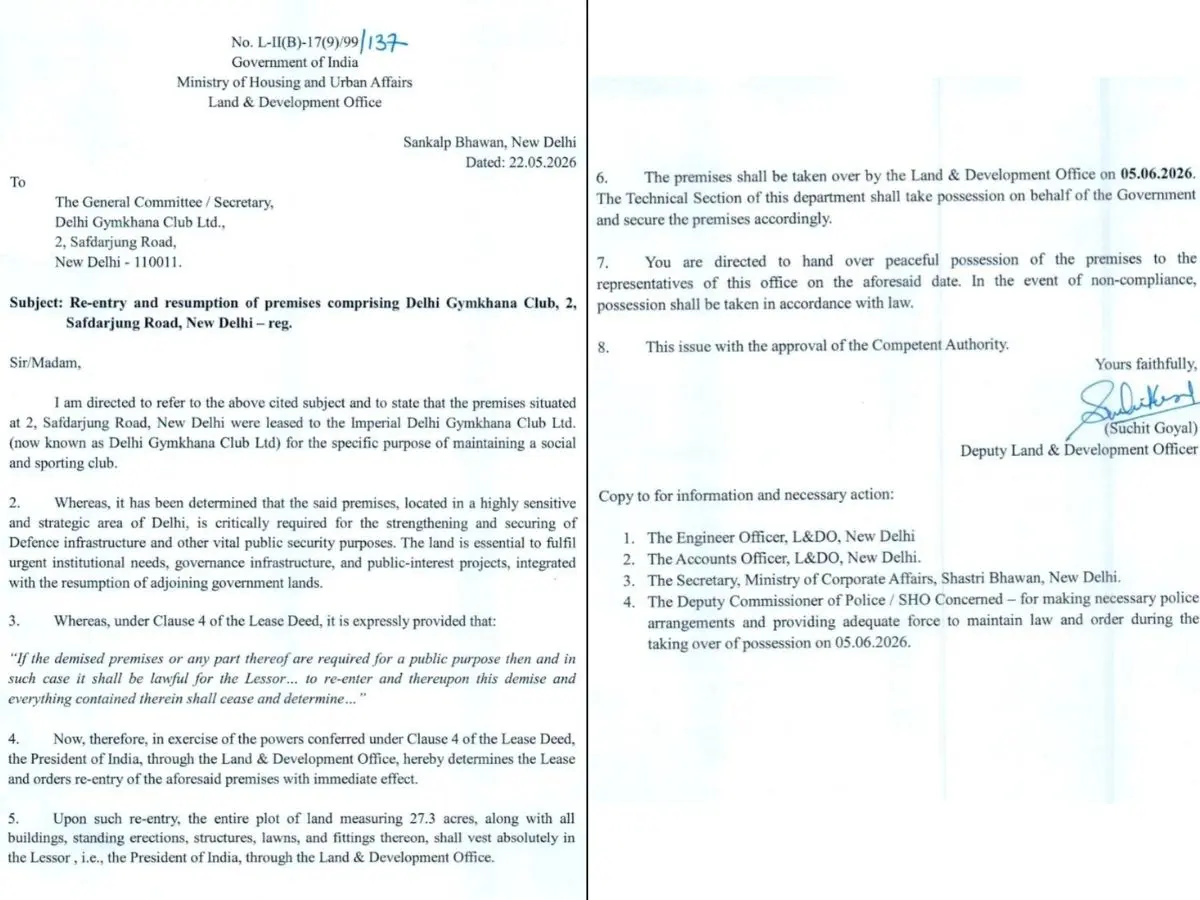)
he Centre has asked Gymkhana Club in Lutyens' Delhi to hand over the premises by June 5 Photograph: (PTI)
A colonial institution that became a power centre

Founded in 1913 as the Imperial Delhi Gymkhana Club under British colonial rule, the institution initially barred Indians under discriminatory membership rules. After Independence in 1947, however, it transformed into a powerful social and networking hub frequented by politicians, judges, senior bureaucrats, diplomats and business leaders.
Located on Safdarjung Road in Lutyens’ Delhi, the club occupies some of the capital’s most expensive real estate, spreading across 27.3 acres, while paying a nominal annual lease rent of Rs 1,000 to the government. Membership has long been considered a symbol of influence and privilege, with waiting periods stretching into decades.
Controversies
Trending Stories
)
Extreme warming in Indian Ocean added 695 billion tons of ice to Antarctica ice sheet
&im=FitAndFill=(700,400))
Ananya Panday to Sharvari: 5 actresses serving major princess vibes
)
‘Will go to any extent’: Pakistan vows to defend Saudi Arabia amid Houthi attacks
66 years of the Indus Waters Treaty: How India and Pakistan settled a bitter river dispute
)
Trump bans CNN, MS NOW and Politico from White House over ‘FAKE NEWS’
)
Flying cars in UAE: Ras Al Khaimah signs deal with Chinese company to test new transport
)
IIT Bombay student dies by suicide, was caught seeking AI help during exams
)
Brigitte Bardot’s private collection set for Paris auction; key items and prices revealed
)
Claude led 26% of Anthropic's AI R&D work
)
Reacher star Alan Ritchson opens up about alleged blackmail, suicide attempt during difficult period
)
It's a girl! Deepika Padukone and Ranveer Singh welcome their second child
)
Pak: A series of counter terrorism operations in Khyber Pakhtunkhwa
)
How did an Australian river with 500 crocodiles pass the Olympic test? Here's how
&im=FitAndFill=(700,400))
How many F-35s does Britain, Japan and Israel have?
&im=FitAndFill=(700,400))
Meet top 5 Indian batters with fastest T20I centuries
)
Mark Carney mimics Trump in hilarious moment over C$70 billion clean-energy investment; room erupts in laughter
)
Putin: European leaders using war rhetoric to save falling ratings
)
Ajit Agarkar’s future as chief selector to be decided at right time, says BCCI secretary
)
China may have gained access to US's classified F-35 jets; parts meant for repairs diverted to Hong Kong, sparking Pentagon inquiry
)
Tirupati Laddu ghee adulterated with chemicals, says ED, supplier arrested
)
Trump signs Russia sanctions bill into law, targets Moscow’s energy sector
)
Africa is splitting, and a lot sooner than estimated, giving way to a new ocean
)
Pentagon revives mandatory testosterone testing for male troops aged 30 and above
)
Cochin shipyard starts building Indian Navy's next-gen missile vessels
)
Russia holds first parliamentary elections since the beginning of the Ukraine war
)
FACT CHECK: Why did PM Modi ask Xi ‘is it okay’ at BRICS Summit? New video reveals...
)
The Verdict | When precision fails: US commits war crime in Minab school strike, UN finds
)
Why Ranveer Singh’s Dhurandhar missed India’s Oscar entry; FFI jury member reveals what happened
Russia attacks Ukraine with 174 drones, kills 8; 2 vessels hit in Black Sea
)
Trump 2.0: Dark days ahead for America’s ‘imperial presidency’
)
New brain discovery could aid neurological disease studies
)
Oxford United's new clothing line featured 'United 93' phase
)
Trump extends H-1B visa's $100,000 fee until September 2027: What it means for Indians?
)
Iran rebuilding nuclear facilities? New satellite images show Tehran may be rapidly restoring bombed Parchin base
)
Arvind Kejriwal, family members, Delhi CM Rekha Gupta get SIR notices
)
)
Membership was notoriously difficult to obtain, with applicants often waiting 30 to 40 years despite paying substantial non-refundable fees upfront. Applicants reportedly paid over Rs. 1 lakh as a non-refundable application fee despite no guarantee of admission. Utility charges also rose sharply over the years, from Rs 5,000 in 2000 to Rs 1.5 lakh for government officials and Rs 7.5 lakh for non-government applicants. As of 2017-18, waitlisted applicants had collectively paid Rs 44.79 crore in fees.
)
Gymkhana Club's gallery Photograph: (delhigymkhana.org.in)
Mismanagement allegations and government intervention
The latest order effectively concludes a process that began in 2020, when the National Company Law Tribunal (NCLT) intervened in the club’s affairs over allegations of financial mismanagement, nepotism and deviation from its original sporting purpose. The institution was frequently criticised for operating as an exclusive networking hub dominated by senior civil servants, politicians, judges and influential business families. Allegations surfaced that membership preferences often favoured bureaucratic and political circles, contributing to claims of nepotism and “family fiefdoms”.
On February 15, 2021, the National Company Law Appellate Tribunal (NCLAT) delivered an interim order suspending the elected General Committee, and directing the Centre to appoint a government administrator to oversee operations.
Investigations reportedly found that only a small portion of the club’s expenditure was directed towards sports, despite its original mandate. Critics alleged that large amounts were instead spent on hospitality and recreation facilities. The club itself remains architecturally significant. Its main building was designed in the early 1930s by British architect Robert Tor Russell, who also designed Connaught Place and Teen Murti House. The complex houses 26 grass tennis courts, the highest for any club in India, along with squash courts, badminton courts, billiards rooms, a covered swimming pool, three lounge bars and 43 residential cottages.
One of the club’s lesser-known historical details involves Lady Willingdon, wife of then Viceroy Lord Willingdon, who donated Rs 21,000 in the 1930s for the construction of the club’s swimming pool and squash courts after struggling to find suitable swimming facilities in New Delhi.

