
&imwidth=800&imheight=600&format=webp&quality=medium "NCERT Mohenjodaro Dancing Girl controversy: Is India's obsession with modesty threatening its culture?")
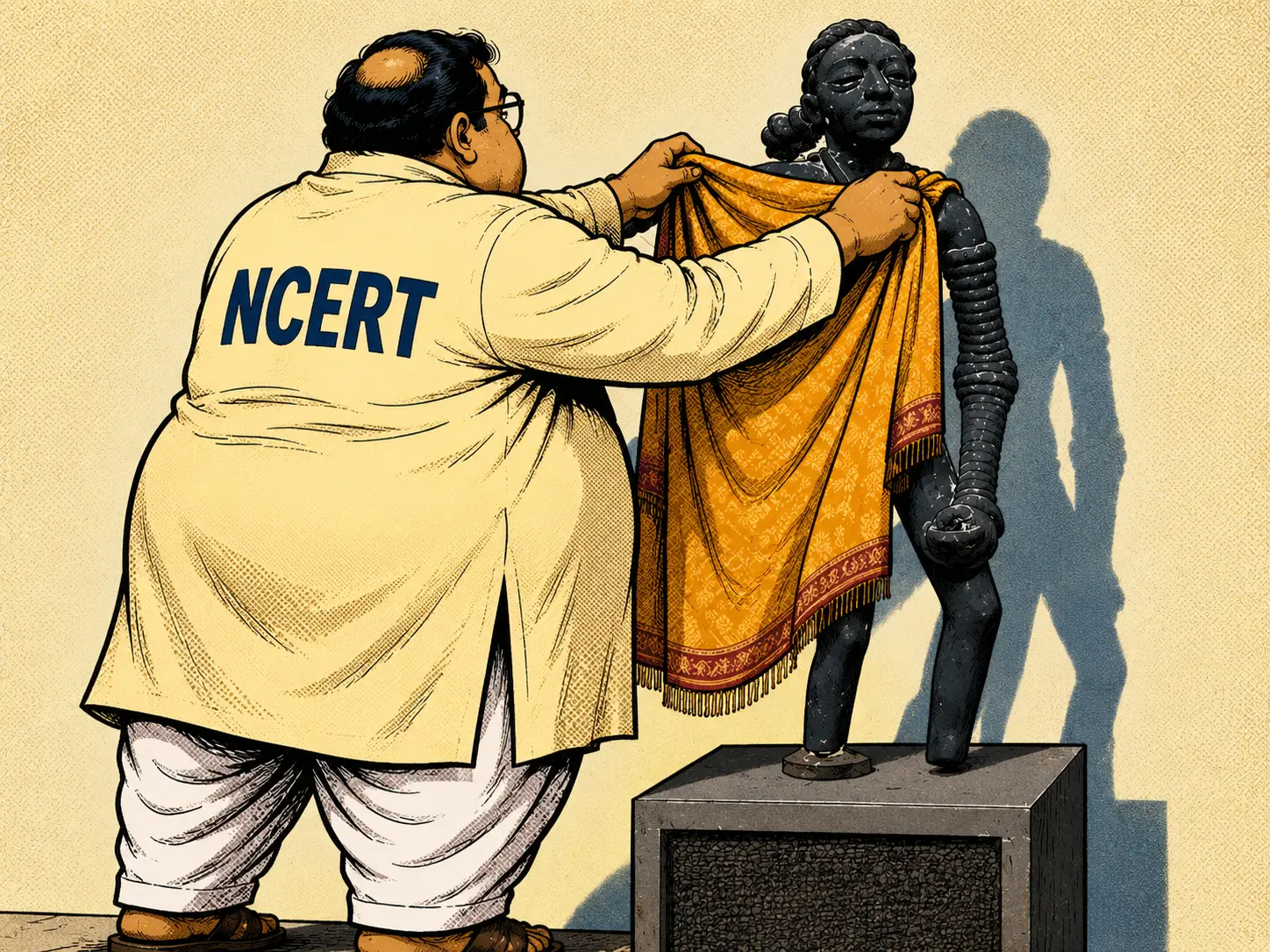
NCERT (National Council of Educational Research and Training), the autonomous Government organisation that looks after the school curriculum in India, has come under fire again. The organisation, which just months ago had to apologise to the Supreme Court after a Class 8 textbook levelled serious allegations against the nation's judiciary, has now invited criticism for its attempts to force modesty. Recently, readers noticed a bizarre edit to the image of what is arguably one of India's most recognisable archaeological treasures: the Mohenjodaro Dancing Girl bronze figurine. The new edition of Madhurima, the Class 9 NCERT Arts textbook, has digitally "covered up" the bronze figurine's bare torso, allegedly to make it more "age-appropriate". Following an uproar, NCERT Director Dinesh Saklani confirmed that the image would be corrected in future editions.
However, the apparent attempt at modesty has sparked criticism from historians, educators, and archaeologists, who argued that the change misrepresented an important artefact of the Indus Valley Civilisation. WION asked educators if school students need to be protected from artwork that celebrates the human form. Here's what they said.

Why is India, even in the 21st century, covering up its history?
To date, the Dancing Girl, discovered at Mohenjodaro in present-day Pakistan, remains one of the most iconic artefacts from the Indus Valley Civilisation. The bronze sculpture, believed to date back to around 2600 BCE, depicts a young female figure standing with one hand on her hip, her chin slightly raised and one knee bent.
While the current NCERT narrative appears to consider it inappropriate for 14 to 15-year-old Class 9 students, it is widely regarded in the art world as a remarkable example of early metal casting and artistic expression.
Trending Stories
&im=FitAndFill=(700,400))
Emmys 2026 Red Carpet: Zendaya, Nicole Kidman and Julia Garner lead the glamour peak
)
Emmys 2026 In Memoriam: Catherine O’Hara honoured by on-screen children Macaulay Culkin, Annie Murphy, Dan Levy; Dolly Parton, Rob Reiner remembered
)
Trump loses Supreme Court battle over mail ballots ahead of US midterms: What happened?
)
800 million years old - Scientists discover 'fingerprints' of supercontinent Gondwana in ancient rocks
)
Extreme warming in Indian Ocean added 695 billion tons of ice to Antarctica ice sheet
)
UPI payments up to Rs 2,000 to stays free, but bigger transactions may soon cost you: Govt
)
Who is Kalyan Bainsla, accused in the Gurugram hit-and-run case involving woman biker?
)
China thinned Himalayan troop presence in 2025, India defence report says; terms border situation 'stable'
)
Gurugram hit and run case: Police arrest car driver Kalyan Bainsla, book him for attempt to murder
)
Russia proposes to build 360 kmph Ivolga FG trains in India: What happened on sidelines of BRICS
)
Iran, India agree to deepen humanitarian and political ties, President Pezeshkian says
)
471 years ago, a prophecy warned of 'immortal lone brain'. Some think it was about AI
)
‘US ensuring global energy supplies’: Trump demands reimbursement for securing Strait of Hormuz
)
'Now Trump is copying us': Shivakumar links US $5,000 plan to Congress guarantees
)
Emmys 2026: Michael J Fox honoured with Bob Hope Humanitarian Award for Parkinson’s advocacy
)
Saudi Arabia discovers 110 million tonnes of Uranium-rich ore in Madinah region
)
Did India risk its US trade deal despite softer stance at BRICS?
)
What is Hyrox, in news for athlete who soiled herself, but kept running and using common equipment?
)
Ex-CIA official David Rush nears plea deal in $40 million gold bar theft case
)
Emmys 2026: Matthew Rhys wins Best Actor twice, sets historic 78-year record
)
Pakistan puts Pak Rs 70 lakh bounty on UN terrorist Masood Azhar; move draws skepticism in Delhi
&im=FitAndFill=(700,400))
New OTT releases this week (September 14-20, 2026): Lust Stories 3, Waiting Hai, Irumudi- 5 new titles coming on Netflix, Prime Video and more
)
Dodgers beat Reds for playoff berth in bid for third consecutive World Series
)
Emmy Awards 2026: Widow's Bay and The Pitt win in lead categories- check out the complete list of winners
)
Legendary costume designer Bob Mackie dies at 87: A look back at his iconic legacy
)
BCCI VP Rajeev Shukla says Mohsin Naqvi 'did not object' India refusing trophy from ACC chief
)
Former Pak PM Imran Khan's ex-wife Jemima Goldsmith marries Australian financier: Who is Cameron O'Reilly
)
Sent home midway from UK tour, Pakistan's Salman Agha hits 300* in domestic return
)
UK man admits drugging, raping wife for 20 years in shocking abuse case
)
3 Italians fly from Delhi to Munich without immigration clearance; Air India gets notice on major security lapse
)
Delhi govt to roll out ₹13,820 crore development projects under Seva Sankalp Abhiyan: CM Rekha Gupta
)
Ecstasy tablets are rage in 'drug haven' Libya | Gravitas
)
'She married her brother': Ilhan Omar faces criminal probe over immigration fraud claims
)
Indian-origin woman, Nepali-American friend crushed to death by subway train in New York
)
Video of Pakistani lawmaker struggling to read English tribute to Jinnah goes viral - WATCH
)
Turkish Airlines plane flies through a storm three times, triggering severe turbulence
)
Ukraine strikes Syzran Oil Refinery deep inside Russia, fires erupt
)
Nigerian Navy seizes 10,000 litres of suspected illegal fuel in Rivers State crackdown
)
Trump downplays China's alleged 'help' to Iran in strike on Jordan base | Gravitas
Educators: Altering the artefact does not change history
Speaking to WION, Rita Bhardwaj, an educator with 26 years of experience teaching Class 9 and 10 students, said, "I do not see the need to alter the original Dancing Girl artefact from Mohenjodaro."
She noted that thanks to the internet, "Children today are far more exposed to the world than previous generations."
"If this has been done to protect teenagers from being exposed to nudity, or for whatever reason NCERT has decided to make the change, I do not think it will achieve much," she added.
Bhardwaj also noted that students in Class 9 are exposed to topics like human reproduction, which arguably can be deemed problematic by certain conservative sections of society. However, the chapter serves to "help students understand the changes taking place in their bodies".
"On the one hand, we are preparing them to engage with such topics in a scientific and mature manner, while on the other, we are altering a historical artefact simply because it depicts a bare torso," she said. "Changing the artefact does not change history. Instead, students should be encouraged to understand and appreciate historical objects in their original context."
Sangeeta Mathur, a retired teacher, noted that "As educators, our foremost responsibility is to present history and culture in an authentic and truthful manner." She said that the Indus Valley civilisation-era figurine "is not merely an artistic object; it is an invaluable testimony to one of the world's earliest urban civilisations."
Mathur said artefacts like these "must be reproduced faithfully in textbooks because they are primary sources of knowledge," adding that "Altering their appearance to conform to contemporary notions of modesty or aesthetics risks distorting the historical record and depriving students of an opportunity to understand the past on its own terms."
The educator with over 30 years of experience stated that, "Education should encourage curiosity, critical thinking, and respect for cultural heritage. Shielding students from authentic representations of history underestimates their ability to engage with the richness and diversity of human civilisation. The role of textbooks is not to reinterpret ancient artefacts according to present-day preferences, but to explain them in their original context with sensitivity and scholarly accuracy."
Addressing the argument that the figurine in its original form was not age-appropriate, she suggested that the original image could have been "accompanied by age-appropriate explanations," arguing that such an approach would allow "educational institutions to promote both cultural literacy and historical understanding."
West celebrates nudity in art. Why is India covering up its past?
Notably, throughout history, nude artwork like Michelangelo's David had been subjected to censorship efforts. The colossal 17 feet (5.17 m) tall sculpture of the biblical hero David as a standing male nude reportedly was labelled "obscene" when it was unveiled in 1504. Subsequently, a garland made of 28 copper or bronze fig leaves was wrapped around David's waist to cover up the nudity. It remained there until at least the mid-16th century.
But those were the sensibilities of the past. Today, the sculpture is a globally celebrated masterpiece of Renaissance art, precisely for its nudity, which is accepted as fundamental to the artwork's historical and humanist significance.
Similarly, other works of art like the ancient Greek marble masterpiece, Venus de Milo of the Goddess Aphrodite; The Thinker by Auguste Rodin and Psyche Revived by Cupid's Kiss by Antonio Canova, all celebrate nudity and are globally recognised, not for being erotic but for challenging societal boundaries, and exploring human anatomy, emotion, and mythology.
'A serious problem': Colonial echoes still haunting India
Criticising the edit, educationist and historian Michel Danino, who headed the committee that developed NCERT's new Class 6 Social Science textbooks, said his first reaction to the alteration was "disbelief". He revealed that he had previously been told that the figurine was considered "not age-appropriate" for younger students. He said his team disagreed with that assessment and had consulted teachers who saw no issue with the sculpture being shown in its original form.
He also argued that modifying historical artefacts creates a misleading representation of the past. He noted that the "notion that nudity is inappropriate is, in my opinion, an obsolete Victorian view". Comparing the change to the addition of a fig leaf to Michelangelo's David, Danino said such alterations distort the original work and undermine historical understanding. "The modification misrepresents the original artefact just as the Church's addition of a fig leaf to Michelangelo's statue of David in the Middle Ages misrepresented that beautiful work of art," he said.
So, what's the solution?
Faced with criticism, NCERT has now confirmed that it will replace the modified image with the original version. However, the U-turn raises the question: whose idea was it to force modesty on a 4,625-year-old artwork?
As educator Sangeeta Mathur noted, "History should be studied as it was lived and expressed, not as we might wish it to have been. Faithful representation of our shared heritage is fundamental to quality education and to the cultivation of informed and responsible citizens."

