
&imwidth=800&imheight=600&format=webp&quality=medium "NCERT withdraws controversial class 8 book, issues 'unconditional' apology for 'corruption in the judiciary' chapter")
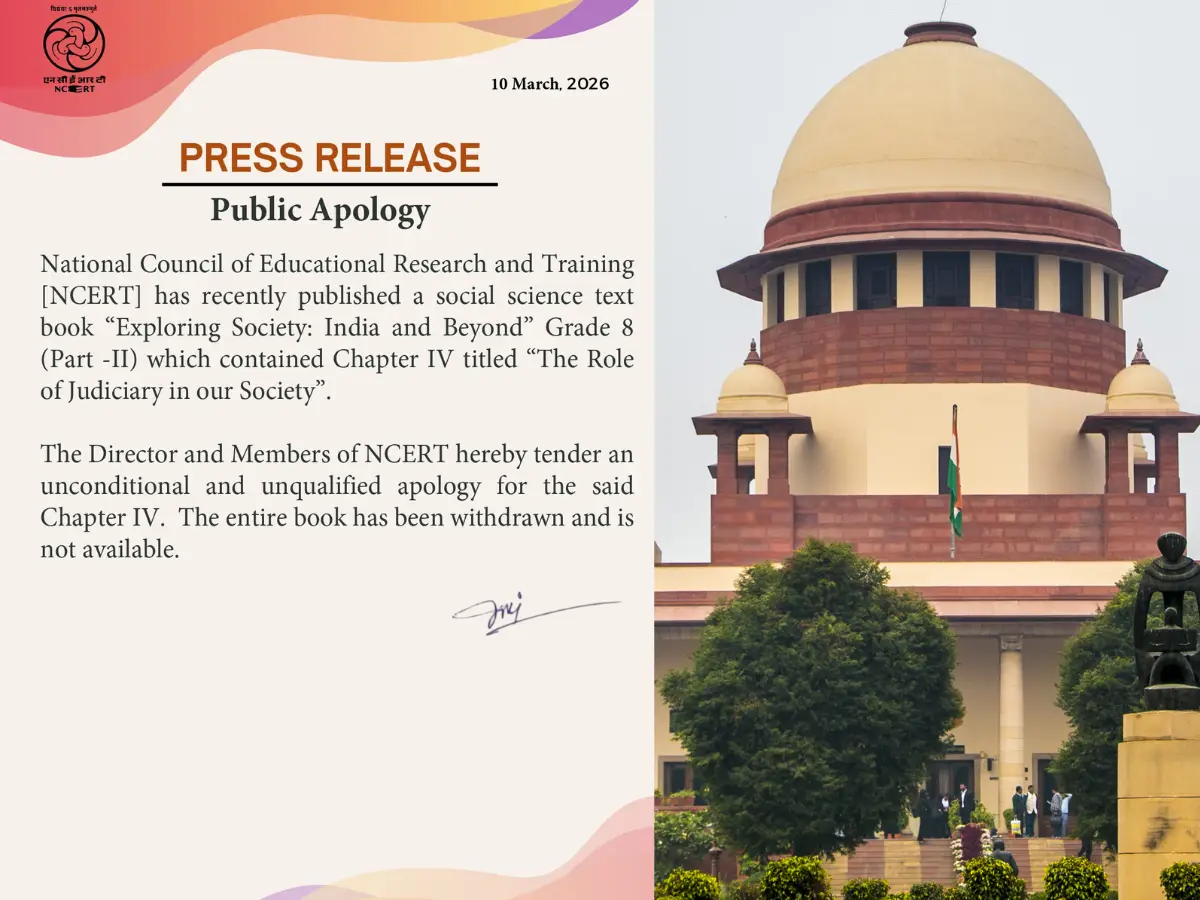
The National Council of Educational Research and Training (NCERT) on Tuesday (Mar 10) tendered an "unconditional and unqualified apology" for the 'Corruption in the judiciary' chapter in its Class 8 Social Science textbook, "Exploring Society: India and Beyond" (Part II). In a statement issued on X, NCERT said that the entire book has now been withdrawn. This comes as the Supreme Court of India on February 26 ordered a "complete blanket ban is hereby imposed on any further publication re: printing or digital dissemination of the book.
NCERT's unconditional and unqualified apology

In a statement on X, NCERT said that the book in its entirety has been withdrawn. "The National Council of Educational Research and Training [NCERT] has recently published a social science textbook, "Exploring Society: India and Beyond," Grade 8 (Part II), which contained Chapter IV titled "The Role of Judiciary in our Society." The Director and Members of NCERT hereby tender an unconditional and unqualified apology for the said Chapter IV. The entire book has been withdrawn and is not available".
Expressing regret for any inconvenience caused, NCERT reiterated its commitment to accuracy and sensitivity in educational materials. "NCERT remains committed to maintaining the highest standards of accuracy, sensitivity, and responsibility in educational content," it said.
What did the chapter 'The Role of Judiciary in our Society' say?
The National Council of Educational Research and Training had, for the first time, added a section on corruption within the judiciary to its Class 8 Social Science textbook. The revised chapter, titled "The Role of the Judiciary in Our Society," still explained the hierarchy of courts and the idea of access to justice. It also addressed the system's vulnerabilities, including corruption and the massive backlog of cases.
The book laid out the scale of the problem in stark numbers. It cites roughly 53,321,000 pending cases across courts - 81,000 in the Supreme Court, 62.4 lakh (62,40,000) in High Courts across India, and about 4.7 crore (4,70,00,000) in district and subordinate courts.

