NASA invites ISRO to build a base on the Moon

&imwidth=600&imheight=450&format=webp&quality=medium "NASA invites ISRO to build a base on the Moon")
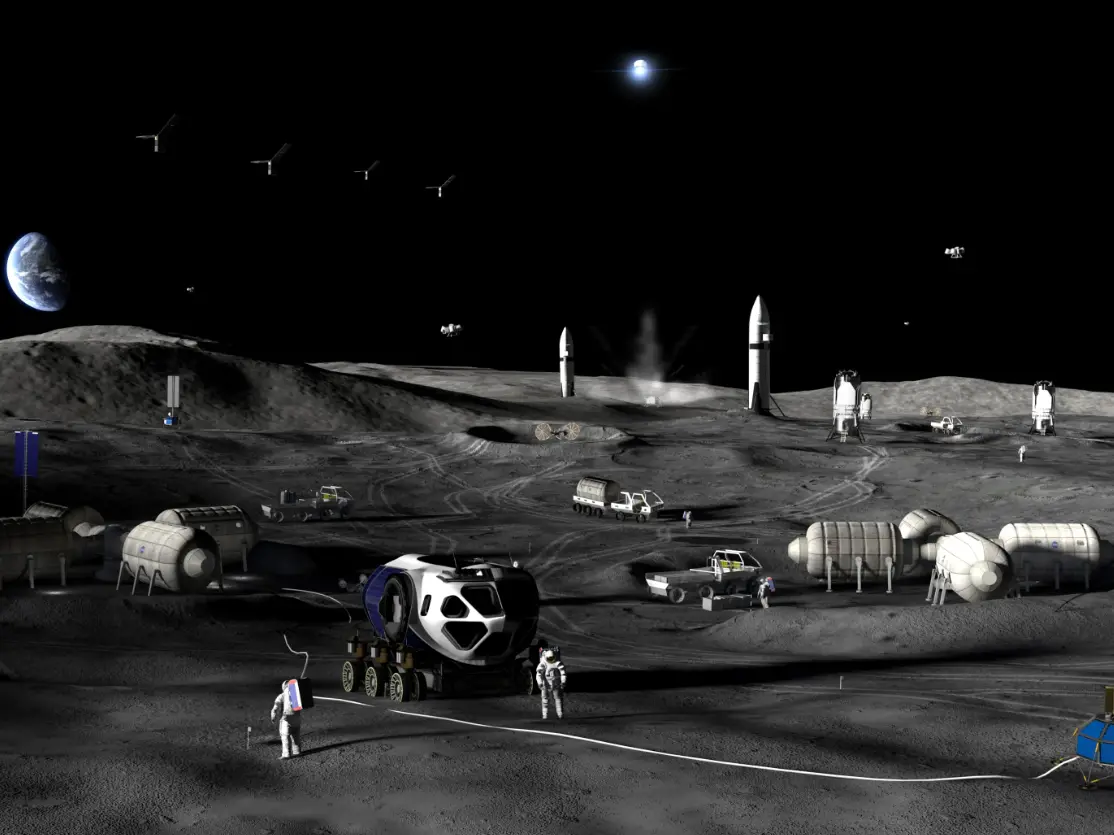
NASA's representative image of the envisioned Moon Base Photograph: (NASA)
NASA has invited ISRO to join its Moon Base programme near the lunar South Pole. Here is what the project aims to achieve and its timeline beyond 2029.
American Space Agency NASA has invited its Indian counterpart, ISRO, to join its Moon Base program, which aims to build humanity's first Lunar outpost: a place where astronauts will live, work, and explore near the Moon’s South Pole(about 400,000 km from Earth). While America's 1969 mission Apollo 11 is the first to land astronauts on the Moon(near the equatorial region), India's 2023 mission Chandrayaan-3 is the first robotic craft to soft-land and explore near the Lunar south pole. NASA's invitation to ISRO was issued during the 9th meeting of the India-U.S. Civil Space Joint Working Group (CSJWG) hosted by India at the ISRO Headquarters in Bengaluru this month.
As for Lunar ambitions, America is working to return astronauts to the moon by the end of this decade or by the start of the next, while India hopes to land its own astronauts on the Moon by 2024 or later. India is also working on sending its astronauts to space on a homegrown mission by the end of this decade. Meanwhile, China is working towards a manned lunar landing mission by the end of this decade and has long-term Lunar exploration and habitation goals. In partnership with Russia, China plans to build a permanent robotic and human research base called the International Lunar Research Station (ILRS) at the Lunar south pole by 2035.
The India-US meet was attended by Dr. V.Narayanan,Chairman, ISRO & Secretary, Department of Space and SergioGor, US Ambassador to India. In their address, Narayanan and Gor highlighted the significance of further strengthening the bilateral space cooperation. The meeting was co-chaired on the Indian side by M.Sankaran, Director, UR Rao Satellite Centre, ISRO and on the U.S. side by Dr. Wesley Brooks, Assistant Secretary of State for Oceans and International Environmental and Scientific Affairs and KathleenKarika, NASA Associate Administrator for International and Interagency Relations.
What is NASA's Moon Base program?
NASA is embarking on one of the most ambitious endeavours in human history: building humanity’s first outpost on another celestial body. Located near the lunar South Pole, the Moon Base will be built step by step through a series of robotic and human missions that help astronauts learn how to live and operate in one of the most demanding and dangerous environments humans have ever set out to explore. The discoveries made and lessons learned there will help shape the future of exploration, from the Moon to Mars.
Through a series of crewed and uncrewed missions, NASA and its partners will build the infrastructure needed to support an enduring human presence on the lunar surface while advancing science, technology, and exploration.
Trending Stories
)
)
)
)
)
)
&im=FitAndFill=(700,400))
)
)
)
)
)
)
)
)
)
)
)
)
)
)
)
)
)
)
)
)
)
)
)
)
NASA plans to establish the Moon Base near the lunar South Pole, a region that offers unique opportunities for exploration, discovery, and long-term human presence. Notably, the Lunar South Pole region is known to hold reserves of water ice, which can serve basic human needs and be converted to cryogenic rocket fuels: liquid hydrogen and liquid oxygen. This remote frontier may hold resources that can help support future explorers and answer important questions about the history of the Moon, Earth, and the solar system.
NASA’s Moon Base strategy is built on commercial participation at an unprecedented scale, combining the strengths of government, private innovation, and global collaboration.
The timeline of NASA's Lunar Base Program
Until 2029, NASA is looking to gain reliable access to the lunar surface and build a deeper understanding of the harsh environment there. Robotic missions will explore the lunar South Pole, demonstrate new technologies, and gather the knowledge needed to guide future development. By expanding experience landing and operating on the Moon, NASA will identify promising locations for future infrastructure, improve mission capabilities, and reduce risk before astronauts arrive.
Between 2029 and 2032, NASA aims to build and expand on what is learned during Phase One. This includes deploying the first infrastructure needed to support long-term operations on the Moon: Early power systems, cargo transportation, logistics, and communications capabilities. These will expand humanity’s footprint on the Moon and enable increasingly complex missions.
Beyond 2032, NASA aims to begin assembling a permanent lunar outpost where astronauts can live and work for extended periods. Habitats, power systems, communications, transportation, and other critical capabilities will come together to support an enduring human presence near the Moon’s South Pole. As the Moon Base grows and evolves, it will enable increasingly ambitious scientific research, technology demonstrations, and exploration, while helping prepare humanity for future journeys deeper into the solar system.