
&imwidth=800&imheight=600&format=webp&quality=medium "Massive terror financing probe: J&K police crack down on 8,000 mule accounts, expose ₹209 crore phishing and fake trading racket")
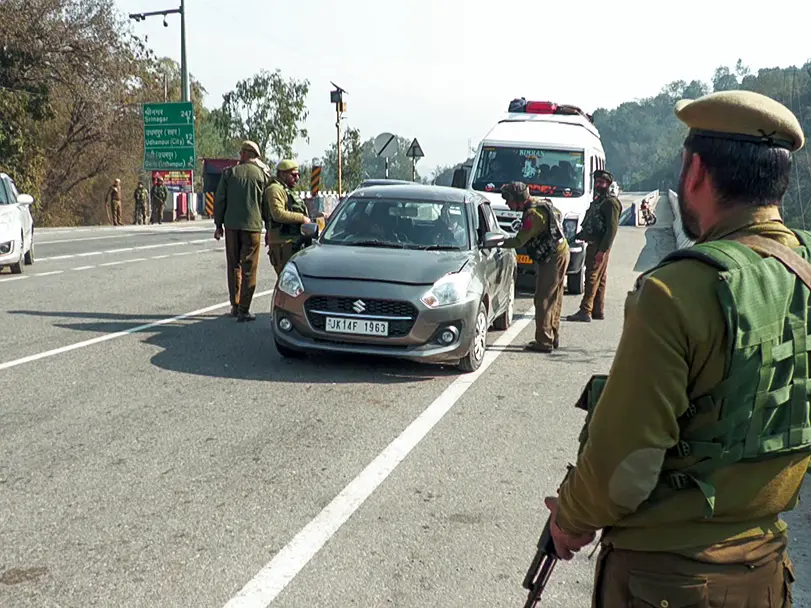
The Jammu and Kashmir Police has intensified its crackdown on a digital hawala network linked to terror financing, following the bust of a major white-collar terror module. Officials have placed over 8,000 bank accounts under scrutiny, suspecting that collected funds were funnelled into terrorist activities. Investigating agencies believe the handlers of the network are operating from across the border in four different countries.
Mule bank accounts have emerged as a major new front in cyber fraud, posing serious challenges for security and financial intelligence agencies. In a significant crackdown, authorities in Jammu and Kashmir recently uncovered a vast network of nearly 8,000 mule accounts, exposing a sophisticated money-laundering operation allegedly linked to international cyber fraud syndicates.
The operation marks a coordinated effort by central agencies and the Jammu and Kashmir Police to dismantle a system in which fraudulently obtained funds were routed through layers of bank accounts to obscure their origin and final destination.

Authorities have directed the J&K Police, banking institutions, and other law enforcement agencies to work in close coordination to identify, monitor, and immediately freeze newly created mule accounts. Investigations are now focused on tracing the intermediaries commonly known as mulers who recruit account holders, manage the network, and facilitate the movement of illicit funds across regions and, in some cases, across borders. Officials believe that identifying these handlers is key to breaking the backbone of the wider cyber fraud ecosystem.
''Around 7,000 to 8,000 accounts are currently under scrutiny due to suspicious transactions and questionable credentials. These accounts are being actively reviewed, and we have requested the department to freeze them while investigations are underway. We are examining potential links to terror financing. Our country has faced terrorism for years, much of it sustained through illicit funding channels. We are determined to disrupt and choke off these financial networks. There is serious concern that these accounts may have been used to funnel funds to terrorist organisations, '' said Tahir Ashraf Bhati, SSP Counterintelligence, Kashmir
Trending Stories
)
Trump's helipad event overshadowed by audio failure as major TV networks suspend pool coverage
)
US-Iran war, peace deals and more: What to expect from Trump's UNGA 2026 speech
)
Samay Raina-Mukesh Chhabra controversy explained: What happened over girlfriend joke on India's Got Latent?
)
Randeep Hooda arrives in Gujarat for his first National Film Award: ‘Very grateful’
)
Key accused in Bihar's Jamui molestation case, arrested after police shoot him in leg
)
Two infants die after fire breaks out at RIMS newborn care unit in Telangana's Adilabad
)
Anti-AI activists storm summit, say 'incompetent' leaders are leading us into a disaster - 'We need a vote'
)
UK PM Burnham agrees to 'defensive' military support for Saudi Arabia against Houthis
)
UK banks are rethinking financial crime detection because of algorithm
)
'Needs time away from the international scene': England white-ball captain Brook on pacer Brydon Carse's future
)
40-foot waves crash into cruise ship in dangerous stretch near Antarctica. Watch
)
India at UNGA81: Jaishankar warns global order under 'growing stress', pushes for ‘reformed multilateralism’
)
New Zealand farms shift to carbon forests: Carbon credits fuel a land rush reshaping rural life
)
$110 billion Warner Bros merger: Paramount reaches settlement with 12 US states
)
From ‘communist’ to ‘great mayor’: Trump praises Mamdani after New York meeting, discusses immigration and housing
)
Raaka creates history! Allu Arjun’s film secures Guinness World Record ahead of release
)
Pilot recreates Mona Lisa in sky over Oklahoma and Arkansas in four-hour flight: VIDEO
)
IND vs JPN one-off T20I: India survive scare from Japan to win five-over a side match by 2 runs
)
Who is Clavicular? The 20-year-old controversial 'Looksmaxxing' influencer charged with rape allegations
)
AI models chose to harm humans to stop ‘pain,’ alarming study raises fresh safety questions
&im=FitAndFill=(700,400))
National Film Awards 2026: Kartik Aaryan, Mammootty, Yami Gautam, Randeep Hooda and other key winners
)
J&K Assembly Session begins amid chaos: BJP, ruling alliance clash as statehood demand dominates
)
Saudi Arabia exits China-led mBridge digital currency platform amid Saudi-Houthi conflict
)
Microsoft executive called AI training the ‘largest theft of labour in human history’
)
Explainer: Why rare-earth export licences and Board of Trade are US priorities ahead of Trump-Xi summit
)
US and China vie for AI dominance as calls grow for regulation | Gravitas
)
How Zaheer Khan came to be CSK's head coach of IPL 2027
)
Indonesian groups sue govt over wildfires as haze crosses borders, nearly 900,000 hectares burned
&im=FitAndFill=(700,400))
Anant Nag to recieve Dadasaheb Phalke Award: From Ankur to Nishant- Revisit his best films and iconic performances on OTT
)
Report: Zelensky meets CIA chief Ratcliffe at Shannon airport, weeks after his secret Moscow trip
)
Asian Games 2026: India women's cricket team beats Sri Lanka by 147 runs for first gold
)
IND vs JPN, one-off T20I: Japan captain Kendel on pushing India to the brink - ‘It was special’
)
Oil slips to $98 as Saudi Arabia restarts East-West oil pipeline
)
Jailer 2: Vidya Balan joins Rajinikanth's upcoming film as Kantha | Watch
)
‘0% chance’: Nvidia CEO Jensen Huang dismisses AI extinction fears by 2030
)
Putin's United Russia party wins 355 seats in Duma election; 4 other parties cross threshold to enter parliament
)
'Lot of things to learn from experienced players': Jayasuriya backs Rohit, Virat for 2027 ODI World Cup
)
FIFA chief Infantino wants to reform governing body with consultation from federations
&im=FitAndFill=(700,400))
New OTT releases this week (September 21-27, 2026): Shaque: Trust No One, Hunkkaar, Don’t Be Shy- 5 new titles coming to Netflix, Prime Video and more
In a separate major breakthrough, the Jammu and Kashmir Police recently constituted a Special Investigation Team (SIT) that uncovered a multi-crore phishing and fake trading racket run through fraudulent websites. Investigations have so far identified around 835 suspicious bank accounts, of which 290 verified accounts received approximately ₹209 crore from investors across India within the past one and a half months. Security agencies estimate that the total amount involved could exceed ₹400 crore after full scrutiny.
Also read | Nikhil Gupta pleads guilty to Khalistani leader Gurpatwant Singh Pannun murder-for-hire case
The scam allegedly involved layered fund transfers through accounts in Budgam, Srinagar, Ganderbal, and Baramulla, along with cryptocurrency conversions, QR code circulation via Telegram channels, and cross-border routing to conceal the money trail.
“In the past one and a half months, Ganderbal Police have been investigating a major web-based investment scam operating through fraudulent websites. These platforms falsely promised unusually high returns and were widely promoted through web browsers such as Google Chrome. Websites, including Paisavault, were used to lure unsuspecting individuals into investing their money. Our investigation has revealed transactions exceeding ₹2 crore in certain accounts, with funds being transferred outside the state and subsequently routed abroad. This is not a game or legitimate investment opportunity, but a well-organised online scam. The alleged mastermind, Ekant Yogdutt, also known as ‘Dr. Morphine,’ is a resident of Hisar, Haryana. He is believed to have developed foreign connections during his MBBS studies in the Philippines. The investigation has further uncovered the use of BPL account holders, approximately 200 ATM/debit cards, foreign currencies, and suspected involvement of certain bank employees. So far, eight individuals have been arrested. Authorities have identified the distribution of 575 QR codes and verified 290 bank accounts that collectively received ₹209 crore from investors across India. The total amount involved is expected to exceed ₹400 crore upon completion of the full scrutiny.” said Khalil Poswal, SSP Ganderbal.
Authorities have urged citizens not to rent out bank accounts and to report cyber fraud to the cyber-Police, while further investigation continues to trace funds and attach properties of the accused.
