
&imwidth=800&imheight=600&format=webp&quality=medium "‘Interests of farmers more important than politics’: Karnataka CM Shivakumar says at all-party meeting on Cauvery issue")
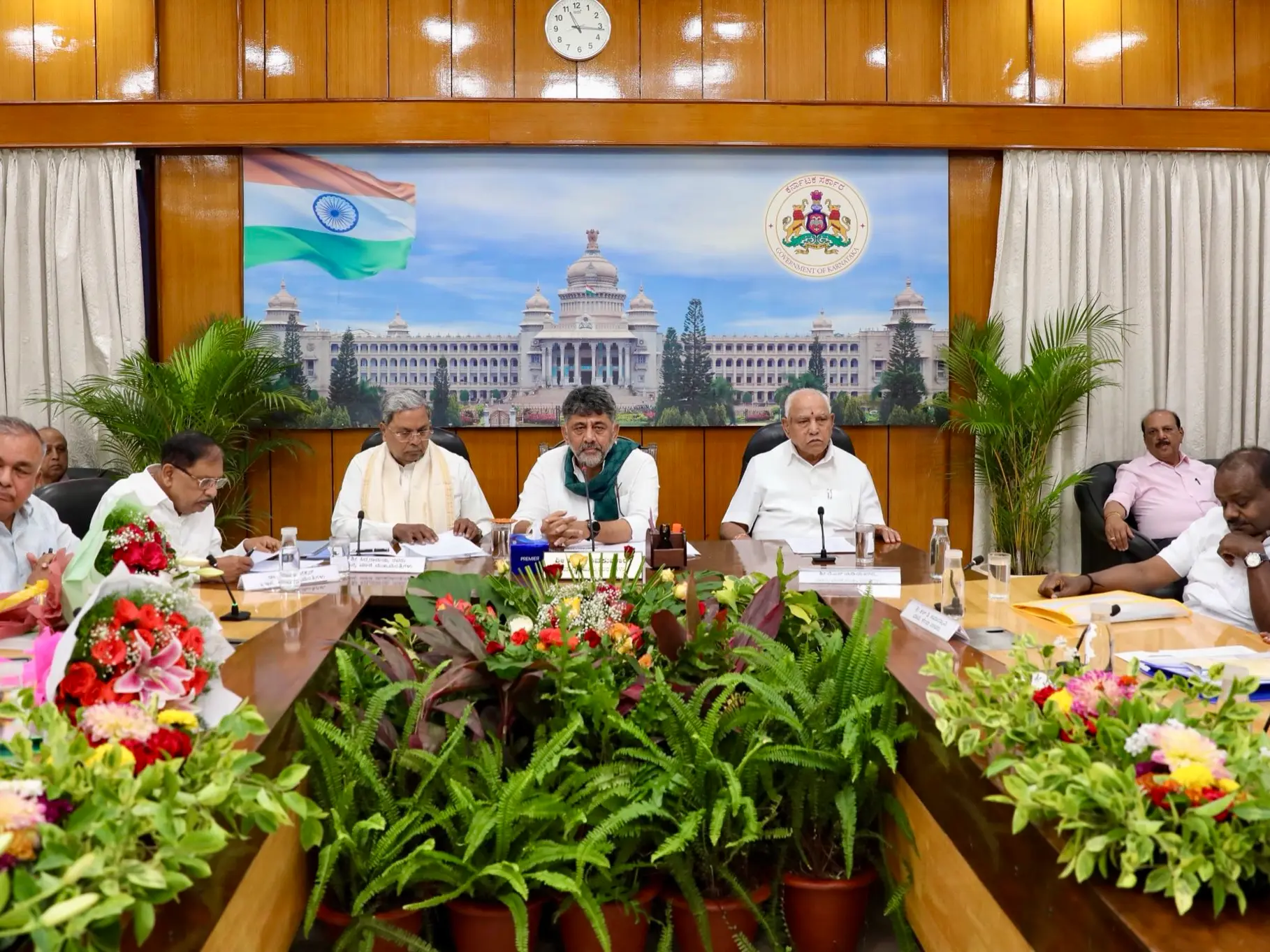
Karnataka Chief Minister Shivakumar on Sunday (Aug 2) said that the interests of the state’s farmers were more important than politics as the dispute with Tamil Nadu state continues over the Cauvery water issue. He made the remarks during an all-party meeting convened to discuss the matter.
“The interests of the state’s farmers and people are more important than politics,” Shivakumar said. He added that Karnataka has a long-standing tradition of putting aside political differences and coming together whenever the state’s interests are involved.
“The Cauvery dispute is not new to us, nor is it new to you. We have all grown up with the Cauvery dispute as an integral part of our lives,” he said.

Reiterating the state’s position on the issue, the chief minister said, “Our stand has always been that drinking water should be given the highest priority. I know that all of you fully agree with this position.”
Ahead of the Cauvery Water Regulation Committee (CWRC) and Cauvery Water Management Authority (CWMA) meetings, Shivakumar said he had conveyed Karnataka’s concerns to Union Ministers and former chief ministers, who also raised the issue with the Centre.
He added that MPs from all parties had assured their support in protecting Karnataka’s interests. The meeting at his official residence ‘Krishna’ was attended by former chief ministers, Union ministers, opposition leaders and senior officials to discuss legal and administrative measures related to the dispute.
Trending Stories
)
No Pandya as Auqib Nabi earns maiden ODI call-up; Mayank returns for WI T20Is| check full squads
)
Chiefs tight end Travis Kelce named one of the victims in $35 million ponzi scheme
)
Trump praises India’s Opium crackdown, hails anti-drug efforts
)
Sydney Sweeney defends provocative ad choice, the internet is still not impressed
)
Former India player Diana Edulji wants Smriti Mandhana to replace Harman as skipper at the earliest
)
Trump calls Canada-EU associate membership plan ‘laughable’ and threatens 'very serious tariffs'
)
Protests erupt over migrant housing plan in Piddington
)
Shahzad Bhatti Network declared terrorist organisation under UAPA: Govt order
)
Europe wants a common playbook for security threats, seeks security beyond NATO
)
Formula One reveals the 2027 race calendar; Monaco to host sprint race for the first time
)
All Indian goods to get duty-free access to New Zealand
)
Bigg Boss 20: Mahhi Vij reveals she lost Yuva role to Kareena Kapoor; 'didn’t work out in my favour'
)
Lionel Messi for 2026 Ballon d’Or over Mbappe and Yamal, says Diego Simeone
)
US House votes 417-3 to pass Ratepayer Protection Act targeting AI data center electricity costs
)
Hong Kong unveils 11 new measures to boost birth rates, offers higher cash bonuses and housing perks
)
Former OpenAI researcher warns of growing risks from Artificial Intelligence
)
Veteran actor Anant Nag honoured with Indian cinema’s highest award
)
AUS vs SA: Steve Smith still gets 'little flashbacks' from sandpaper gate
)
Pakistan naval vessel returns to harbour with 'severe damage' after collision with Indian warship in Arabian Sea
)
Fed raises rates for first time in 3 years, Kevin Warsh defies Trump as inflation mounts
)
Katrina Kaif’s postpartum weight is not the problem; your gaze is
)
Taiwan seeks deeper India ties as direct flights restart soon and chip projects advance
)
Daayra movie review: Kareena Kapoor, Prithviraj Sukumaran shine in Meghna Gulzar’s cop-versus-cop crime thriller
)
Saudi Vs Houthis: Yemeni military rebels clash with Houthis
)
Pak batter Rizwan's petition against being questioned by cyber crime agency rejected by court
)
US trade tariff: 100% tariff targets Russian buyers amid trade tensions
)
Pakistan: Imran Khan's sons Kasim & Sulaiman claim their father is 'tortured' in jail
&im=FitAndFill=(700,400))
New OTT releases this week (September 14-20, 2026): Lust Stories 3, Waiting Hai, Irumudi- 5 new titles coming on Netflix, Prime Video and more
)
Trump gets new power to hit India, China with up to 100% tariffs as US Senate clears Russia sanctions bill
)
Prime Minister Narendra Modi's birthday: Italian PM Meloni sends birthday wishes
)
‘Imagine 50 AI fighters cornering one manned jet’: India’s mobbing doctrine eyes a new era of air warm
)
Saudi vs Houthis: Riyadh claims to have shot Houthi drone targeting Mecca
)
US Treasury rallies global financial institutions for Op Economic Outcast to isolate Iran
)
India breaks silence on US Russia sanctions bill, 100% tariff threat: ‘Committed to energy security’ for 1.4 billion
)
Pakistan boycotts chess match against Israel at Olympiad
)
Want to get married within a year? Why 18 lakh people rush to Jaipur for ‘sacred henna’
&im=FitAndFill=(700,400))
Suriya and Jyothika say ‘I do’ again after 20 years! See their dreamy wedding pics
)
Abhishek Sharma rises to No. 2 in T20Is; ENG’s Robinson 3rd after record Pakistan Tests
)
The Early Spring season 2 is happening, but fans have one request - 'don't change the actors'
What is Cauvery water dispute?
The long-standing dispute between Karnataka, Tamil Nadu, Kerala, and the Union Territory of Puducherry over Cauvery water stems from colonial-era agreements from 1892 and 1924. When the latter agreement expired in 1974, Karnataka, the upper riparian State, started diverting water without Tamil Nadu's consent. After decades of conflict, the Cauvery Water Disputes Tribunal was set up in 1990 and finalised the water-sharing framework in 2007. The tribunal also recommended setting up a Cauvery Water Management Board and the Cauvery Water Regulation Committee.
In January 2018, the Supreme Court modified the allocation, increasing Karnataka’s share by 14.75 thousand million cubic feet, citing Bengaluru’s growing drinking water needs, and reduced Tamil Nadu’s allocation by the same amount. It fixed the final allocation at 284.75 TMC for Tamil Nadu, 270 TMC for Karnataka, 30 TMC for Kerala and 7 TMC for Puducherry.
However, the conflict continues, especially during drought periods as both Karnataka and Tamil Nadu depend heavily on the river for agriculture and drinking water.
The Cauvery water dispute resurfaced last month after Tamil Nadu alleged that it is not receiving its mandated share of Cauvery water, while Karnataka has cited water scarcity and low inflows into its reservoirs as reasons for delay. Following this, the Cauvery Water Regulation Committee (CWRC) directed Karnataka to release 3,500 cusecs of water daily to Tamil Nadu for 15 days from July 29, a move Karnataka has indicated it may challenge, citing its own water needs.

