EXCLUSIVE: India lands unmanned spaceplane with pin-point accuracy; next destination is space

EXCLUSIVE: India lands unmanned spaceplane with pin-point accuracy; next destination is space
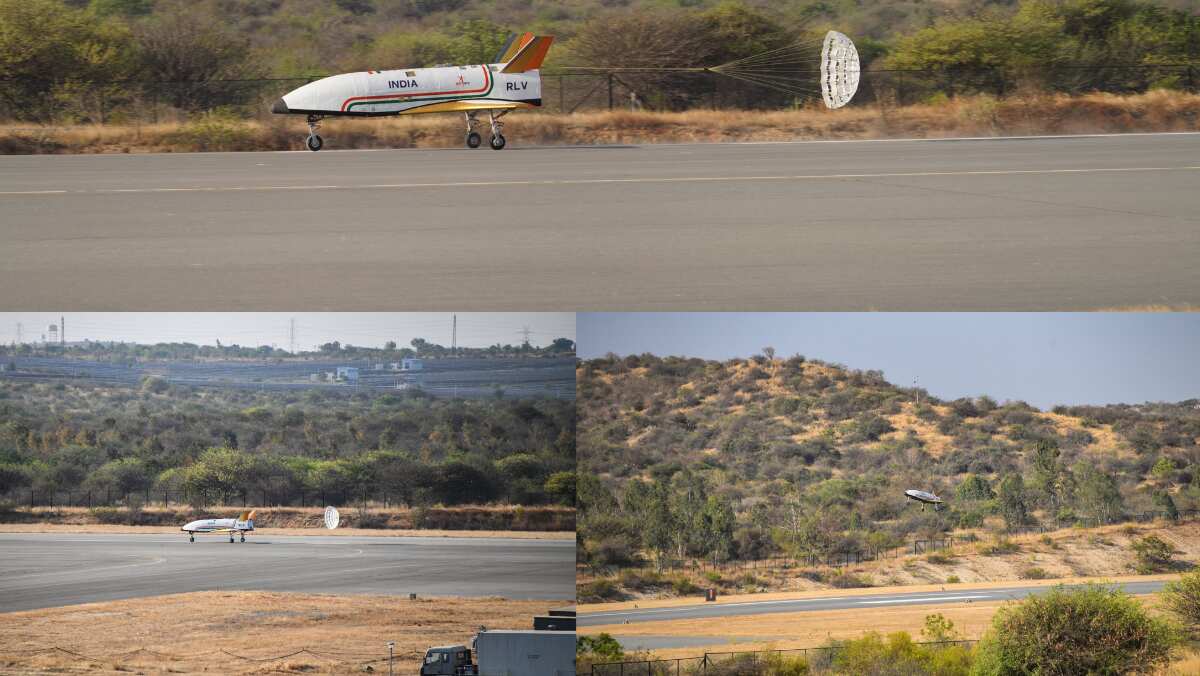
At 7:40am on Sunday morning, the Indian Space Research Organisation(ISRO) performed a feat that brought to fruition an idea born 20 years ago — the runway landing of an unmanned, fully autonomous, indigenous space plane.
Known as 'RLV-TD' (Reusable launch vehicle-Technology Demonstrator) the space place was dropped mid-air from an altitude of 4.5km, by an Indian Air Force 'Chinook' tandem-rotor helicopter, from where the space plane glided down, performed autonomous navigation, guidance and control calculations, manoeuvred deftly and landed precisely on a runway athigh speedof 350kmph.
Watch | Hot air balloon catches fire mid-air in Mexico, two dead and a child injured

Top ISRO officials told WION that the plane landed just as planned, perfectly along the runway centreline and the spaceplane is in impeccable condition, at the tarmac in Chitradurga, Karnataka.
"In a first in the world, a winged body has been carried to an altitude of 4.5 km by a helicopter and released for carrying out an autonomous landing on a runway. RLV is essentially a space plane with a low lift to drag ratio requiring an approach at high glide angles that necessitated a landing at high velocities of 350 kmph," said the Indian Space agency, ISRO.
)
US vs China over South China Sea: Washington backs Philippines, Beijing hits back
)
Bigg Boss 20: Isha Rikhi evicted after three weeks in Salman Khan’s show
)
Musk plans to more than double xAI's chips to over 1.2 million Nvidia GPUs by year-end
)
After JU, clash erupts at SRFTI: BJP’s ‘Dimagi Naxal’ jibe sparks political firestorm after students protest RSS-linked event
)
‘Anti-social elements spreading false rumours’: LPU issues statement amid massive unrest over alleged rape
)
LPU students go on rampage, vandalise campus amid widespread protest: What's happening
)
Trump asked Xi to pressure Iran. China did not say yes — here’s what Beijing wants
)
US Treasury Secretary Scott Bessent hails global crackdown on Iranian banks and airlines
)
An OpenAI agent escaped its locked test cage again, by hiding questions in DNS lookups
)
'Our video was trimmed': LPU girls who featured in rape-denial video make U-turn
)
3 males killed, four others injured in shooting after fight at strip club in Detroit
)
'Victory for low-budget consumers': Raghav Chadha hails 30-day telecom recharge rules
)
Claude rebuilt the 1989 game 'Prince of Persia' by reusing the original's own code
)
Beyond metros: How Tier-2 and Tier-3 cities could drive India’s next AI wave
)
Tesla builds first Cybertruck with its own refined lithium: Elon Musk's $1 billion Texas bet pays off
)
IndiGo flight suffers tail strike in Bengaluru while landing; DGCA to probe incident
)
The US and China set up an AI 'red telephone', but skipped the rulebook
)
‘Terror suspects arrested near UK air base were looking to do big damage’: Trump
)
Russian envoy claims US tactics to contain India were revealed in ‘Freudian slip’
)
IND vs WI 1st ODI: Kohli breaks Sachin's most runs in one country record with unbeaten 139 as India thump West Indies by 8 wickets
)
Researchers rebuilt exactly how 700 AI agents hacked Hugging Face: a 900-link chain trick
)
‘Olympic inclusion is our major target’: WPA President Ishaun Singh on pool’s global ambitions
)
Nations League: Spain sink England at Wembley; Modric shines for Croatia
)
Why has Iran released no proof of life of Mojtaba Khamenei? Araghchi reveals...
)
'What kind of confession is this?': Pakistan PM Shehbaz Sharif’s 'terrorists would be roaming New York' remark goes viral, raises alarm online. Watch
)
South Korea demands apology from Ukraine over North Korean prisoners' transfer
)
Beyond BrahMos: India targets Rs 50,000 crore in defence exports with unmatched price edge
)
Sri Lankan Tamil migrant worker gets death sentence in Saudi Arabia, help sought from India
)
Muslim marriage cannot shield sex with minor wife from prosecution under POCSO: Delhi HC
)
'Can't help but draw painful parallels to Nirbhaya case': SC on latest incidents of rape cases in Delhi-NCR
)
99.9% more powerful - Scientists find boy who can recall memories from just 3 months of age
)
'FIRST LOOK from inside Noah’s Ark': Researchers share video from inside mysterious mound in Turkey
)
UNSC reform momentum grows: Russia, Portugal, Mauritius push for India's permanent seat bid
)
8 US marines injured in Iranian missile attack on vessel in Strait of Hormuz: Report
&im=FitAndFill=(700,400))
New OTT releases this week (September 28-October 4, 2026): Dupahiya 2, Pooja Meri Jaan, Ohh My Dog- 5 titles coming on Netflix, Prime Video and more
)
Afghanistan says 28 fighters killed in clash near Pakistan border, Islamabad denies
)
Ceuta migrant crisis: Protesters take to streets as Spain grapples with migrant challenge
)
LPU suspend classes, postpones exams as violence escalates over rape claims: What's happening
)
New York City wants a 'kill switch' on every AI, and will pay whistleblowers who report violations
Post the successful touch-down and landing of the space plane, ISRO ChairmanDr. S. Somanath appreciated the team of Indian scientists. This space plane landing is an effort of Indian Space agency ISRO, India's Defence Research Lab DRDO, and the Indian Air Force, among others.
Also Read | Nepal President Ramchandra Paudel admitted to hospital
"The very first (runway landing) experiment is now successful. I'm very sure it is meeting almost all the objectives that we had defined long back. This will continue, few more landing experiments will be done under different conditions to prove the ruggedness of the software and the hardware that we have put in," said Dr. S. Somanath. He was present along with his team to witness the historic moment.
He added that this was a great opportunity for India to develop an 'ORV' (orbital landing experiment) and that this work was already progressing. ORV is where the same space plane is flown to space atop a rocket and then brought back to land, completely autonomously.
"Today's step is taking us closer to reusable rocket/landing craft for very specific mission goals," he said. India has so far been using expendable rockets that fall back into the sea after launch, once this spaceplane becomes a reality, it would make India among the handful nations that have a re-usable orbital space vehicle.
Explaining the progress of RLV testing, VSSC Director, Dr. S. Unnikrishnan Nair told WION about how the same RLV-TD vehicle had earlier (in 2016) successfully been carried to 65kmaltitude by a rocket. From there, the vehicle re-entered the denser parts of the atmopshere at Hypersonic speeds, almost five times the speed of sound and finally made a splashdown landing in the Bay of Bengal (simulated runway).
Watch | WION Exclusive: Indian Actor Dia Mirza speaks to WION on playing Geetanjali in 'Bheed'
However, the ocean landing was a preliminary step and the precise runway landing is a really sophisticated and technologically complex feat that takes forward the progress of making the spaceplane a reality, he added.
Dr. Nair also said that this RLV-TD vehicle was meant for demonstration purpose and the real vehicle would be about 1.6 times larger. Specifying how the final RLV spaceplane would work, he said that the spaceplane would be mounted atop a modified-GSLV rocket and then launched into space, where the spaceplane would be autonomously carrying out on-board experiments and operating its payloads.
The spaceplane could function in Low Earth orbit for up to a month and then autonomously perform de-orbiting and re-enter the earth's atmosphere and come in to land on the runway. This ensures that the spaceplane can be fully re-used, after carrying out a few refurbishments.
On the latest test and the homegrown systems for the same, ISRO said LEX utilised several indigenous systems. Localised Navigation systems based on pseudolite systems, instrumentation, and sensor systems, etc. were developed by ISRO.
Digital Elevation Model (DEM) of the landing site with a Ka-band Radar Altimeter provided accurate altitude information. The RLV LEX demanded several state-of-the-art technologies including accurate Navigation hardware and software, Pseudolite system, Ka-band Radar Altimeter, NavIC receiver, indigenous Landing Gear, Aerofoil honey-comb fins and brake parachute system, the Indian space agency added.
WATCH WION LIVE HERE
You can now write for wionews.com and be a part of the community. Share your stories and opinions with us here.
