Drones, drugs and insurgents: The Golden Triangle is arming India’s Northeast?

&imwidth=600&imheight=450&format=webp&quality=medium "Drones, drugs and insurgents: The Golden Triangle is arming India’s Northeast?")
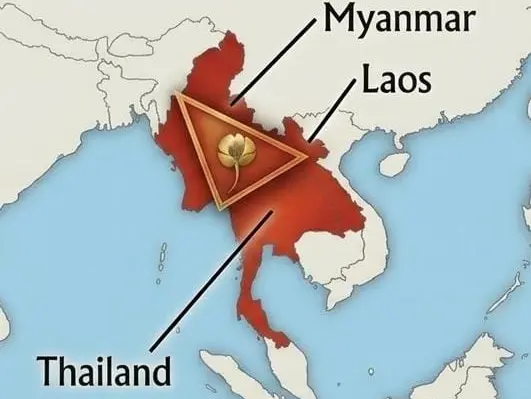
Drones, drugs and insurgents: The Golden Triangle is arming India’s Northeast? Photograph: (AI image from Gemini)
NIA’s arrest of foreign nationals in a Mizoram-linked case highlights a deeper nexus between drugs, arms and insurgency. With Myanmar’s booming opium and meth trade, agencies warn of rising narco-terrorism
When India’s National Investigation Agency swept up six Ukrainian nationals and one American citizen at airports in Delhi, Lucknow and Kolkata last week, the immediate charge was terrorism. But the geography of the alleged conspiracy pointed somewhere older and deeper: a border corridor in Mizoram that, for decades, has been one of the Golden Triangle’s most reliable entry points into India carrying first opium, then heroin, then industrial-scale methamphetamine, and now, if the NIA’s allegations hold, drones.
The accused allegedly entered Mizoram without mandatory Restricted Area Permits, crossed into Myanmar, met ethnic armed groups hostile to India and helped ferry large consignments of drones from Europe into the region, according to NIA submissions before Patiala House Court in New Delhi this week. A Delhi court has remanded them in custody until March 27. All charges remain at the allegation and investigation stage.
THE MACHINE BEHIND IT
No drug charges have been filed in this specific case. The connection, however, is structural. The ethnic armed organisations the NIA names operate across the same geography, Myanmar’s Shan and Chin states, that the United Nations Office on Drugs and Crime identifies as the epicentre of the world’s largest illicit methamphetamine and opium economy. In Myanmar, the drug trade and the gun trade have long been financed by the same hands.
Myanmar overtook Afghanistan as the world’s largest illicit opium producer in 2023, following the Taliban’s near-total ban on poppy cultivation. By 2025, UNODC data showed opium poppy cultivation in Myanmar had climbed a further 17 per cent to approximately 53,100 hectares, a ten-year high, with the sharpest increases in areas that border India directly. Simultaneously, methamphetamine seizures across East and Southeast Asia reached 236 tonnes in 2024, a 24 per cent rise over an already record-breaking prior year, even as wholesale prices fell, a sign, UNODC noted, that supply was outpacing enforcement by a significant margin.
INDIA’S NUMBERS
Trending Stories
&im=FitAndFill=(700,400))
)
)
)
)
)
)
)
)
)
)
)
)
)
)
&im=FitAndFill=(700,400))
)
)
&im=FitAndFill=(700,400))
)
)
)
)
)
)
)
&im=FitAndFill=(700,400))
)
)
)
)
)
)
&im=FitAndFill=(700,400))
India is absorbing the consequences in hard numbers. Nationwide seizures of amphetamine-type stimulants, the category that includes methamphetamine, more than doubled from 34 quintals in 2023 to 80 quintals in 2024, India’s Press Information Bureau reported in 2025. The total value of all narcotics seized across India in 2024 rose roughly 55 per cent year-on-year to approximately 25,330 crore rupees. In November 2024 alone, the Indian Coast Guard intercepted a Myanmarese fishing vessel in the Andaman Sea carrying approximately 5,500 kilograms of methamphetamine, the single largest drug haul in the service’s history, according to an official Coast Guard release.
NAMING IT FOR WHAT IT IS
That trajectory has forced a vocabulary shift at the highest levels. At the launch of the International Narcotics Control Board’s 2023 Annual Report at UN House in New Delhi in April 2024, India’s Narcotics Control Bureau Deputy Director General Monika Ashish Batra stated that investigations were showing drug proceeds “increasingly being used to fund terrorism, and to support armed groups” a framing she described as rising narco-terrorism. The INCB report itself warned that drug-trafficking profits in South Asia were being channelled to fund armed groups. Earlier, India’s Home Minister Amit Shah has separately stated that drug money is financing Naxalism, terrorism and separatism, with the NIA and Enforcement Directorate deployed to financially choke these networks.
THE FORENSIC TRAIL
On the eastern front, Indian security agencies and researchers at the Manohar Parrikar Institute for Defence Studies and Analyses have for years documented that outfits including NSCN(K) and anti-talks ULFA are embedded in the drug economy of Kachin and Shan states, using opium cultivation and trafficking revenue to sustain cadres, purchase weapons and fund operations.
While the record on India’s western front already carries the argument in court-filed detail. In the Salaya case, the NIA has told a Gujarat court that 500 kilograms of heroin smuggled by sea from Pakistan was part of a “transnational narco-terror conspiracy” to finance Lashkar-e-Taiba, with masterminds traced to Pakistan, the UAE, Italy and Australia, according to NIA charge sheets. In Jammu and Kashmir, the Handwara network investigated since 2020 yielded heroin seizures, over 1.15 crore rupees in cash and 91 lakh rupees buried in a dismissed BSF officer’s field, described by the NIA in its charge sheet as drug proceeds destined for Lashkar-e-Taiba and Hizbul Mujahideen.
THE ESCALATION
The NIA’s latest case, if its allegations are proven, would mark a qualitative escalation in that calculus. Narco-funded ethnic armed groups now allegedly stand accused of acquiring drone technology capable of supporting more sophisticated operations against Indian security forces, and of using a European supply chain to do it. The agency has told the Delhi court it is seeking custody partly to “ascertain the alleged source of funding,” a phrase that suggests investigators are already following the money and asking whether it leads back through the same narco-financing structures.
About the Author
