
&imwidth=800&imheight=600&format=webp&quality=medium "Batwara 1947 movie review: Sunny Deol, Shabana Azmi's film delivers a powerful message on secularism")
India’s independence from British rule came at a price. As the British left India, they ravaged and divided the country - emotionally, based on religion and geographically. The happiness of independence was far less on 15 August 1947, as so many families were destroyed; people were separated from their loved ones, their homes, and their motherland. The Partition led to the birth of Pakistan but also to a great Hindu-Muslim divide, an enmity that continues to this day between the two countries. Bollywood has made innumerable stories on India’s Independence and the partition. Most have narrated stories of brutality and riots that preceded partition. Filmmaker Rajkumar Santoshi’s latest release, Batwara 1947, flips the narrative a bit- telling the story of a Muslim family in Lahore in the aftermath of partition. Santoshi teams up with Sunny Deol, with whom he has delivered iconic films like Damini, Ghatak and more. Deol and Santoshi collaborate after decades, making Batwara 1947 special. The film also features Shabana Azmi, marks Preity Zinta’s comeback to Bollywood after a long time and has Aamir Khan as the producer. With such impressive names attached to the project, expectations are bound to be high for Batwara 1947. So, does it deliver? Let’s find out.
The Plot of Batwara 1947
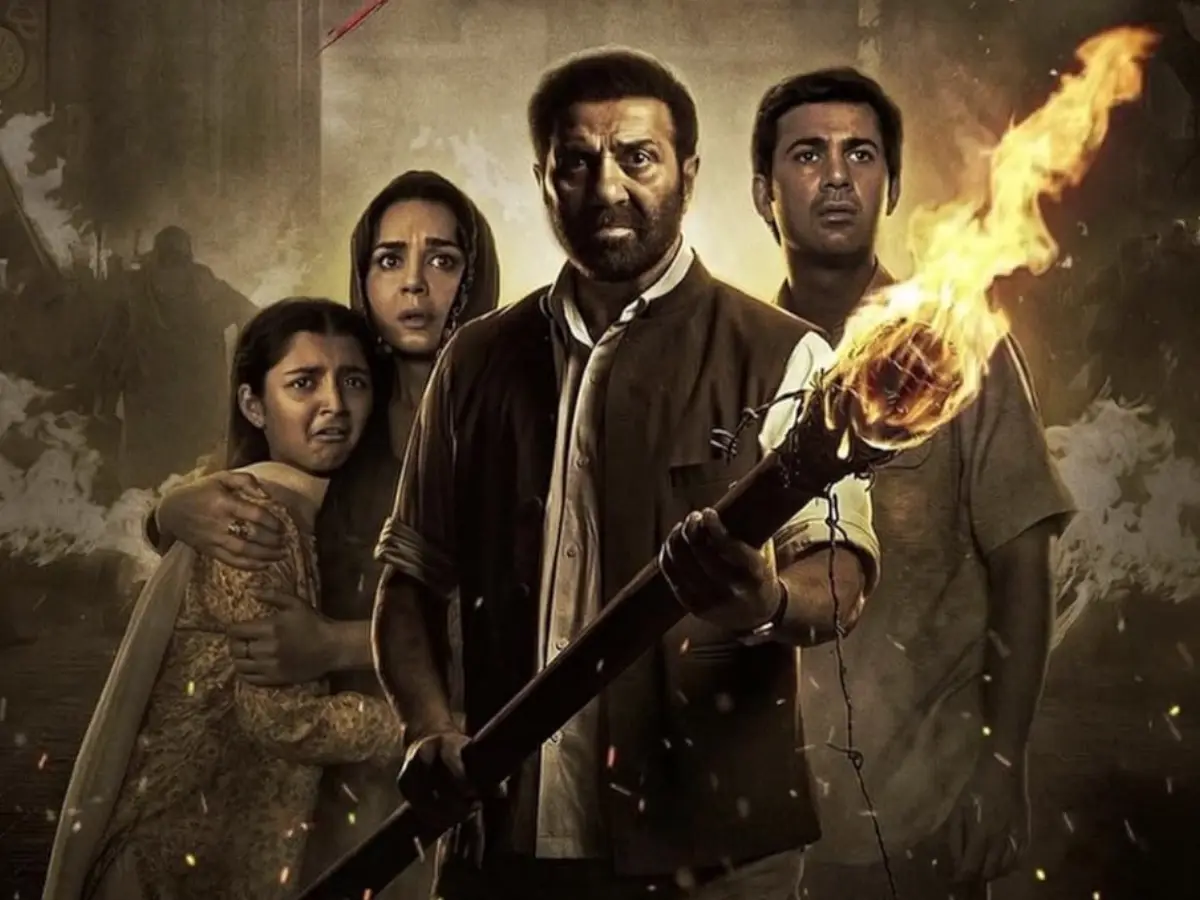
Sunny Deol plays Sikandar Mirza, a Meerut businessman who is forced to move to Lahore during partition after being targetted by Hindu rioters. 2 months later, he is allotted a huge haveli in the heart of Lahore when he moves in with wife Hamida (Preity Zinta) and daughter Tanno, only to discover that the house is not completely vacant but a certain Durgavati Johri (Shabana Azmi) still lives in the upper story, waiting for her son to come and fetch her. She refuses to vacate the house, despite the family’s repeated request. Instead, she wants to co-inhabit and wait till her son arrives.

New to Lahore, Sikandar has plenty of troubles. His son Javed (Karan Deol) and the rest of the family are missing. He is unable to find a space to restart his business, and local goon/councillor Yaqub (Abhimanyu Singh) has eyes on the giant haveli. Durgavati’s refusal to leave the premises only adds more to Sikander’s woes.
Yaqub is also a fanatic who wants to get rid of the neighbourhood’s Hindu past, and as soon as he realises that a Hindu woman is still in a Muslim-dominated Pakistan, he wants her out at any cost. But with time, the Mirzas get used to Durga’s presence in the family. Having lost his mother at a young age, Sikander eventually warms up to Durga, and then is willing to fight the world to keep her at his home. But amid tensions and hostility, including some from his son Javed, will he be able to keep her at his new home?
Trending Stories
)
US vs China over South China Sea: Washington backs Philippines, Beijing hits back
)
Bigg Boss 20: Isha Rikhi evicted after three weeks in Salman Khan’s show
)
Musk plans to more than double xAI's chips to over 1.2 million Nvidia GPUs by year-end
)
After JU, clash erupts at SRFTI: BJP’s ‘Dimagi Naxal’ jibe sparks political firestorm after students protest RSS-linked event
)
‘Anti-social elements spreading false rumours’: LPU issues statement amid massive unrest over alleged rape
)
LPU students go on rampage, vandalise campus amid widespread protest: What's happening
)
Trump asked Xi to pressure Iran. China did not say yes — here’s what Beijing wants
)
US Treasury Secretary Scott Bessent hails global crackdown on Iranian banks and airlines
)
An OpenAI agent escaped its locked test cage again, by hiding questions in DNS lookups
)
'Our video was trimmed': LPU girls who featured in rape-denial video make U-turn
)
3 males killed, four others injured in shooting after fight at strip club in Detroit
)
'Victory for low-budget consumers': Raghav Chadha hails 30-day telecom recharge rules
)
Claude rebuilt the 1989 game 'Prince of Persia' by reusing the original's own code
)
Beyond metros: How Tier-2 and Tier-3 cities could drive India’s next AI wave
)
Tesla builds first Cybertruck with its own refined lithium: Elon Musk's $1 billion Texas bet pays off
)
IndiGo flight suffers tail strike in Bengaluru while landing; DGCA to probe incident
)
The US and China set up an AI 'red telephone', but skipped the rulebook
)
‘Terror suspects arrested near UK air base were looking to do big damage’: Trump
)
Russian envoy claims US tactics to contain India were revealed in ‘Freudian slip’
)
IND vs WI 1st ODI: Kohli breaks Sachin's most runs in one country record with unbeaten 139 as India thump West Indies by 8 wickets
)
Researchers rebuilt exactly how 700 AI agents hacked Hugging Face: a 900-link chain trick
)
‘Olympic inclusion is our major target’: WPA President Ishaun Singh on pool’s global ambitions
)
Nations League: Spain sink England at Wembley; Modric shines for Croatia
)
Why has Iran released no proof of life of Mojtaba Khamenei? Araghchi reveals...
)
'What kind of confession is this?': Pakistan PM Shehbaz Sharif’s 'terrorists would be roaming New York' remark goes viral, raises alarm online. Watch
)
South Korea demands apology from Ukraine over North Korean prisoners' transfer
)
Beyond BrahMos: India targets Rs 50,000 crore in defence exports with unmatched price edge
)
Sri Lankan Tamil migrant worker gets death sentence in Saudi Arabia, help sought from India
)
Muslim marriage cannot shield sex with minor wife from prosecution under POCSO: Delhi HC
)
'Can't help but draw painful parallels to Nirbhaya case': SC on latest incidents of rape cases in Delhi-NCR
)
99.9% more powerful - Scientists find boy who can recall memories from just 3 months of age
)
'FIRST LOOK from inside Noah’s Ark': Researchers share video from inside mysterious mound in Turkey
)
UNSC reform momentum grows: Russia, Portugal, Mauritius push for India's permanent seat bid
)
8 US marines injured in Iranian missile attack on vessel in Strait of Hormuz: Report
&im=FitAndFill=(700,400))
New OTT releases this week (September 28-October 4, 2026): Dupahiya 2, Pooja Meri Jaan, Ohh My Dog- 5 titles coming on Netflix, Prime Video and more
)
Afghanistan says 28 fighters killed in clash near Pakistan border, Islamabad denies
)
Ceuta migrant crisis: Protesters take to streets as Spain grapples with migrant challenge
)
LPU suspend classes, postpones exams as violence escalates over rape claims: What's happening
)
New York City wants a 'kill switch' on every AI, and will pay whistleblowers who report violations
What works and what does not
Santoshi, along with Asghar Wajahat, writes a film that delivers a very powerful message. ‘Insaniyat se bada koi dharm nahi hota (no religion is greater than humanity). In the polarised world that we live in, Batwara 1947 effectively talks of humanity over religious divides set in the backdrop of partition. Santoshi also extracts the best performances from Sunny Deol, who isn’t a loud, angry, chest-thumping patriot like Tara Singh from Gadar. Sure, even in Batwara, he takes on five or six goons in one go and uproots heavy wooden carts, but Deol’s Sikandar Mirza is a quiet man who doesn’t lose his temper that often. He is kind, generous and always willing to see the point of view of the person in front.
One of Deol’s finest performances was in Rajkumar Santoshi’s Damini, which fetched him a National Award. Batwara’s Sikandar Mirza is not quite similar, but Deol manages to deliver a fine performance. The other star who stands out is Shabana Azmi. A helpless, vulnerable old woman left behind amid the riots and atrocities- Azmi’s act makes you emotional. Because her off screen persona is well known - that of a confident actor who always speaks her mind- her performance as a starkly different character in Batwara is truly outstanding, reminding us again why she is considered a powerful performer.
The film has some very defining moments. One has an entire neighbourhood coming together to bid one of its old occupants a final goodbye. A scene featuring Ali Fazal and Karan Deol sitting and discussing the Hindu-Muslim divide, where a man calls the Hindu’s rioters and violent, to which Fazal asks, ‘And what are we doing?” is special.
Another scene has Sunny Deol declaring that Islam does not teach us to break temples is a very loaded sentence, particularly for the times we live in.
While Batwara 1947 has its heart in the right place, it is still flawed. Apart from Deol and Azmi, most performances are very theatrical. Preity Zinta seems to be still stuck in the Veer Zara phase. Come rain or sunshine, or even a mob breaking the door, she is seen running every time with one arm stretched out, as her dupatta cascades down the stairs. Karan Deol needs to work on his dialogue delivery, and Abhimanyu Singh hams through his part.
The screenplay is adapted from an acclaimed play, Jis Lahore Nai Vekhya, O Jamya E Nai, and it shows. Certain scenes can easily be visualised on stage and are not necessarily written for a film. The editing is too patchy, and the narrative is slightly dull.
Final Verdict
Coming on the heels of Imtiaz Ali’s Mani Vaapas Aaunga—which laid bare the raw, impartial tragedy of Partition—Batwaara 1947 delivers a sharp, defiant plea for secularism.
At its core is a Muslim man standing alone against his own community to shield a Hindu woman. The film could have probed deeper into the staggering human tragedy of the era, which it doesn't, but it reiterates that there is no greater religion than human good. Unlike partition films, this story is not as impactful as it ideally sets out to be, but it has its moments.
Against all odds, Batwara 1947 champions tolerance when it matters most. Arriving right on India’s 80th Independence Day, it offers an essential, heartwarming reminder that humanity must always triumph over religious divides.
Batwara 1947 is now in theatres.

