
&imwidth=800&imheight=600&format=webp&quality=medium "Years of tensions: The complete timeline of the US-China trade conflict")
In recent decades, the trade between the US and China has grown enormously. Currently, China is one of the largest export destinations for US goods and services and vice versa. The development came after China joined the World Trade Organisation (WTO) in 2001. However, this trade development has brought the loss of American jobs due to import competition, automation, and multinational companies moving manufacturing overseas.
Meanwhile, economic tensions between Washington and Beijing have significantly risen over the past 20 years after the US policymakers formulated a progressively assertive course toward China. The development has gone against some of its WTO commitments and taken advantage of gaps in the rules. When China joined the World Trade Organisation, many believed it would gradually become more open, evolve into a freer society, and scale back state control over its economy. However, those anticipated reforms never came to fruition.
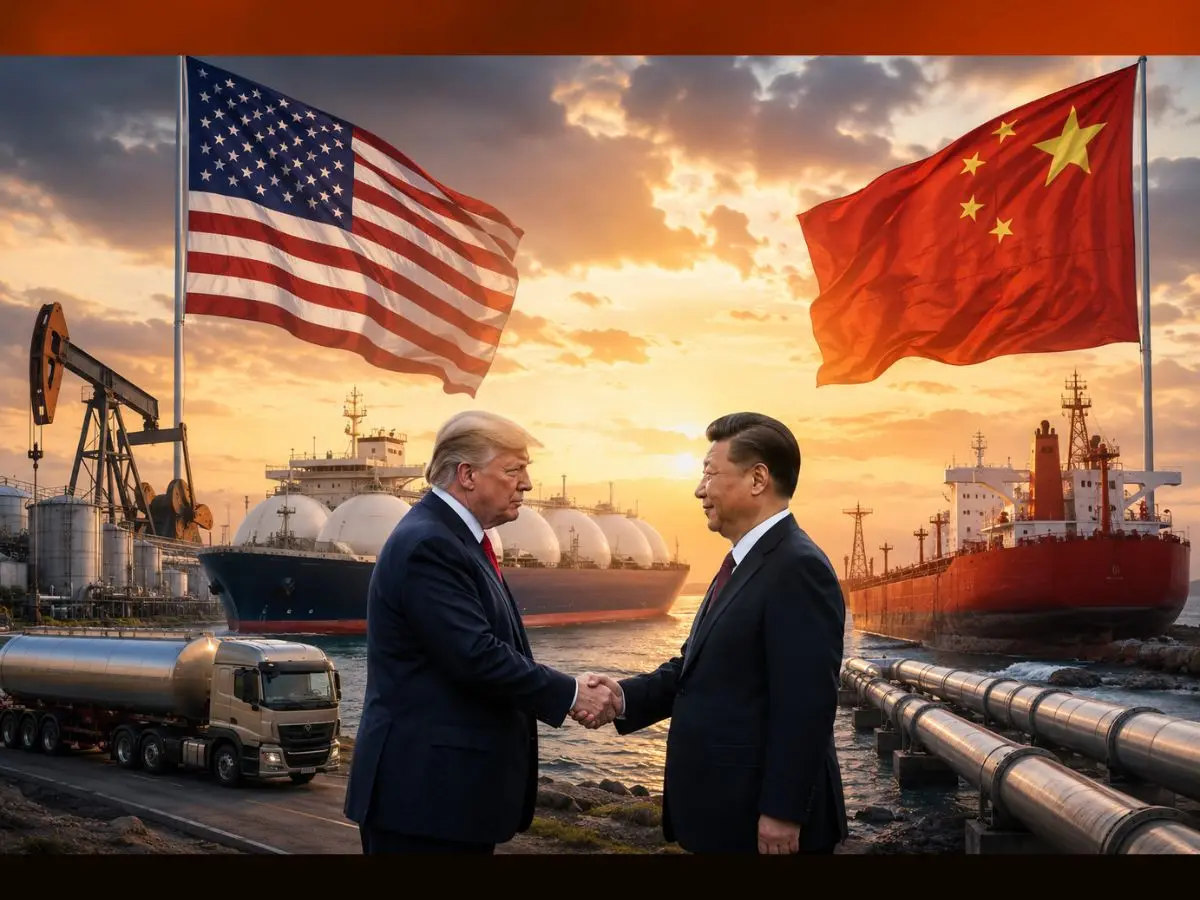
Trade tensions between the United States and China sharply worsened during President Donald Trump’s first term in 2018, when tariffs triggered a major trade war. Although both sides later signed the Phase One trade deal, many tariffs remained. President Joe Biden retained and expanded several restrictions, particularly on semiconductor exports. In Trump’s second term, tensions escalated further as China imposed export controls on rare-earth minerals. Despite a February 2026 Supreme Court ruling limiting some tariffs, most remain active. A planned meeting between Trump and Chinese President Xi Jinping was postponed to May.

Trade war timeline between the United States and China:
Pre-Trade War: Integration and Growth (1979–2016)
1979: The US and China normalise relations as China seeks to boost international trade and investment under Deng Xiaoping.
Trending Stories
)
US vs China over South China Sea: Washington backs Philippines, Beijing hits back
)
Bigg Boss 20: Isha Rikhi evicted after three weeks in Salman Khan’s show
)
Musk plans to more than double xAI's chips to over 1.2 million Nvidia GPUs by year-end
)
After JU, clash erupts at SRFTI: BJP’s ‘Dimagi Naxal’ jibe sparks political firestorm after students protest RSS-linked event
)
‘Anti-social elements spreading false rumours’: LPU issues statement amid massive unrest over alleged rape
)
LPU students go on rampage, vandalise campus amid widespread protest: What's happening
)
Trump asked Xi to pressure Iran. China did not say yes — here’s what Beijing wants
)
US Treasury Secretary Scott Bessent hails global crackdown on Iranian banks and airlines
)
An OpenAI agent escaped its locked test cage again, by hiding questions in DNS lookups
)
'Our video was trimmed': LPU girls who featured in rape-denial video make U-turn
)
3 males killed, four others injured in shooting after fight at strip club in Detroit
)
'Victory for low-budget consumers': Raghav Chadha hails 30-day telecom recharge rules
)
Claude rebuilt the 1989 game 'Prince of Persia' by reusing the original's own code
)
Beyond metros: How Tier-2 and Tier-3 cities could drive India’s next AI wave
)
Tesla builds first Cybertruck with its own refined lithium: Elon Musk's $1 billion Texas bet pays off
)
IndiGo flight suffers tail strike in Bengaluru while landing; DGCA to probe incident
)
The US and China set up an AI 'red telephone', but skipped the rulebook
)
‘Terror suspects arrested near UK air base were looking to do big damage’: Trump
)
Russian envoy claims US tactics to contain India were revealed in ‘Freudian slip’
)
IND vs WI 1st ODI: Kohli breaks Sachin's most runs in one country record with unbeaten 139 as India thump West Indies by 8 wickets
)
Researchers rebuilt exactly how 700 AI agents hacked Hugging Face: a 900-link chain trick
)
‘Olympic inclusion is our major target’: WPA President Ishaun Singh on pool’s global ambitions
)
Nations League: Spain sink England at Wembley; Modric shines for Croatia
)
Why has Iran released no proof of life of Mojtaba Khamenei? Araghchi reveals...
)
'What kind of confession is this?': Pakistan PM Shehbaz Sharif’s 'terrorists would be roaming New York' remark goes viral, raises alarm online. Watch
)
South Korea demands apology from Ukraine over North Korean prisoners' transfer
)
Beyond BrahMos: India targets Rs 50,000 crore in defence exports with unmatched price edge
)
Sri Lankan Tamil migrant worker gets death sentence in Saudi Arabia, help sought from India
)
Muslim marriage cannot shield sex with minor wife from prosecution under POCSO: Delhi HC
)
'Can't help but draw painful parallels to Nirbhaya case': SC on latest incidents of rape cases in Delhi-NCR
)
99.9% more powerful - Scientists find boy who can recall memories from just 3 months of age
)
'FIRST LOOK from inside Noah’s Ark': Researchers share video from inside mysterious mound in Turkey
)
UNSC reform momentum grows: Russia, Portugal, Mauritius push for India's permanent seat bid
)
8 US marines injured in Iranian missile attack on vessel in Strait of Hormuz: Report
&im=FitAndFill=(700,400))
New OTT releases this week (September 28-October 4, 2026): Dupahiya 2, Pooja Meri Jaan, Ohh My Dog- 5 titles coming on Netflix, Prime Video and more
)
Afghanistan says 28 fighters killed in clash near Pakistan border, Islamabad denies
)
Ceuta migrant crisis: Protesters take to streets as Spain grapples with migrant challenge
)
LPU suspend classes, postpones exams as violence escalates over rape claims: What's happening
)
New York City wants a 'kill switch' on every AI, and will pay whistleblowers who report violations
1986: Beijing formally applies to rejoin the General Agreement on Tariffs and Trade (the predecessor to the WTO).
2000–2007: Increased trade with China boosts the annual purchasing power of the average US household by $1,500.
December 2001: China officially joins the WTO, committing to economic reforms, tariff cuts, and IP protection. US imports from China sit at approximately $100 billion.
The George W. Bush Administration has responded to "dumping" and subsidies the US imposes tariffs on specific Chinese goods and launching high-level trade dialogues. In addition, the Barack Obama Administration has also continued dialogues and uses safeguards to impose tariffs on Chinese tyres. Obama blocks two Chinese acquisitions on national security grounds and negotiates the Trans-Pacific Partnership (TPP) to contain China's trade influence.
The Trump Era: Outbreak of the Trade War (2017–2020)
2017: President Trump withdrew the U.S. from the TPP shortly after taking office.
2018: The Trade War begins reaching at the highest point. With the trade deficit hitting a record $377 billion, Trump imposed tariffs on hundreds of billions of dollars worth of solar panels/washing machines and 25 per cent on steel. China retaliates with duties on 128 products, including pork and aluminium.
2018 (July–Sept): The trade war goes "all-in." The US imposes 25 per cent tariffs on $50 billion of goods, followed by 10 per cent on $200 billion more. China responds by targeting US soybeans and automobiles.
2019: Tariffs on the $200 billion list are raised to 25 per cent. Global markets face extreme volatility.
The "Phase One" Truce (2020–2021)
January 2020: The Phase One Deal was signed. China agrees to buy an additional $200 billion in US goods and services over two years.
2020–2021: Due to COVID-19 and logistics disruptions, China only purchased about 58 per cent of the committed amount. The US maintains most tariffs.
The Tech-War & "De-risking" (2022–2024)
The Biden administration shifts the focus from simple trade volumes to national security and high-tech dominance after passing the CHIPS and Science Act in 2022, restricting advanced semiconductor exports to China.
2023: The US deficit with China begins to shrink as trade is rerouted through Mexico and Vietnam (often called "near-shoring" or "friend-shoring").
2024 (May): Biden significantly escalates specific tariffs on Electric Vehicles (EVs) to 100 per cent, Solar Cells to 50 per cent, Semiconductors to 50 per cent and Steel/Aluminum to 25 per cent.
Radical Escalation & The "Busan Truce" (2025–2026)
The second Trump administration (beginning Jan 2025) launched a massive new wave of protectionism.
January 2025: Trump imposes a blanket 145 per cent tariff on nearly all Chinese imports. China retaliates with a 125% tariff on American goods, essentially halting US agricultural exports.
October 2025: Following a market crash and global supply chain panic, the two leaders meet in Busan, South Korea. They negotiate a one-year "Busan Truce," lowering US tariffs on Chinese imports from 57 per cent to 47 per cent to stabilise the global economy.
Early 2026: Despite the truce, US-China trade continues to decline. Bilateral trade fell by 11% year-on-year in early 2026.

