WION Explains: The 'embryos are babies' debate and how it will affect 2024 US Presidential elections

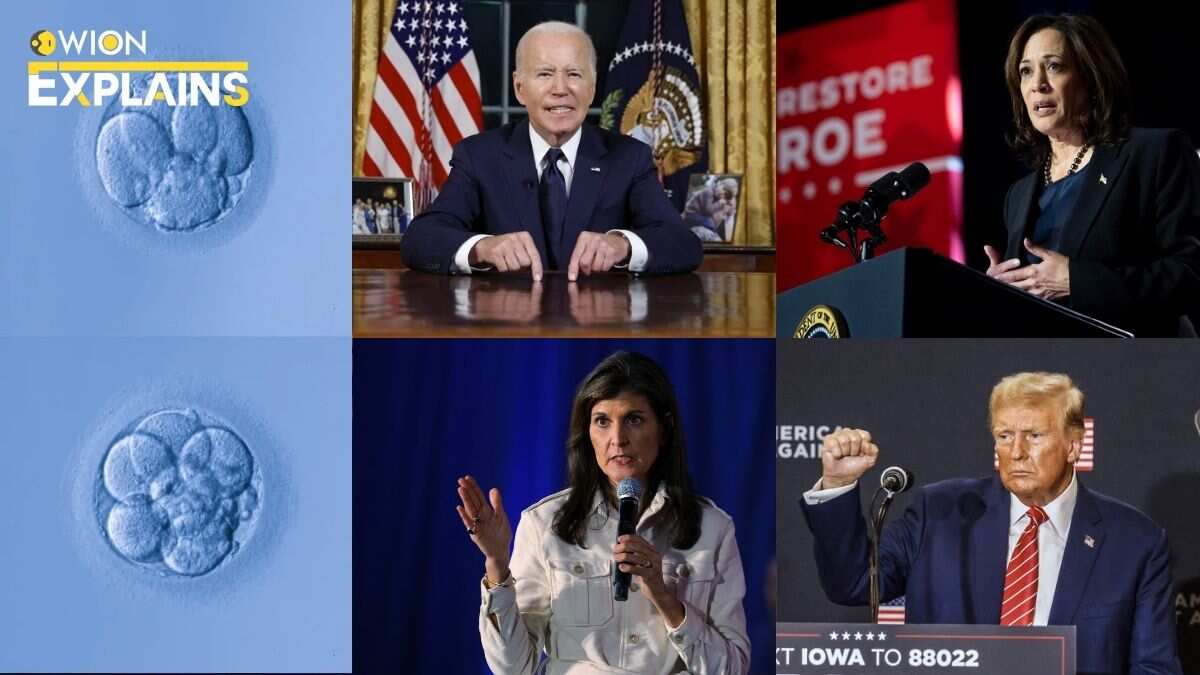
Abortion rights 2024 elections
In the United States, Nikki Haley, a Republican Presidential hopeful has courted controversy by stating that she believes frozen embryos created through in vitro fertilisation (IVF) were babies. Her comments echo a recent controversial ruling by the Alabama Supreme Court.
Haley, the last major 2024 Republican presidential challenger to frontrunner Donald Trump, has added fuel to the debate over the status of embryos in IVF procedures and the legal implications of considering them as children. With the 2024 presidential race gaining heat in the US, the issue is likely to remain contentious.
Here's all you need to know about the 'embryos are babies' issue.

What is IVF, and what are embryos?
IVF or In-vitro fertilisation is a popular fertilisation method available to childless individuals. It uses eggs from a biologically female individual and sperm from a biologically male person to create embryos.
Here, embryos refer to the initial stage of development of a multicellular organism. In humans, the term embryo is used to refer to a pregnancy until the end of the seventh week following conception.
)
US vs China over South China Sea: Washington backs Philippines, Beijing hits back
)
Bigg Boss 20: Isha Rikhi evicted after three weeks in Salman Khan’s show
)
Musk plans to more than double xAI's chips to over 1.2 million Nvidia GPUs by year-end
)
After JU, clash erupts at SRFTI: BJP’s ‘Dimagi Naxal’ jibe sparks political firestorm after students protest RSS-linked event
)
‘Anti-social elements spreading false rumours’: LPU issues statement amid massive unrest over alleged rape
)
LPU students go on rampage, vandalise campus amid widespread protest: What's happening
)
Trump asked Xi to pressure Iran. China did not say yes — here’s what Beijing wants
)
US Treasury Secretary Scott Bessent hails global crackdown on Iranian banks and airlines
)
An OpenAI agent escaped its locked test cage again, by hiding questions in DNS lookups
)
'Our video was trimmed': LPU girls who featured in rape-denial video make U-turn
)
3 males killed, four others injured in shooting after fight at strip club in Detroit
)
'Victory for low-budget consumers': Raghav Chadha hails 30-day telecom recharge rules
)
Claude rebuilt the 1989 game 'Prince of Persia' by reusing the original's own code
)
Beyond metros: How Tier-2 and Tier-3 cities could drive India’s next AI wave
)
Tesla builds first Cybertruck with its own refined lithium: Elon Musk's $1 billion Texas bet pays off
)
IndiGo flight suffers tail strike in Bengaluru while landing; DGCA to probe incident
)
The US and China set up an AI 'red telephone', but skipped the rulebook
)
‘Terror suspects arrested near UK air base were looking to do big damage’: Trump
)
Russian envoy claims US tactics to contain India were revealed in ‘Freudian slip’
)
IND vs WI 1st ODI: Kohli breaks Sachin's most runs in one country record with unbeaten 139 as India thump West Indies by 8 wickets
)
Researchers rebuilt exactly how 700 AI agents hacked Hugging Face: a 900-link chain trick
)
‘Olympic inclusion is our major target’: WPA President Ishaun Singh on pool’s global ambitions
)
Nations League: Spain sink England at Wembley; Modric shines for Croatia
)
Why has Iran released no proof of life of Mojtaba Khamenei? Araghchi reveals...
)
'What kind of confession is this?': Pakistan PM Shehbaz Sharif’s 'terrorists would be roaming New York' remark goes viral, raises alarm online. Watch
)
South Korea demands apology from Ukraine over North Korean prisoners' transfer
)
Beyond BrahMos: India targets Rs 50,000 crore in defence exports with unmatched price edge
)
Sri Lankan Tamil migrant worker gets death sentence in Saudi Arabia, help sought from India
)
Muslim marriage cannot shield sex with minor wife from prosecution under POCSO: Delhi HC
)
'Can't help but draw painful parallels to Nirbhaya case': SC on latest incidents of rape cases in Delhi-NCR
)
99.9% more powerful - Scientists find boy who can recall memories from just 3 months of age
)
'FIRST LOOK from inside Noah’s Ark': Researchers share video from inside mysterious mound in Turkey
)
UNSC reform momentum grows: Russia, Portugal, Mauritius push for India's permanent seat bid
)
8 US marines injured in Iranian missile attack on vessel in Strait of Hormuz: Report
&im=FitAndFill=(700,400))
New OTT releases this week (September 28-October 4, 2026): Dupahiya 2, Pooja Meri Jaan, Ohh My Dog- 5 titles coming on Netflix, Prime Video and more
)
Afghanistan says 28 fighters killed in clash near Pakistan border, Islamabad denies
)
Ceuta migrant crisis: Protesters take to streets as Spain grapples with migrant challenge
)
LPU suspend classes, postpones exams as violence escalates over rape claims: What's happening
)
New York City wants a 'kill switch' on every AI, and will pay whistleblowers who report violations
IVF combines egg and sperm to grow embryos in the culture medium until they are implanted in the uterus.
Alabama Supreme court ruling on embryos
On Friday (Feb 16), the Alabama Supreme Court ruled that frozen embryos can be considered children under the state's laws, and that they are entitled to the same right as other unborn children.
Passing the 7-2 majority ruling, Justice Jay Mitchell wrote "Unborn children are 'children'… without exception based on developmental stage, physical location, or any other ancillary characteristics".
The ruling by the Alabama Supreme Court was issued in response to wrongful death cases involving destroyed embryos. In 2021, a patient at a fertility clinic in Mobile had allegedly broken into an IVF freezer and dropped several trays containing embryos. The case was brought against the fertility clinic, and after the top court ruling, three couples can now sue the facility for wrongful death.
Nikki Haley's comments
On Wednesday (Feb 21), speaking during a TV interview with NBC News, the presidential candidate addressing the Alabama court ruling remarked, "Embryos, to me, are babies."
"When you talk about an embryo, you are talking about, to me, that's a life. And so I do see where that’s coming from when they talk about that," said Haley.
However, when asked about the potential ramifications of the decision, she chose a softer approach and said: "This is one where we need to be incredibly respectful and sensitive about it."
In another interview later the same day — with CNN, she clarified that her remarks didn't mean she agreed with the court ruling.
"I didn't say that I agreed with the Alabama ruling," she said, adding "Our goal is to always do what the parents want with their embryo. It is theirs."
Nikki has campaigned as an anti-abortion presidential contender, reports ABC News. However, seeking to differentiate herself from the Republican field, she tends to voice a less strict tone on the issue.
Concerns over the court ruling
The Alabama Supreme Court ruling on embryos has raised concerns among IVF patients and doctors, with some unsure about how to proceed with treatments.
Following the ruling, the University of Alabama at Birmingham hastemporarily stopped IVF treatments due to fears of legal repercussions and said: "We must evaluate the potential that our patients and our physicians could be prosecuted criminally or face punitive damages for following the standard of care for IVF treatments."
Watch |Are frozen embryos Children? Alabama Supreme Court gives first-of-its-kind decision
Thedecision has been met with criticism, from experts who warn that it could have a devastating impact on people suffering from infertility and hoping to utilise IVF.
"We know for all these years that we've been doing IVF not only in the United States, but around the world, there is no moment of conception. This is a group of cells. We know that not every embryo even gets to a stage of several days, let alone a live birth. And so to say that every single embryo is a child is just factually incorrect, flies in the face of science, and it is an affront to the millions of babies that have been born through IVF and this process," Barbara Collura, President and CEO of infertility advocacy group Resolve, told Reuters.
On X, Vice President Kamala Harris called the decision "outrageous" and said it would rob "women of the freedom to decide when and how to build a family."
Criticising the decision, the White House, said it would create chaos for American families.
Speaking to reporters aboard Air Force One, White House press secretary Karine Jean-Pierre said the decision reflected the consequences of the Supreme Court overturning Roe v. Wade and blamed Republican elected officials from blocking access to reproductive and emergency care to women.
"This president and this vice president will continue to fight to protect access to reproductive health care and call on Congress to restore the protections of Roe v. Wade in federal law for all women in every state," he added.
In the upcoming elections, abortion rights is likely to be a key issue. On one hand, Democrats are likely to utilise it to draw more Democrats and some independent and Republican voters to US President Joe Biden.
His likely opponent, former President Donald Trump, however, is known for his anti-abortion stand, and has gone as far to take credit for the Supreme Court decision to overturn Roe v. Wade. Polls have shown that most voters oppose candidates who favour strict abortion restrictions. Will the issue sway the 2024 US Presidential elections? Only time will tell.
(With inputs from agencies)

