
&imwidth=800&imheight=600&format=webp&quality=medium "Who is Rebeca Grynspan? The woman who could become United Nations first female Secretary-General")
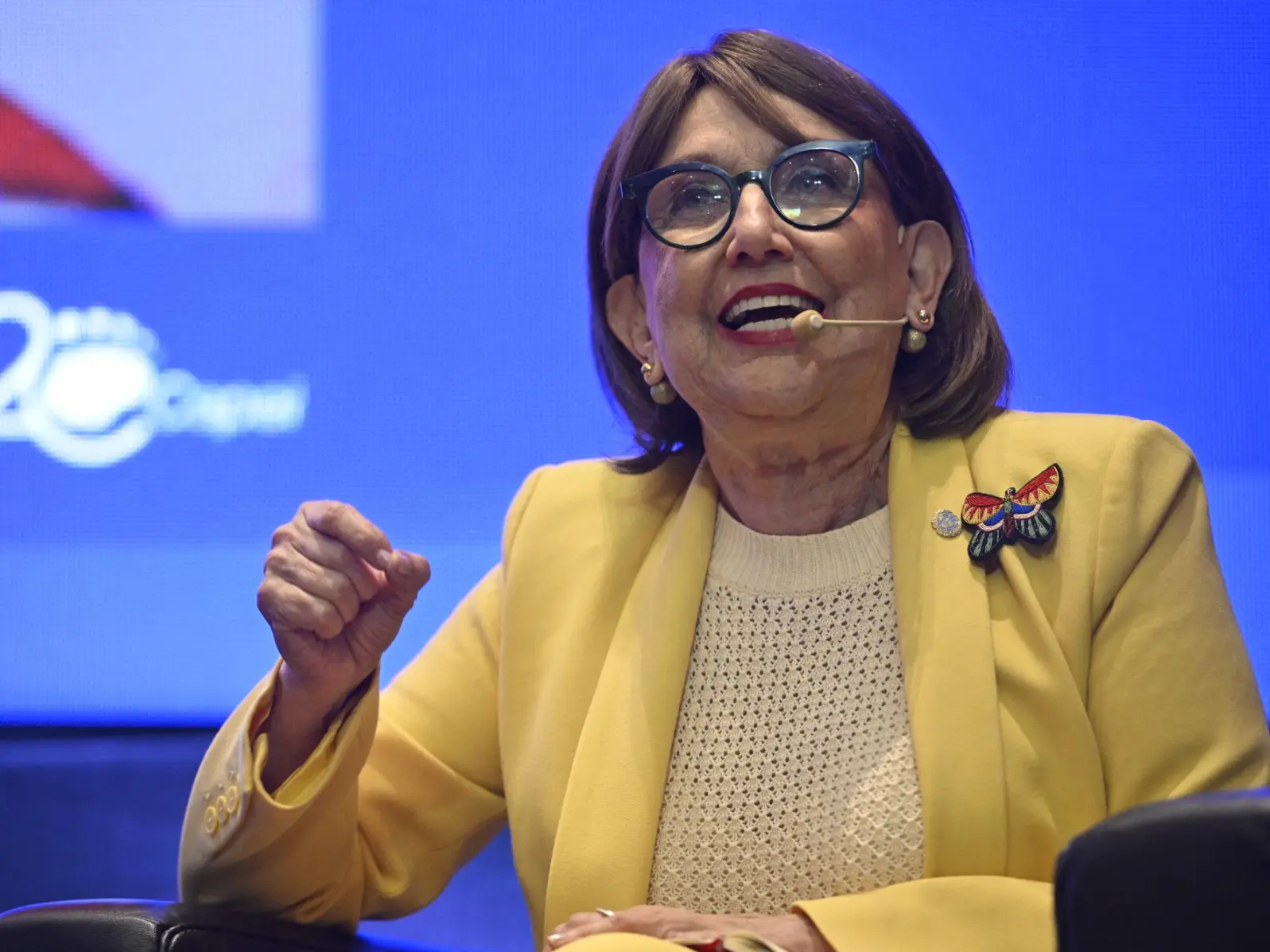
Costa Rican diplomat and former vice-president Rebeca Grynspan has emerged as the surprise frontrunner in the race to become the next secretary-general of the United Nations, potentially making history as the organisation’s first woman to hold the post. Grynspan, whose parents fled Europe after the Holocaust, currently heads the UN Conference on Trade and Development (UNCTAD). Her maternal grandparents were killed by the Nazis, while her parents emigrated from Poland to Central America.
The UNCTAD chief has also overseen detailed assessments of the economic impact of Israel’s occupation of the Palestinian territories. The current UN secretary-general, Antonio Guterres, is due to complete his second five-year term on 31 December 2026. Under the informal regional rotation system traditionally followed for the position, the next secretary-general is expected to come from Latin America.
Grynspan leads first UN Security Council straw poll

In the first secret straw poll conducted by the UN Security Council, its five permanent members and 10 elected members were asked to indicate whether they “encourage”, “discourage” or have “no opinion” about seven candidates.
Grynspan emerged with the strongest result, receiving 10 “encourage” votes, four “no opinion” votes and just one “discourage” vote. The identity of the member that cast the “discourage” vote has not been disclosed. However, securing only one objection gives Grynspan a strong early position in what is expected to be a closely watched selection process. The process is expected to continue through further consultations, with the final stages likely to take place in October.
Carolyn Rodrigues-Birkett emerges as closest rival
Trending Stories
)
Mushtaq Khan dies at 56: When Welcome actor opened up about his salary for iconic role Ballu
)
US Supreme Court backs Trump administration's use of SAVE database to check voter citizenship
)
Hawaii braces for Hurricane Nolo: NOAA warns of flash flooding and mudslides
)
Bangkok declares flood disaster as heavy rain submerges roads and homes
)
Outrage erupts after 3-year-old is married to 60-year-old man in Pakistan, link to her sister's murder being probed
)
Donald Trump shares image of Xi's arrival in Washington, carries signs of AI
)
Pakistan deploys over 20,000 security personnel as PTI vows march for Imran Khan's release
)
Anthropic says Claude found a new gene-editing enzyme but science isn't confirmed
)
Farhan, who went viral for AK47 celebration vs India in Asia Cup, hopes to lead Pakistan beyond Asian Games
)
Prince Harry offers rare glimpse into Archie and Lilibet’s life after UK move
)
OpenAI AI Agents hacked 4 websites before Hugging Face, researchers reveal
)
Pentagon quietly adds 37 wounded troops to Iran war tally without explaining when or how
&im=FitAndFill=(700,400))
New Friday OTT releases (September 25, 2026): Don’t Be Shy, Hunkkaar: The Roar, Mango Pachcha- 6 movies and TV shows on Netflix, Prime Video and more
)
Asian Games 2026: India face Afghanistan in quarterfinal on Sep 28; Pakistan clash with Hong Kong
)
‘Attack on Mecca a red line for Pakistan’: Shehbaz Sharif warns Houthis at UN
)
‘I rejected it’: Trump confirms turning down Iran’s proposal to reopen Hormuz, claims Tehran is losing ‘badly’
)
Did Hitler kill his niece Geli Raubal? Newly found records reopen a 95-year-old mystery
)
Nigeria Navy moves to boost oil security, tackle crude theft and infrastructure threats
)
Indian diplomat Petal Gahlot raises deteriorating situation in Pakistan-occupied Kashmir in right of reply at UN
)
'Countries far from conflict are penalised': Jaishankar calls for Gulf peace, seafarer safety at UN
)
‘It is all possible’: Putin weighs next steps on Ukraine talks, rules out Europe conflict
)
Global community 'absent' in Gulf crisis: Saudi at UN calls for freedom of navigation, pre war status for Hormuz
)
10,000 gather in support of 87-year-old forcefully evicted from home of 71 years
)
The Paradise: Nani reacts to mixed reviews from critics and audience; ‘I have also learnt from the flaws’
)
Gaza's war turned environmental damage into second crisis
)
Trump-Xi summit wrap: Big pageantry, Iran talks, few major developments and more meetings planned
)
'What kind of confession is this?': Pakistan PM Shehbaz Sharif’s 'terrorists would be roaming New York' remark goes viral, raises alarm online. Watch
)
Myanmar training camp case: US national, 6 Ukrainians allowed to meet their families abroad
)
'FIRST LOOK from inside Noah’s Ark': Researchers share video from inside mysterious mound in Turkey
)
Cindy Crawford’s son Presley Gerber cremated as death probe continues
)
WATCH | As Shehbaz Sharif claims Pakistan’s ‘victory’ during 2025 conflict, Indian diplomat R Srinivas laughs at UN
)
'A terrorist country is asking me that question?': Jaishankar hits back at Pakistani journalist at UN; flags attacks on commercial shipping
)
Russia will achieve Ukraine war aims; Europe doing everything to block peace talks: Lavrov at UN
)
‘Serial practitioner of terrorism’: Jaishankar calls out Pakistan’s ‘state-sponsored’ terror at UNGA
)
US court backs Pentagon's decision to exclude Anthropic over Claude AI restrictions
Grynspan's closest challenger is Guyana’s former UN ambassador Carolyn Rodrigues-Birkett, who received nine “encourage” votes, two “discourage” votes and four “no opinion” votes. Rodrigues-Birkett performed particularly strongly in a Bloomberg-sponsored debate held at the UN General Assembly last month. She received 49% of the vote among attendees, while Grynspan finished second with 14%. “Grynspan is seen by some as the continuity candidate, having the tacit support from Guterres,” said one western diplomat. “But the key is the source of the candidate’s discouragement votes: if [the votes] are coming from Russia, China or the US, there is a risk of deadlock.”
UN faces major test over multilateralism
The leadership contest comes at a difficult time for the United Nations, which is facing pressure over its effectiveness and relevance in a rapidly changing international order. The organisation is preparing for significant job cuts, with its workforce expected to shrink by around 20%. At the same time, the secretary-general’s traditional role as an international mediator has increasingly been challenged by other global actors. The next secretary-general will therefore inherit an organisation facing questions over its ability to influence conflicts and maintain its role at the centre of international diplomacy.
Grynspan could become first Jewish UN secretary-general
If elected, Grynspan would also become the first Jewish secretary-general of the United Nations. Her family history has given her personal connections to the Holocaust and the experience of refugees. She has previously highlighted her Jewish heritage while arguing for the importance of peace and conflict resolution.
She told the UN general assembly: “Peace is what made it possible for my parents, two refugees from the second world war, to find respect and dignity in a small country, Costa Rica. I am the daughter of this peace, a demonstration of what peace makes possible.” Grynspan’s family also has a connection to Israel. Her sister moved there at the age of 17 to study chemistry at the Hebrew University, while her niece and nephew later completed compulsory military service in the Israel Defense Forces.
Grynspan's UNCTAD record on Palestinian economy
Despite her family connections to Israel, UNCTAD under Grynspan has produced detailed reports documenting the economic consequences of Israel’s occupation of the Palestinian territories. A major UNCTAD report published in February 2026 estimated that the Palestinian economy had suffered $212.2 billion in lost economic output between 2000 and 2024. The report stated that “cumulatively, the Palestinian economy lost an estimated $212.2bn (in constant 2015 dollars) from 2000 to 2024.
This partial, estimated lost potential, equivalent to nearly 20 times the entire Palestinian GDP of 2024, stems directly from Israeli occupation policies, restrictions, closures, and recurrent military operations.” In November 2025, Grynspan also highlighted the dramatic decline in Gaza’s economic output, noting that GDP per capita had fallen to approximately $161 a year.
How is the UN secretary-general elected?
The secretary-general is selected through a process involving both the Security Council and the UN General Assembly. The Security Council must recommend a candidate to the 193-member General Assembly, which is then asked to endorse the nominee. A candidate needs at least nine positive votes in the Security Council and must avoid a veto from any of its five permanent members.
The next secretary-general must be selected before the end of 2026, when Guterres’ second term expires. Further Security Council consultations and straw polls are expected as countries assess the candidates and determine who can secure the broadest support. For now, Grynspan’s strong opening poll result puts her at the front of a highly competitive race that could determine the future direction of the United Nations.

