
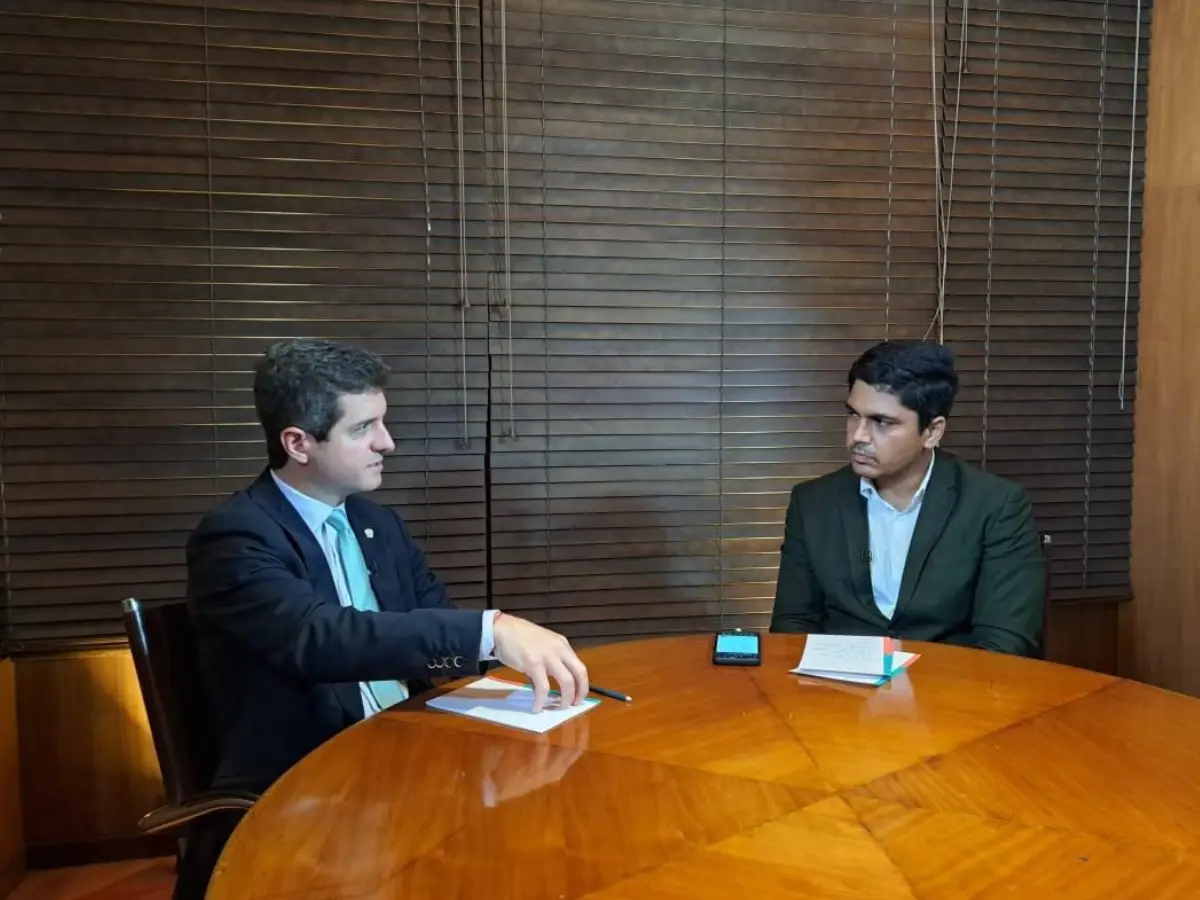
&imwidth=800&imheight=600&format=webp&quality=medium "We respect India's right to defend, says Panama on Pahalgam terror attack")
Panama's Vice Minister of Foreign Affairs, Carlos Arturo Hoyos, who is in India for key talks, has backed India's right to defend after the Pahalgam terror attack and emphasised the need to act on terrorism. Speaking to WION's Sidhant Sibal in Delhi, he said, "We fully respect India's right to protect itself and protect itself also means to deter other actors from thinking that they can commit such acts and then they will go unpunished". Panama is a non-permanent member of the UNSC and will be the President of the council starting Friday.
The minister, terming India a "close friend", hoped that India could establish an IIT in his country and join the Panama Canal Neutrality Treaty, which ensures that the Panama Canal remains neutral, open both in peacetime and wartime. During the Delhi visit, he met with the minister of state in the Ministry of External Affairs, Pabitra Margherita and held key UN talks with Secretary West Tanmaya Lal. Full interview:
Sidhant Sibal: How do you characterise the relationship between the two countries?
Carlos Arturo Hoyos: I think it's a fantastic relationship, a historical relationship that we are looking to strengthen, and we are looking for more closeness. We received a high-level parliamentary delegation led by His Excellency, Mr. Shashi Tharoor, and we had some Distinguished Members of Parliament with whom we engaged. We had a great conversation on how we can make our relationship more dynamic. In Panama, we have a very important, thriving Indian community. They are Panamanian Indians, in the second, third, and fourth generation, and they are people who create jobs, have big businesses, and as Panamanian citizens, are commercially, culturally, and politically active. So we are hoping to leverage pre-existing friendships to make sure that we take it to the next level. And what is the next level? I would say it is more political cohesiveness, it is more commercial relationship, is a mutual investment. We would certainly like to see more Indian companies come to Panama and invest and benefit from our great logistics hub. We are certainly at the centre of the American continent, and we have a lot to offer to the Indian community in general, but Indian businesses that I'm sure will be very attractive.

Sidhant Sibal: You also want India to join a certain protocol that is about the neutrality of the Panama Canal. So if you can perhaps explain about this certain protocol and as to how it benefits India as well, and as to how it benefits Panama
Carlos Arturo Hoyos: The Panama Canal is the crown jewel, the heart and soul of our country and the Neutrality Treaty, which has been enforced since 1977, when it was signed, is a very important international document that was initially signed between Panama and the United States. Both countries are committed to the treaty. At this period in time, when there are so many changes, we are looking to reiterate the importance and the strength of a neutral Panama Canal. India is certainly a global powerhouse, almost in every aspect, certainly a very important seafaring nation, so being both a big user of the Panama Canal, being a country with a lot of seafarers that go through the Panama Canal, we believe that India's joining the Panama Canal neutrality treaty would certainly strengthen the treaty. We have 40 countries that are members, and adding India, which is about 15% of the global population, would certainly be a good message internationally, obviously for the Panama Canal, but also for India. India is taking a step to perhaps look at an area that is geographically far away, but that is still strategically very important for Indian diplomacy and for Indian commerce.
Sidhant Sibal: Areas of collaboration, there are several. There's education, you are keen that there's an IIT in Panama, this pharma, and then there is, of course, areas like semiconductors. Perhaps you can sum it up as to how you see the areas of collaboration?
Trending Stories
)
US vs China over South China Sea: Washington backs Philippines, Beijing hits back
)
Bigg Boss 20: Isha Rikhi evicted after three weeks in Salman Khan’s show
)
Musk plans to more than double xAI's chips to over 1.2 million Nvidia GPUs by year-end
)
After JU, clash erupts at SRFTI: BJP’s ‘Dimagi Naxal’ jibe sparks political firestorm after students protest RSS-linked event
)
‘Anti-social elements spreading false rumours’: LPU issues statement amid massive unrest over alleged rape
)
LPU students go on rampage, vandalise campus amid widespread protest: What's happening
)
Trump asked Xi to pressure Iran. China did not say yes — here’s what Beijing wants
)
US Treasury Secretary Scott Bessent hails global crackdown on Iranian banks and airlines
)
An OpenAI agent escaped its locked test cage again, by hiding questions in DNS lookups
)
'Our video was trimmed': LPU girls who featured in rape-denial video make U-turn
)
3 males killed, four others injured in shooting after fight at strip club in Detroit
)
'Victory for low-budget consumers': Raghav Chadha hails 30-day telecom recharge rules
)
Claude rebuilt the 1989 game 'Prince of Persia' by reusing the original's own code
)
Beyond metros: How Tier-2 and Tier-3 cities could drive India’s next AI wave
)
Tesla builds first Cybertruck with its own refined lithium: Elon Musk's $1 billion Texas bet pays off
)
IndiGo flight suffers tail strike in Bengaluru while landing; DGCA to probe incident
)
The US and China set up an AI 'red telephone', but skipped the rulebook
)
‘Terror suspects arrested near UK air base were looking to do big damage’: Trump
)
Russian envoy claims US tactics to contain India were revealed in ‘Freudian slip’
)
IND vs WI 1st ODI: Kohli breaks Sachin's most runs in one country record with unbeaten 139 as India thump West Indies by 8 wickets
)
Researchers rebuilt exactly how 700 AI agents hacked Hugging Face: a 900-link chain trick
)
‘Olympic inclusion is our major target’: WPA President Ishaun Singh on pool’s global ambitions
)
Nations League: Spain sink England at Wembley; Modric shines for Croatia
)
Why has Iran released no proof of life of Mojtaba Khamenei? Araghchi reveals...
)
'What kind of confession is this?': Pakistan PM Shehbaz Sharif’s 'terrorists would be roaming New York' remark goes viral, raises alarm online. Watch
)
South Korea demands apology from Ukraine over North Korean prisoners' transfer
)
Beyond BrahMos: India targets Rs 50,000 crore in defence exports with unmatched price edge
)
Sri Lankan Tamil migrant worker gets death sentence in Saudi Arabia, help sought from India
)
Muslim marriage cannot shield sex with minor wife from prosecution under POCSO: Delhi HC
)
'Can't help but draw painful parallels to Nirbhaya case': SC on latest incidents of rape cases in Delhi-NCR
)
99.9% more powerful - Scientists find boy who can recall memories from just 3 months of age
)
'FIRST LOOK from inside Noah’s Ark': Researchers share video from inside mysterious mound in Turkey
)
UNSC reform momentum grows: Russia, Portugal, Mauritius push for India's permanent seat bid
)
8 US marines injured in Iranian missile attack on vessel in Strait of Hormuz: Report
&im=FitAndFill=(700,400))
New OTT releases this week (September 28-October 4, 2026): Dupahiya 2, Pooja Meri Jaan, Ohh My Dog- 5 titles coming on Netflix, Prime Video and more
)
Afghanistan says 28 fighters killed in clash near Pakistan border, Islamabad denies
)
Ceuta migrant crisis: Protesters take to streets as Spain grapples with migrant challenge
)
LPU suspend classes, postpones exams as violence escalates over rape claims: What's happening
)
New York City wants a 'kill switch' on every AI, and will pay whistleblowers who report violations
Carlos Arturo Hoyos: With IIT, often referred to as the MIT of Asia, what we are looking for is for them to have in the region a hub so that they can use Panama as the place where the international students of Latin America can go to study. Because of our connectivity, we have direct flights to almost every capital city in the Americas, and we would be the ideal place for a regional centre for studies. However, that looks, you need to think about Panama, not in the 4.5 million people that live there, but in the more than 400 people that have direct access to it with one single flight. So in that sense, education is a very strong part of our agenda. We are in the process of raising the level of our industrial ambitions and our industrial capacities. India certainly is one of the global leaders in this sense, and what we'd like to do is create a cycle where we have higher education that is aimed at high-level, industrial capabilities, services and intellectual property, which benefits from our logistics, both air, land and sea. Pharma can benefit from the three items that I mentioned, plus the fact that Panama has the most robust Free Trade Agreement structure in the entire American continent.
Sidhant Sibal: So, how do you plan to invite Indian businesses, and why should an Indian businessperson invest in your country?
Carlos Arturo Hoyos: So our president has been leading a very strong campaign since he took office on July 1, 2024, to reclaim Panama's position of goodwill, high status, and good reputation. That effort has been fruitful in our very recent exclusion from the EU list on the AML list. This is recognition of the strong political and technical work that has been going on with the President's Leadership and the idea or the ambition behind having this summit, which is being called the Davos of Latin America, organised by the Caf. And this year was the first year it was a massive success. Next year, our inaugural speaker will be President Lula da Silva, from Brazil, a fellow BRICS member.
Sidhant Sibal: How has your country supported India in the aftermath of the Pahalgam terror attack?
Carlos Arturo Hoyos: I think we were among the first countries to react. We issued a statement immediately condemning the attack, making sure that our position was very well established and very clear. We continue in this position wholeheartedly. We believe India is a close friend and should not be subject to any type of terrorist activities at all. In this case, it was particularly disturbing that the attacks happened to a group of people who were actually on their way to celebrate life. So our position continues to be one of full support. We commend India for showing such restraint, so as not to elevate the tensions and perhaps escalate the conflict of an already historically complex relationship.
In Panama, India is seen as a peace-loving, inclusive society, and it is also important that India shows that it accompanies that with humble strength, which is what we have seen. And I think that is very respectable. We fully support India's position in this sense that the attacks are completely heinous, and we will continue now in our presidency of the United Nations Security Council in the month of August. So this Friday, Panama will officially become president of the Security Council for a full month. And these subjects will obviously be part of the agenda, and we have to make sure that every country understands that it has our responsibility to take care of its territory, and to not foster this type of activity in any way, shape or form because it's unacceptable.
Sidhant Sibal: How has Panama supported India on Kashmir and supported India's right to defend?
Carlos Arturo Hoyos: We fully respect India's right to protect itself, and protecting itself also means to deter other actors from thinking that they can commit such acts and then they will go unpunished. The rule of law and respect for state and international law need to be accompanied by a reciprocal respect that is a basis of international relations.
Sidhant Sibal: Last question on this subject itself, what's your relationship with Pakistan? Because here in India, Pakistan is seen as an epicentre of terrorism, the country that has been involved in cross-border terrorism in India,
Carlos Arturo Hoyos: We have diplomatic relations with Pakistan. They are currently a member of the UN Security Council. We have a respectful relationship with them. We understand that it's a country that has gone through a lot of difficulties in terms of terrorism and groups that have been operating in its territory. So it is a very difficult challenge, and I believe the world should support any government action that Pakistan takes in order to eliminate these groups from operating within its borders. So hopefully they are on the same page as the rest of the world is with that, and that the tensions with its neighbours, and especially with India, don't escalate. We know that the issue is structural; it goes back to the partition. It goes back to why it is two countries where it used to be one. So we know that part, we can somehow empathise being Panamanians and Panama being a department of Colombia for a period of 80 years, how can there be some hard feelings that are lingering in time?
Sidhant Sibal: What are your key priorities as a UNSC non-permanent member? Your priorities as the president of the UNSC for the month of August? If you can give a general overview.
Carlos Arturo Hoyos: Our main subject, especially in the high-level session that will take place on August 11, is going to be on maritime security. So that is going to be the main concern, because of our position, because of the Panama Canal, the reliance of global trade on the Panama Canal, and we also have a big responsibility on other committees that we need to make sure are going. So, for example, Al Shabaab in Somalia, we currently preside over that committee, so we need to make sure that action is being taken. The same with the 1540 Committee, which is the Non-Proliferation Committee. This is a very important one that we're also co-penning, and in this committee, we need to make sure that all members, not just UN Security Council members, are aware of the importance of resolution 1540, and Non-Proliferation, non-financing.
Sidhant Sibal: And what's your view of the chance of the UNSC reforms? Because India has been very keen on UNSC reforms. It's the fifth-largest economy, the most populated country on the planet, but it's not at the high table. It's not a permanent member. So what's your stance on that?
Carlos Arturo Hoyos: I think India welcomed our Foreign Minister's remarks when the high-level parliamentary delegation went to visited, that Panama would support the inclusion of India as a permanent member in the UN Security Council. The United Nations is turning 80 years old now, so it's probably time for honest introspection by all the members, and an important figure, for example, is that the United Nations has 3600 mandates. Now these mandates probably overlap and overstep into each other, so the UN has to be able to evolve like any institution, to make up for or take into account the current global situations. And I believe India's case for being a permanent member is quite clear. Apart from what you mentioned, he is a very well-respected member of the international community. It's a leader in many respects, and not in the least in a political respect. It's a great moment for Indian leadership in the world. You have a prime minister who is widely regarded as a great figure and as a great leader.
Sidhant Sibal: You have 15,000 people who are of Indian origin, Indian diaspora, which is the largest in the Central American region. So, if you can perhaps give a slight overview, a sense of how the Indians have been part of Panama society.
Carlos Arturo Hoyos: So, Panama has been a place of transit for hundreds of years. If you go back even to the colonial times, it was a place of transit between the gold mines in Peru, then to Panama, and then to Spain, and obviously, people from Spain and from the Caribbean and the colonies down to the new colonies in the south. The Indian diaspora, which, as you said, numbers 15,000 and it's quite active, has been successful on all fronts. They are very proactive in the business community. They are very proactive religiously. They are cultural reminders of their ancestral home, so that part, they keep alive, and we enjoy quite a lot. I was joking with the ambassador that the best samosas in the world are not made in India, but in Panama by Panamanian Indians.

