
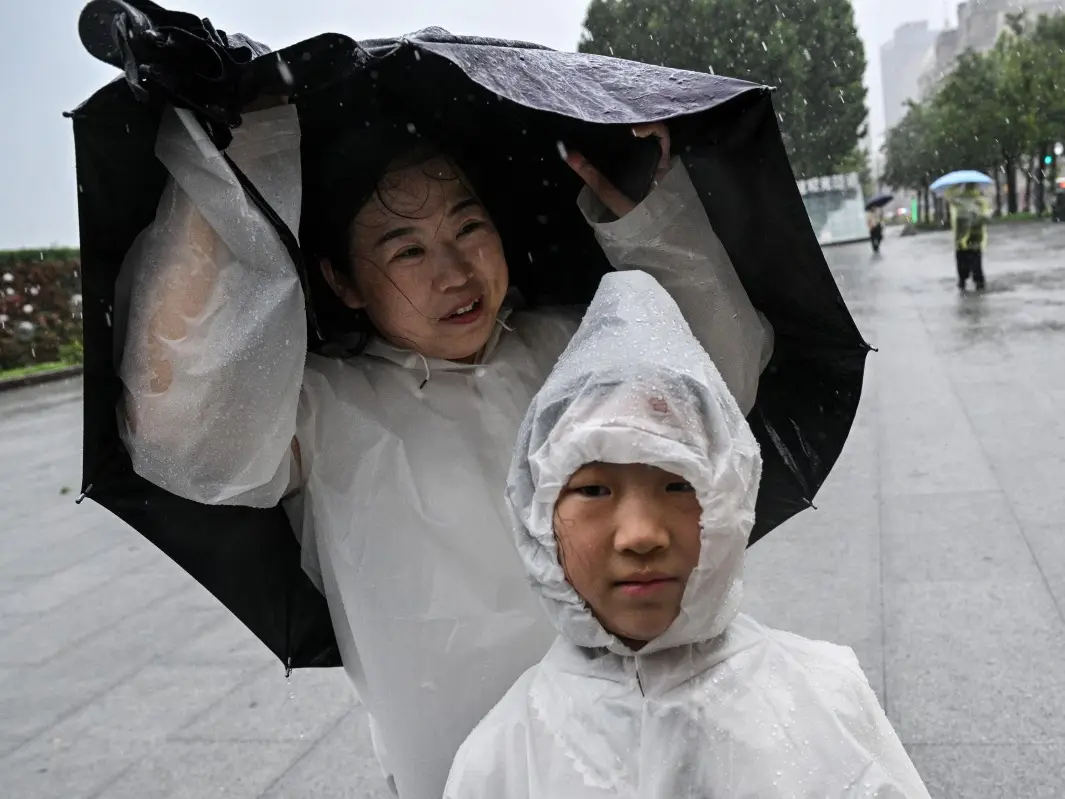
&imwidth=800&imheight=600&format=webp&quality=medium "Typhoon Dolphin: Beijing braces for record rainfall; high risk of floods and landslides")
Beijing is bracing for an extraordinary spell of rainfall, with Typhoon Dolphin expected to bring more than one-third of the capital’s average annual precipitation in just 24 hours as the powerful storm moves deeper inland. From Tuesday evening through Thursday, most parts of Beijing are forecast to receive heavy rainfall, with cumulative precipitation expected to exceed 150mm within a 24-hour period. Beijing receives an average of about 528mm of rainfall annually, with most of it typically recorded between June and September.
The intense weather has prompted authorities to step up emergency preparations, close tourist attractions and suspend high-risk construction activities. Four districts on the outskirts of Beijing have activated the highest, level-one emergency flood response. In mountainous Mentougou district in western Beijing, authorities issued the highest flood emergency alert on Tuesday and urged residents to remain indoors unless necessary. People have also been advised to avoid travelling to mountainous areas and locations near rivers because of the heightened risk of flooding and landslides.
Typhoon Dolphin brings widespread disruption across China

Typhoon Dolphin, described as the strongest typhoon to hit China this year, has proved unusually resilient as it travels inland. The storm travelled nearly 6,000km (3,728 miles) before making landfall over the weekend, affecting China's eastern coast before pushing inland with a vast cloud field and large amounts of moisture. More than one million people were moved to safer locations across eastern China over the weekend as authorities prepared for torrential rainfall, flooding and landslides.
In Wenzhou, a coastal city in Zhejiang province, more than 900,000 people were relocated and over 1,500 emergency shelters were opened. In neighbouring Fujian province, around 98,900 people were moved to safety. Shanghai authorities also relocated 215,600 people from areas considered vulnerable to the storm by Sunday evening. The storm has caused widespread disruption, with flooding reported in several areas and tourist attractions and infrastructure projects being temporarily shut.
Hubei faces heavy rain and flood risk
Trending Stories
)
Mushtaq Khan dies at 56: When Welcome actor opened up about his salary for iconic role Ballu
)
Pakistan deploys over 20,000 security personnel as PTI vows march for Imran Khan's release
)
'Making history': Xi Jinping praises Trump as US-China leaders dine at White House
)
‘Not just a local tragedy’: Nepal PM Shah warns UN of growing climate threat, says Nepal floods were 'a warning to the world'
)
Heart of the Beast review: Brad Pitt leads a gripping tale of survival and loyalty
)
Gaza's war turned environmental damage into second crisis
)
WATCH | As Shehbaz Sharif claims Pakistan’s ‘victory’ during 2025 conflict, Indian diplomat R Srinivas laughs at UN
)
Did Hitler kill his niece Geli Raubal? Newly found records reopen a 95-year-old mystery
)
India's UN Envoy slams Pakistan: 'They claim security by day, terrorism by night'
)
'A terrorist country is asking me that question?': Jaishankar hits back at Pakistani journalist at UN; flags attacks on commercial shipping
)
US Supreme Court backs Trump administration's use of SAVE database to check voter citizenship
)
Scientists detect first radio signals directly from faraway planet
)
Yemen's war escalates: Saudi-backed leader calls for general mobilisation against the Houthis
)
Asian Games: Shooting spree continues as India win silver in women’s 50m rifle 3P team event
)
OpenAI AI Agents hacked 4 websites before Hugging Face, researchers reveal
)
Tesla is preparing something big for Optimus: new Gen 3 models surface in app
)
Cindy Crawford’s son Presley Gerber cremated as death probe continues
)
Bias or safety concerns? Bengaluru CEO says firm will not hire men from UP, Bihar, Rajasthan, MP. Here's why
)
Indian diplomat Petal Gahlot raises deteriorating situation in Pakistan-occupied Kashmir in right of reply at UN
)
10,000 gather in support of 87-year-old forcefully evicted from home of 71 years
)
US court backs Pentagon's decision to exclude Anthropic over Claude AI restrictions
)
Pentagon quietly adds 37 wounded troops to Iran war tally without explaining when or how
)
India's insurance regulator overhauls policies
)
Red Sea crisis: Houthis promise not to target European ships; UNSC condemns Saudi attacks
)
Saudi oil exports surge despite Iran war
)
'FIRST LOOK from inside Noah’s Ark': Researchers share video from inside mysterious mound in Turkey
&im=FitAndFill=(700,400))
New Friday OTT releases (September 25, 2026): Don’t Be Shy, Hunkkaar: The Roar, Mango Pachcha- 6 movies and TV shows on Netflix, Prime Video and more
)
Trump rejects Iran's 7-day ceasefire proposal as US weighs renewed bombing after midterms: Report
)
Myanmar training camp case: US national, 6 Ukrainians allowed to meet their families abroad
)
Nigeria Navy moves to boost oil security, tackle crude theft and infrastructure threats
)
‘Attack on Mecca a red line for Pakistan’: Shehbaz Sharif warns Houthis at UN
)
Asian Games 2026: India women’s kabaddi team edge Iran 37-34 to clinch 3rd gold medal
)
Trump-Xi summit wrap: Big pageantry, Iran talks, few major developments and more meetings planned
)
Saudi Arabia still harbours intent to develop nuclear weapons, reveals US intelligence: Report
)
‘Goal is to win it’: Virat Kohli confirms 2027 ODI World Cup will be his final tournament for India
)
‘It is all possible’: Putin weighs next steps on Ukraine talks, rules out Europe conflict
)
Jay-Z rape case: Accuser says allegations were false, never met rapper
)
Outrage erupts after 3-year-old is married to 60-year-old man in Pakistan, link to her sister's murder being probed
By early Tuesday, Dolphin had moved over Hubei province in central China, a major hub for automobile and high-tech electronics manufacturing with a population of more than 58 million. China’s National Meteorological Center renewed an orange alert for heavy rain on Tuesday, the country's second-highest warning level. Northwestern Hubei was expected to receive as much as 250mm of rainfall within 24 hours, increasing the risk of flash floods and landslides.
Authorities issued yellow warnings for cities including Xiangyang, Huanggang and Suizhou. The extreme weather has also affected tourism and infrastructure. Several scenic areas across Hubei announced temporary closures, including the popular Three Gorges Dam tourist area in Yichang. Of 107 major highway and waterway construction projects underway across the province, 26 high-risk projects have been suspended as a precaution. In Xiangyang, 57 of 59 tourist sites were reportedly closed as heavy rainfall caused flooding and disrupted transport. Authorities have also relocated thousands of residents as rivers and reservoirs came under increasing pressure.
Henan also on alert
Neighbouring Henan province is also facing an increased threat from the storm as Dolphin channels moisture further north. Authorities have issued flash-flood warnings, with heavy rainfall raising concerns about flooding, landslides and disruption to transport and daily life. The continued movement of Dolphin's moisture plume means areas far from the storm's original landfall zone could experience dangerous rainfall.
Why is Beijing at such high risk?
Beijing's location and surrounding mountainous terrain make the city particularly vulnerable to flash flooding and landslides during periods of intense rainfall. The expected rainfall is especially significant because more than 150mm could fall within just 24 hours, a substantial share of the capital's typical annual precipitation. Authorities have therefore focused on keeping residents away from vulnerable mountain and river areas while preparing drainage and flood-control systems. The latest warnings come after Beijing was already hit by heavy rainfall earlier in August, raising concerns about saturated ground and the potential for additional flooding and landslides.
Japan prepares for Typhoon Chan-hom
China is not the only country facing severe weather. Japan is also preparing for heavy rain, strong winds, flooding and landslides as Typhoon Chan-hom approaches the country. The Japan Meteorological Agency has warned that the storm could move across Japan's mainland, raising the risk of further disruption. Chan-hom was tracking towards Japan on Tuesday, with forecasts indicating that the system could bring dangerous weather conditions as it moves closer to the country's populated areas.

