Trump’s push for Muslim nations to join Abraham Accords puts Pakistan in a fix

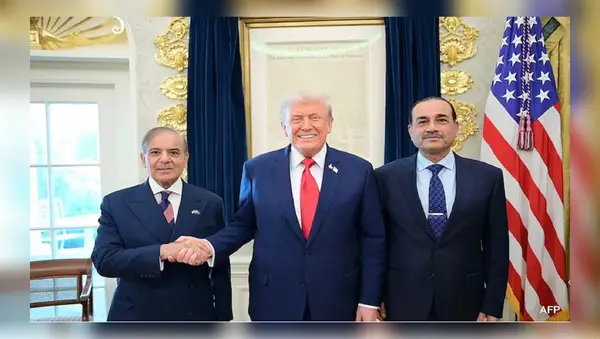
President Donald Trump’s push puts Pakistan Army chief Asim Munir and Prime Minister Shehbaz Sharif in a difficult spot. Photograph: (AFP)
President Donald Trump said that countries involved in the discussions should be mandatory signatories to the Abraham Accords if a peace settlement with Iran is achieved. Trump said it should start with the immediate signing by Saudi Arabia and Qatar, and everybody else should follow suit.
US President Donald Trump has intensified pressure on Muslim-majority nations, including Pakistan, to join the Abraham Accords, linking the future of a potential peace agreement with Tehran to a big diplomatic reshaping across the Middle East.
In a lengthy Truth Social post on Monday, Trump said that the ongoing negotiations with Iran were “proceeding nicely” but warned that failure to reach a deal could send the region back to the “battlefront and shooting, but bigger and stronger than ever before.”
Trump’s push came during a phone call with leaders from Muslim countries, including Saudi Crown Prince Mohammed bin Salman, UAE President Mohammed bin Zayed Al Nahyan, Qatar’s Emir Tamim bin Hamad Al Thani, Pakistan Army chief Field Marshal Asim Munir, Turkish President Recep Tayyip Erdogan, Egyptian President Abdel Fattah el-Sisi, Jordan’s King Abdullah II and Bahrain’s King Hamad bin Isa Al Khalifa.
Nations involved in peace talks should be ‘mandatory signatories,’ says Trump
Trump told the leaders that countries involved in the discussions “should be mandatory” signatories to the Abraham Accords if a peace settlement with Iran is achieved. He added that the Abraham Accords had delivered a “Financial, Economic, and Social BOOM” for countries already involved, including the UAE, Bahrain, Morocco, Sudan and Kazakhstan.
Trending Stories
&imwidth=280&imheight=210&format=webp&quality=medium)
&imwidth=280&imheight=210&format=webp&quality=medium)
&imwidth=280&imheight=210&format=webp&quality=medium)
&imwidth=280&imheight=210&format=webp&quality=medium)
&imwidth=280&imheight=210&format=webp&quality=medium)
&imwidth=280&imheight=210&format=webp&quality=medium)
&imwidth=280&imheight=210&format=webp&quality=medium)
&imwidth=280&imheight=210&format=webp&quality=medium)
&imwidth=280&imheight=210&format=webp&quality=medium)
&imwidth=280&imheight=210&format=webp&quality=medium)
&imwidth=280&imheight=210&format=webp&quality=medium)
&imwidth=280&imheight=210&format=webp&quality=medium)
&imwidth=280&imheight=210&format=webp&quality=medium)
&imwidth=280&imheight=210&format=webp&quality=medium)
&imwidth=280&imheight=210&format=webp&quality=medium)
&imwidth=280&imheight=210&format=webp&quality=medium)
&imwidth=280&imheight=210&format=webp&quality=medium)
&imwidth=280&imheight=210&format=webp&quality=medium)
&imwidth=280&imheight=210&format=webp&quality=medium)
&imwidth=280&imheight=210&format=webp&quality=medium)
&imwidth=280&imheight=210&format=webp&quality=medium)
&imwidth=280&imheight=210&format=webp&quality=medium)
&im=FitAndFill=(700,400)&imwidth=280&imheight=210&format=webp&quality=medium)
&imwidth=280&imheight=210&format=webp&quality=medium)
&imwidth=280&imheight=210&format=webp&quality=medium)
&imwidth=280&imheight=210&format=webp&quality=medium)
&imwidth=280&imheight=210&format=webp&quality=medium)
&im=FitAndFill=(700,400)&imwidth=280&imheight=210&format=webp&quality=medium)
&imwidth=280&imheight=210&format=webp&quality=medium)
&imwidth=280&imheight=210&format=webp&quality=medium)
&imwidth=280&imheight=210&format=webp&quality=medium)
&im=FitAndFill=(700,400)&imwidth=280&imheight=210&format=webp&quality=medium)
&imwidth=280&imheight=210&format=webp&quality=medium)
&imwidth=280&imheight=210&format=webp&quality=medium)
Trump said that the agreements could bring “true Power, Strength, and Peace to the Middle East for the first time in 5,000 years”.
“It should start with the immediate signing by Saudi Arabia and Qatar, and everybody else should follow suit,” Trump wrote.
Also Read: Iran demands urgent release of $12 billion frozen in Qatar before advancing peace talks with US
He said Iran should also become part of the agreement if it finalises a peace deal with Washington.
The Abraham Accords, signed in 2020, normalised diplomatic ties between Israel and several Arab nations, but Saudi Arabia, Qatar and Pakistan avoided formal recognition of Israel.
Trump’s push is aimed at turning Iran peace deal into a Middle East realignment, one that could pull regional powers into a new US-backed order highly beneficial to Israel.
Trump catches all leaders off guard
Trump’s proposal was met with silence from several leaders, reported Axios. Leaders from Saudi Arabia, Qatar and Pakistan who do not have formal diplomatic relations with Israel were caught off guard.
“One of the US officials said Trump joked and asked if they were still there,” Axios reported.
Iran’s inclusion in any such framework, though highly unlikely, would mark an even more dramatic shift given Tehran’s long-running conflict with Israel.
Why Pakistan finds itself in a tight spot
Trump’s push creates a huge challenge for Pakistan, since it is wilfully playing the mediator and is basking in the glory of its new role.
Moreover, Pakistan also maintains deep economic, military and political ties with Gulf monarchies that are increasingly engaging with Israel under US pressure. Pakistan has also been wary of domestic backlash on joining the accords and hence this paradox puts Islamabad in an uncomfortable position.
Furthermore, Pakistan’s dependence on Gulf financial assistance, remittances and security cooperation will only intensify the pressure on it if they join.
However, any recognition of Israel risks provoking strong opposition from religious groups at home.
In 2025, Pakistan’s foreign minister Ishaq Dar firmly rejected speculation that Islamabad could join the accords. “We are not ready to recognise Israel until the two-state solution to the Palestine conflict is accepted,” Dar said.
“There is no change in our stated policy on the Palestine issue.”
Trump’s push puts Pakistan Army chief Asim Munir and Prime Minister Shehbaz Sharif in a difficult spot as they will have to balance growing US pressure with the deeply sensitive public stance on Palestine at home.
Trump’s demand is not something Pakistan had hoped for as payback after playing peacemaker between Iran and the US.