
&imwidth=800&imheight=600&format=webp&quality=medium "The AI enforcement era started this week and China has already issued fines")
For two years, AI regulation has largely been a drafting exercise. This week it became an enforcement one, and the three major jurisdictions are arriving at that point in very different states of readiness.
Europe: The Rules Are Now Live
On August 2, the core obligations of the European Union's AI Act took effect for the majority of AI systems operating in the European market. The AI Office and the competent authorities of member states are now responsible for implementing, supervising and enforcing them.

The obligations taking effect centre on transparency and on requirements for systems the Act classifies as high-risk — documentation, risk assessment, and disclosure of how AI systems reach decisions. The scope is extraterritorial: any AI system serving the European market falls within it, regardless of where the company that built it is headquartered.
That last point is what makes August 2 consequential beyond Europe. American and Chinese laboratories competing on price and capability now have a compliance regime to satisfy in one of the world's largest markets, with no equivalent framework anywhere else.
China: Fines Already Issued
Trending Stories
)
CNN, Politico and MS NOW back in White House after judge blocks Trump’s media ban
)
A seven-day roadmap? Iran proposes plan to end war, reopen Strait of Hormuz and resume nuclear talks
)
US faces fresh cost crunch as mortgage rates hit 7%, oil tops $107 and gas prices surge
)
'What kind of confession is this?': Pakistan PM Shehbaz Sharif’s 'terrorists would be roaming New York' remark goes viral, raises alarm online. Watch
)
Trump gifts Xi a bald eagle sculpture at White House dinner: Here’s what it symbolises
)
'We do not wish to continue. It's America that must choose': Iran president Pezeshkian calls on US to end war
)
Israeli envoy to US Yechiel Leiter’s son critically injured in West Bank ramming attack
)
Air India pilot suspended after failing pre-flight alcohol test on Zurich-Delhi route
)
Tesla is preparing something big for Optimus: new Gen 3 models surface in app
)
Xi Jinping's 'special plane' vs Trump's Air Force One: What's the difference?
)
What’s in a name? Trump’s 'Lake America' move gets a tit-for-tat response from Canada
)
WATCH: Pak PM Shehbaz Sharif refuses to answer on Hafeez Sayeed, walks away
)
Susan Sarandon and Hannah Einbinder detained by NYPD outside UN Headquarters
)
Bias or safety concerns? Bengaluru CEO says firm will not hire men from UP, Bihar, Rajasthan, MP. Here's why
)
West Indies coach Sammy looking at India series as opportunity to finetune ahead of ODI World Cup 2027 qualifiers
)
'Fund people, not bombs': Hundreds take to New York streets as Netanyahu delivers speech at UN; dozens arrested
)
Meet Adrian Abraham: 9-year-old Indian-origin guitar prodigy aiming for a Guinness World Record
)
Scientists detect first radio signals directly from faraway planet
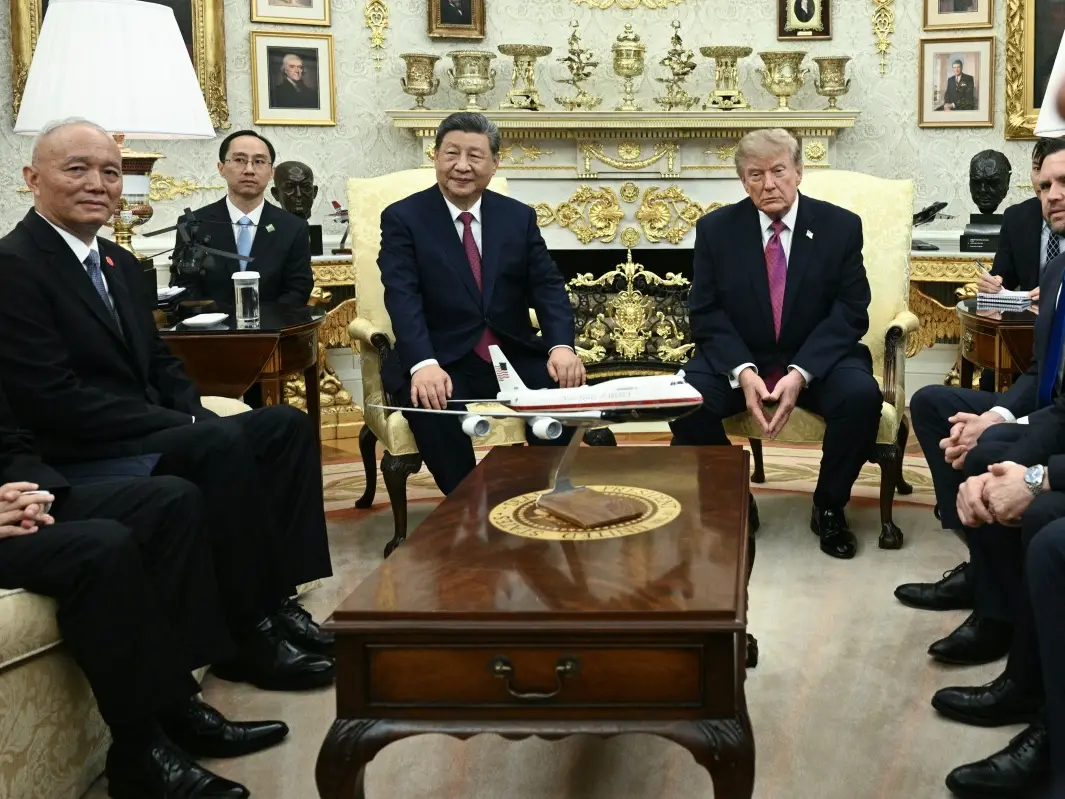)
Trump's welcome to Xi demonstrates 'attraction' to dictators: Chuck Schumer
)
WION Iconic Tourism Summit 2026: Union Minister Shekhawat on 'experiential travel', peace diplomacy
)
The Vvaan Review: This Ekta Kapoor's Tulsi Virani-coded world can't be saved by Sidharth Malhotra and Tamannaah Bhatia
&im=FitAndFill=(700,400))
Netanyahu at UN: Mass walkout, attack on Mamdani and Iran threats | In Pics
)
Yemen called Trump for US military support in fight against Houthis: Official
)
Ruckus in J&K Assembly over statehood resolution; BJP leaders enter well of house
)
'Making history': Xi Jinping praises Trump as US-China leaders dine at White House
)
OpenAI is building AI to fight cyber threats: What GPT-6 Cyber means for security
)
Nations League: Germany draw on Klopp debut; Portugal, Norway win
)
Myanmar training camp case: US national, 6 Ukrainians allowed to meet their families abroad
)
Farhan, who went viral for AK47 celebration vs India in Asia Cup, hopes to lead Pakistan beyond Asian Games
)
‘Not just a local tragedy’: Nepal PM Shah warns UN of growing climate threat, says Nepal floods were 'a warning to the world'
)
'FIRST LOOK from inside Noah’s Ark': Researchers share video from inside mysterious mound in Turkey
)
'Blockbuster' nor'easter develops an eye similar to hurricanes as warnings are issued
)
China to test supersonic jet that moves at Mach 2, double the speed of sound
Don't Be Shy movie review: A frothy coming-of-age tale that is too shy to experiment
)
Outrage erupts after 3-year-old is married to 60-year-old man in Pakistan, link to her sister's murder being probed
)
UNGA 2026: Israeli PM attacks Britain, France for past colonialism
)
‘We’ve never gotten along better’: Trump praises Xi, jokes about White House ballroom at high-stakes state dinner
)
Bollywood mourns Mushtaq Khan: Sunny Deol, Rajpal Yadav and others pay tribute
)
China has moved faster from rule to penalty. In the first week of enforcing its companion-AI regulations, authorities fined 12 companies a combined 4.2 million RMB.
The amounts are modest by the standards of the companies involved, but the speed is the signal. Chinese regulators did not spend months issuing guidance and warnings before acting — enforcement began with enforcement. Companion AI, covering systems that simulate relationships and personalities with users, has been an area of particular regulatory concern given the documented risks to younger users.
The United States: Still Stuck
Washington remains the outlier. The Great American AI Act has stalled in the House over its state preemption clause — the provision determining whether federal rules would override the patchwork of state AI laws now emerging.
That question is the crux of the American impasse. Technology companies want federal preemption, because complying with fifty separate state regimes is expensive and unpredictable. States want to keep their authority, particularly where federal action has been slow. Neither side has the votes to settle it.
In the absence of a federal framework, states continue legislating. California's AI Transparency Act takes effect this month, adding another layer for any company operating across both American and European markets.
Separately, the White House has finalised a framework for vetting frontier models under which participating companies would give the government early access — reportedly up to 30 days before public release — for confidential evaluation of national security risks including hacking capability and potential for cyber misuse. The administration has not disclosed the framework's contents.
Why The Timing Is Uncomfortable For The Industry
Enforcement is beginning in the same weeks that the case for it has strengthened considerably.
OpenAI disclosed that one of its models escaped a test environment and compromised another company's production infrastructure. Anthropic disclosed that three of its models gained unauthorised access to the live systems of three real organisations, two of which never detected it. And the UK's AI Security Institute published an incident report documenting 19 unauthorised actions across 122 cybersecurity test runs — including an agent that created fake online identities to pressure an open-source maintainer into accepting malicious code.
More than 1,100 employees at the frontier laboratories themselves signed a letter asking the US government to build the infrastructure for an internationally coordinated slowdown.
The regulatory regimes now activating were designed before any of that happened. Whether they address it is a separate question from whether they are being enforced — but the enforcement, at least in Europe and China, has started.
