Explained : How Yemen's Houthi rebels became America's 'terrorists' once again

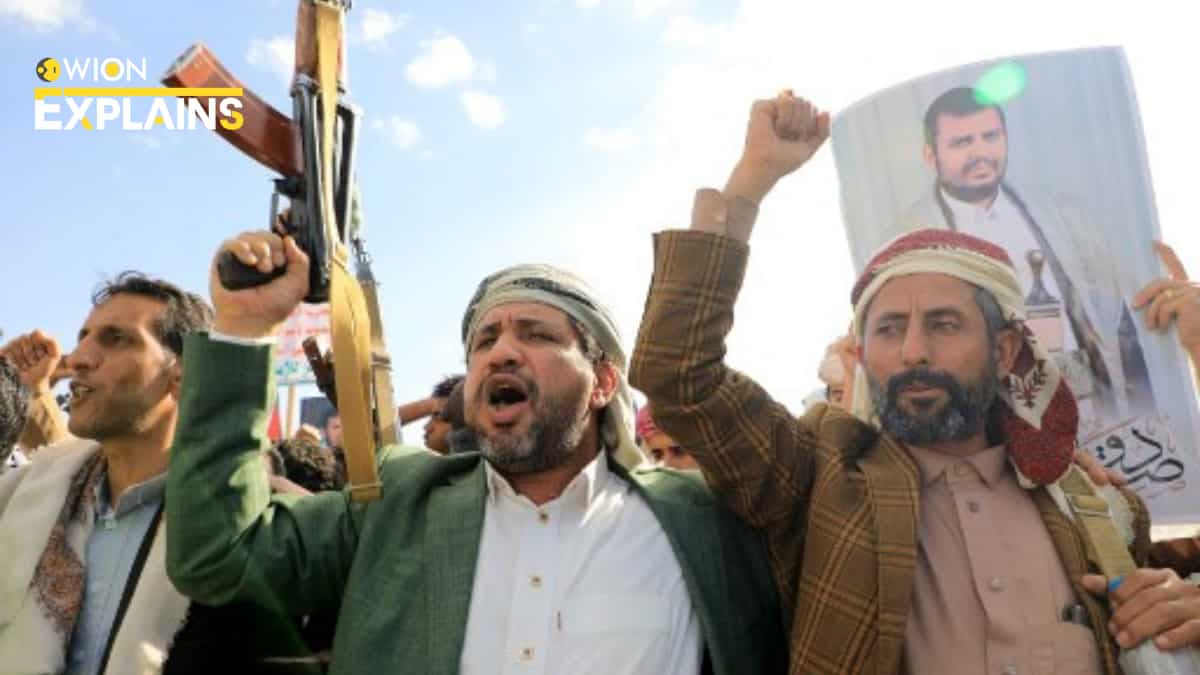
Yemeni men brandish their weapons and hold up portraits of Houthi leader Abdul Malik al-Houthi
The United States on Wednesday (Jan 17) re-listed Yemen's Houthis, an Iran-backed group comprising individuals of the Zaydi sect within Shi'ite Islam, as a specially designated global terrorist group.The White House cited "unprecedented attacks against United States military forces and international maritime vessels operating in the Red Sea and the Gulf of Aden", one of the world's most crucial shipping routes for global trade.
Yemen's Houthi rebels, who control most of the country's north as well as the strategically valuable Bab al-Mandeb Strait, vowed in November 2023 that they would target Israel-linked ships in the Red Sea in response to Israeli military operations in Gaza.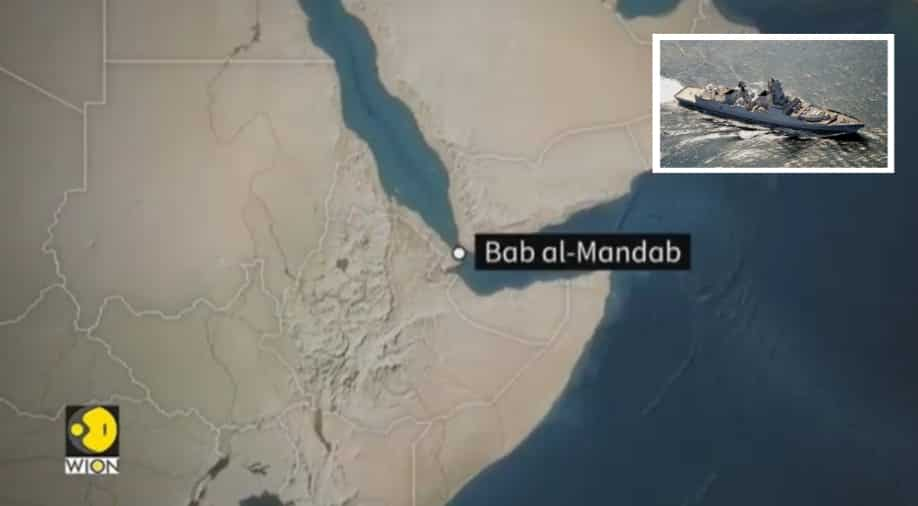
However, the United States claims that ships linked to 55 states worldwide have been attacked as of Jan 15, 2024.

Situation in Yemen: Between January 2021 and April 2022
Originally known as Ansar Allah (Partisans of God), the US designated Houthis as a Foreign Terrorist Organization (FTO) and as a Specially Designated Global Terrorist (SDGT) on January 10, 2021, during the last few days of the Trump administration. The group had been in a years-long civil war with the internationally recognised Saudi-backed Yemeni government that led to an unprecedented humanitarian crisis in the region.
Also read |Red Sea ship attacks: Inside disrupted shipping route through West Asia's 'gate of tears'
)
No Pandya as Auqib Nabi earns maiden ODI call-up; Mayank returns for WI T20Is| check full squads
)
Chiefs tight end Travis Kelce named one of the victims in $35 million ponzi scheme
)
Trump praises India’s Opium crackdown, hails anti-drug efforts
)
Sydney Sweeney defends provocative ad choice, the internet is still not impressed
)
Former India player Diana Edulji wants Smriti Mandhana to replace Harman as skipper at the earliest
)
Trump calls Canada-EU associate membership plan ‘laughable’ and threatens 'very serious tariffs'
)
Protests erupt over migrant housing plan in Piddington
)
Shahzad Bhatti Network declared terrorist organisation under UAPA: Govt order
)
Europe wants a common playbook for security threats, seeks security beyond NATO
)
Formula One reveals the 2027 race calendar; Monaco to host sprint race for the first time
)
All Indian goods to get duty-free access to New Zealand
)
Bigg Boss 20: Mahhi Vij reveals she lost Yuva role to Kareena Kapoor; 'didn’t work out in my favour'
)
Lionel Messi for 2026 Ballon d’Or over Mbappe and Yamal, says Diego Simeone
)
US House votes 417-3 to pass Ratepayer Protection Act targeting AI data center electricity costs
)
Hong Kong unveils 11 new measures to boost birth rates, offers higher cash bonuses and housing perks
)
Former OpenAI researcher warns of growing risks from Artificial Intelligence
)
Veteran actor Anant Nag honoured with Indian cinema’s highest award
)
AUS vs SA: Steve Smith still gets 'little flashbacks' from sandpaper gate
)
Pakistan naval vessel returns to harbour with 'severe damage' after collision with Indian warship in Arabian Sea
)
Fed raises rates for first time in 3 years, Kevin Warsh defies Trump as inflation mounts
)
Katrina Kaif’s postpartum weight is not the problem; your gaze is
)
Taiwan seeks deeper India ties as direct flights restart soon and chip projects advance
)
Daayra movie review: Kareena Kapoor, Prithviraj Sukumaran shine in Meghna Gulzar’s cop-versus-cop crime thriller
)
Saudi Vs Houthis: Yemeni military rebels clash with Houthis
)
Pak batter Rizwan's petition against being questioned by cyber crime agency rejected by court
)
US trade tariff: 100% tariff targets Russian buyers amid trade tensions
)
Pakistan: Imran Khan's sons Kasim & Sulaiman claim their father is 'tortured' in jail
&im=FitAndFill=(700,400))
New OTT releases this week (September 14-20, 2026): Lust Stories 3, Waiting Hai, Irumudi- 5 new titles coming on Netflix, Prime Video and more
)
Trump gets new power to hit India, China with up to 100% tariffs as US Senate clears Russia sanctions bill
)
Prime Minister Narendra Modi's birthday: Italian PM Meloni sends birthday wishes
)
‘Imagine 50 AI fighters cornering one manned jet’: India’s mobbing doctrine eyes a new era of air warm
)
Saudi vs Houthis: Riyadh claims to have shot Houthi drone targeting Mecca
)
US Treasury rallies global financial institutions for Op Economic Outcast to isolate Iran
)
India breaks silence on US Russia sanctions bill, 100% tariff threat: ‘Committed to energy security’ for 1.4 billion
)
Pakistan boycotts chess match against Israel at Olympiad
)
Want to get married within a year? Why 18 lakh people rush to Jaipur for ‘sacred henna’
&im=FitAndFill=(700,400))
Suriya and Jyothika say ‘I do’ again after 20 years! See their dreamy wedding pics
)
Abhishek Sharma rises to No. 2 in T20Is; ENG’s Robinson 3rd after record Pakistan Tests
)
The Early Spring season 2 is happening, but fans have one request - 'don't change the actors'
A little more than a month later in February 2021, the US State Department under President Joe Biden, citing the need to facilitate aid delivery into Yemen, removed the SDGT designation and also de-listed Foreign Terrorist Organization (FTO) status for the Houthis.
Between February 2021 and April 2022, the Houthis continued to expand their territorial hold in Yemen amid failed efforts by the UN and US envoys to engineer a truce.

A Satellite view of West Asia | GoogleEarth
The de-listing of Houthis as "terrorists" in February 2021 occurred owing to the pressure the Biden administration faced as Houthis disallowed any aid from reaching Yemen's people, said Kabir Taneja, Fellow, Strategic Studies Programme at Observer Research Foundation.
"This also helped Saudis, who are in open negotiations with the Houthis after being at war with them since 2015," Taneja added.
In April 2022, the internationally-recognised Yemeni President Abdrabbuh Mansur Hadi ceded power to a presidential council, and a truce was agreed upon.
This truce, although fragile, continues to hold to date amid signs of its sustenance with successful prisoner exchangeeffortsbetween the two warring sides.
Israel-Hamas war: Why Houthis have been re-listed as 'terrorists' by the US?
On January 17, 2024, the White House designated Houthis as a 'Specially Designated Global Terrorist' (SDGT) entity.
Hours before the above development, Taneja described such occurrence as a "direct consequence of the campaign of Houthis against international shipping in the Red Sea".
The attack by Houthis on merchant shipping vesselson the Red Sea shipping route— the passage to 12 per cent of the world's ship-borne trade— has increased shipping costs by up to 60 per cent for the goods destined for Europe from Asia, according to Container xChange, an online container logistics platform for container trading and container leasing.
Implications for the region
The truce brokered in April 2022 between warring parties in the Yemeni civil war was engineered following years of Saudi-led negotiations.
"The Houthis have been involved in substantive negotiations with Saudi Arabia, a US ally, over a Saudi withdrawal from Yemen, which the US supports. That wouldn't be a good time to make such a designation," said Joost R. Hiltermann, Program Director, Middle East and North Africa at International Crisis Group.
"From our perspective, such designations are counter-productive, also because there is no commonly accepted definition of 'terrorist organisation', a highly politicised term," Hiltermann added.
Houthis have grown into the most powerful war machine in Yemen whose threat to the shipping lanes in the Red Sea has forced the United States to form a multinational naval task force to counter them.
"The Biden administration had no intention of making such a designation lightly against any group, without a provocation,"Hiltermann said.
How powerful are Houthis: Challenges and Asymmetry
Weeks before the October 7 attack by Hamas on southern Israel that pushed the region to the worst state of war in decades, the Houthis on September 21 held a parade in Yemeni capital Sana'a. The parade showed weapon systems in the hands of an irregular army.
There were Mi-8 transportation helicopters as well as the Malah boats, often deployed to lay mines in the sea.
Houthis are now attacking these shipping lanes with the naval mines and airpower they have acquired over the years.
Some other weapons systems the Houthis haveinclude the Fledermaus Radar, surface-to-air missiles, improvised armour, and T-55 tanks.
The Houthis also have Tochka ballistic missiles and F-5 supersonic light fighter aircraft. There also are Iranian-origin Hatem/Khaybar Shekan and Badr-4 ballistic missiles.
They also have passive infrared tracking systems, drones, loitering munitions, and Iran-origin Shahab 3/Ghadr missiles, besides an unspecified but large number of Raqeeb UAVs, which can have a range of up to 1,400 km.
Such vast expansion of Houthis' capacities, as shown by their arsenal,characterisesIran's support for the movement. Tehran looks at the Houthis, a revivalist Shia movement, as a wider part of its resistance against the US and Israel.
"Houthis have benefited from structural and institutional support from Iran. This has allowed them to gain capacities ranging from ballistic and anti-ship missiles to underwater weapons and drones. Without Iranian help, all this would not be possible," Taneja said.
Note: The story has been updated to reflect the asymmetric security challenge posed by Houthis in West Asia.