
&imwidth=800&imheight=600&format=webp&quality=medium "Nepal’s 'Bangladesh-Sri Lanka' deja vu: Three neighbours, three fallen govts — How political turmoil engulfed India’s neighbourhood")
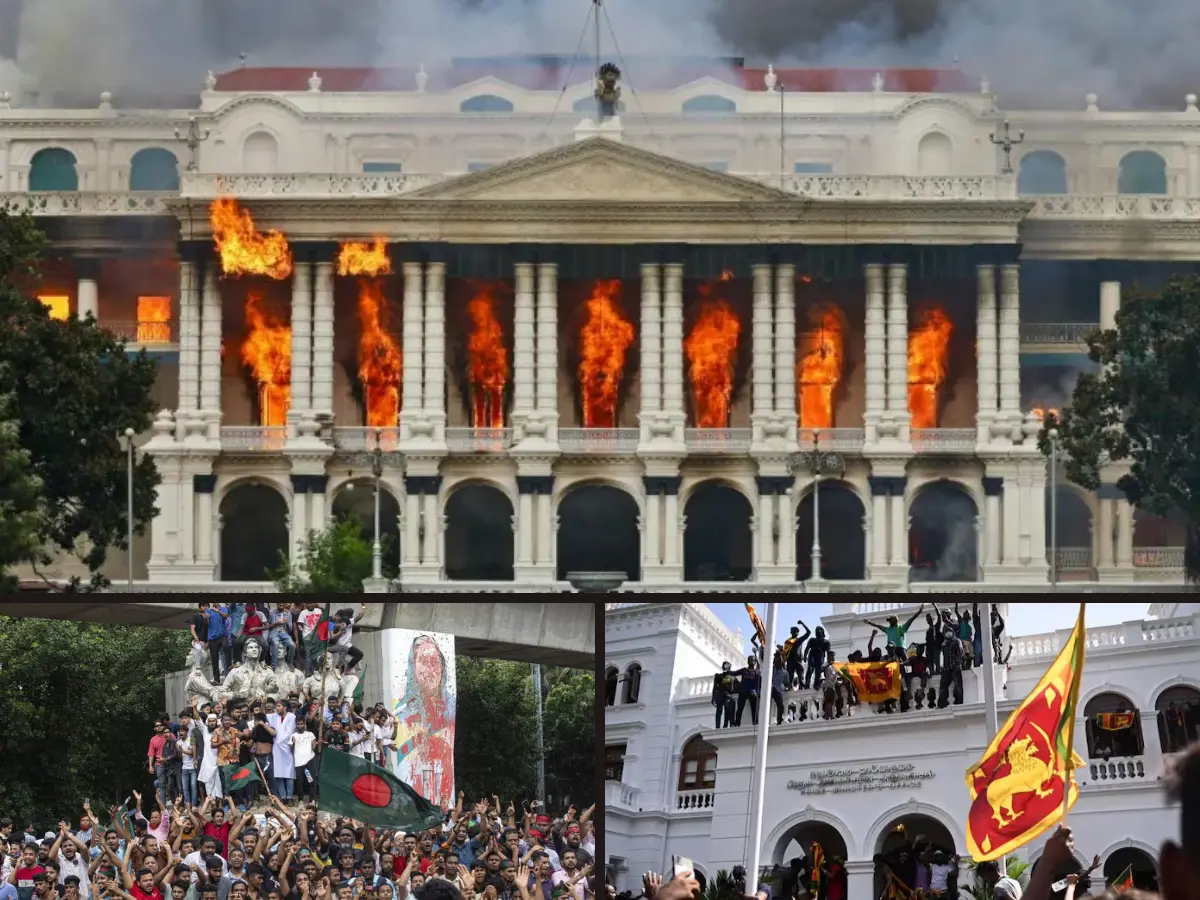
One year, one month and four days ago, Bangladesh Prime Minister Sheikh Hasina was ousted and she was forced to flee her country amid violent protest. The script was repeated on Tues (Sep 9) in Nepal - yet another India's neighbour. PM KP Oli was forced to resign due to widespread protest and he reportedly fled to Dubai. The protest, however, did not stop after his exit. In fact, it escalated with protesters barging into the Parliament and Oli's official residence and vandalising it. The images of buildings on fire, protesters dancing and cheering the fall of government and damaging government property - were eerily similar to what the world saw in Dhaka in 2024, when Hasina was ousted. Clashes with police and security personnel gave a deja vu moment from 2022 too - when similar protest in Sri Lanka forced President Gotabaya Rajapaksa to flee the country. Sanjeev Sanyal, member of Indian PM Narendra Modi's Economic Advisory Council questioned the ‘organic’ nature of these protests, pointing out that they look like a repeat of each other. While his concerns may require a larger probe, or may be dismissed as conspiracy theory, what must surely be pondered upon is the unrest and instability in India's neighbouring countries in the past few years.
Three neighbours, three different years and collapse of three governments: A look at what has happened in Bangladesh, Sri Lanka and now Nepal and what lies ahead for New Delhi:

Nepal Protest
Kathmandu's political history might be taking a new turn with the recent protest. Youth-led protest over digital censorship has spiralled into a full-blown political crisis, plunging Nepal into uncertainty. Prime Minister KP Sharma Oli has stepped down and fled the country. Several ministers were assaulted, chased and their homes were set afire by angry protesters. Rajyalaxmi Chitrakar, wife of former PM Jhalanath Khanal, died after her home was torched. Protesters also stormed and set fire to key government buildings, including Parliament, the PM’s residence, and the President’s house. Reportedly, country's President and Chif Justice have also resigned and Army Chief said that Army will ensure national security and speak to the protesting people.
While the trigger was a sweeping government move on September 4, when 26 social media platforms, including Facebook, Instagram, YouTube, Whatsapp and X were blocked, protesters, mostly youngsters, also came to streets over rising corruption and a lack of accountability and inequality from the top echelons of the nation. Termed by many as the ‘Gen Z Protest’ or even the ‘Gen Z Revolution’, Nepal on Tuesday witnessed widespread unrest marked by vandalism, violent clashes, and assaults on public officials. Across Kathmandu and other major cities, protesters torched vehicles, stormed government buildings, and rejoiced the destruction, even as the deadly clash resulted in the death of 19 people. The streets turned into battlegrounds, as the younger generation, demanded a complete overhaul of the political system. Nepali youth now want Kathmandu’s young mayor, Balendra Shah popularly known as ‘Balen Shah’, rapper-turned-politician, as their next leader.
Trending Stories
&im=FitAndFill=(700,400))
Before Extraordinary Minami Minami, these popular K-dramas got Japanese versions
)
'Were you here to sell chickpeas?': Wasim Akram criticises Babar Azam's captaincy
)
Saudi vs Houthis: Houthis claim missiles & drones used in attack on key Saudi sites
)
‘Will go to any extent’: Pakistan vows to defend Saudi Arabia amid Houthi attacks
)
‘End of my career...’: NSA Doval recalls tense Sikkim mission when China captured Indian intelligence team
)
China now makes advanced memory chips without the machines it was banned from buying
)
Raphinha hat-trick powers Barcelona to 3-1 win over Sevilla in La Liga
66 years of the Indus Waters Treaty: How India and Pakistan settled a bitter river dispute
)
Trump defends AI amid growing alarm, announces new 'AI force' and promises an 'AI czar'
)
Several petrol pumps, other businesses to refuse UPI payments above Rs 2,000 from Oct 16: Is it legal?
)
Trump announces ‘AI Force’ as debate grows over AI risks and regulation
)
Mark Carney mimics Trump in hilarious moment over C$70 billion clean-energy investment; room erupts in laughter
)
Harry Brook targets long reign at top of T20I rankings after Sri Lanka sweep
)
Ed Sheeran addresses Macklemore's removal, Gaza conflict during Philadelphia concert: 'I cannot hide how I feel'
&im=FitAndFill=(700,400))
‘Not the US or China’: These are the countries leading the world in arable land
&im=FitAndFill=(700,400))
How many F-35s does Britain, Japan and Israel have?
)
West Indies Squad for India Series: Hetmyer included for T20Is, Holder rested
)
Arvind Kejriwal, family members, Delhi CM Rekha Gupta get SIR notices
)
Gaza under attack: Health chief's son killed in IDF strikes
)
US-Iran war: Tehran draws red lines — seven demands before any peace talks
)
Reacher star Alan Ritchson opens up about alleged blackmail, suicide attempt during difficult period
)
S Jaishankar, former Army chief among high-profile names issued Delhi SIR notices
)
9 women found dead near Johannesburg: South Africans rally, demand 'enough' to femicide
)
AI actress Tilly Norwood glitches mid-interview, switches from English to Chinese | Watch
)
Russia's deadly Ukraine strikes kill 2 in Sumy, hit Dnipro mall
)
Sikh bus driver assaulted, bus stolen and rammed into cars in England; video surfaces
)
Report: Iran rebuilding Taleghan 2, nuclear site tied to past weapons research, hit twice by Israel
)
Russia holds first parliamentary elections since the beginning of the Ukraine war
)
EXCLUSIVE | Singer Hanita Bhambri on her Toxic debut, working with Vishal Mishra and more
)
Aravana prasadam shortage at Sabarimala temple in Kerala triggers protests, TDB questioned
)
Iran sets 7 conditions to end war with US: What are Tehran’s demands?
)
China may have gained access to US's classified F-35 jets; parts meant for repairs diverted to Hong Kong, sparking Pentagon inquiry
)
Trump says he'll build an 'AI Force' and appoint a czar, for 'high IQ' people only
)
Nigeria: Protesters take to the streets, police fire shots
)
The Verdict | When precision fails: US commits war crime in Minab school strike, UN finds
)
Kampala-Ankara rift deepens: Uganda suspends military ties, seeks Fred Lumbuye's extradition
)
US-Iran war: Tehran sets seven conditions to re-engage in talks with US
)
Man breaks open wall hiding hundreds of books since 15 years
&im=FitAndFill=(700,400))
Meet top 5 Indian batters with fastest T20I centuries
)
Russia-Europe tensions: Polish PM warns Russian attacks could test NATO's unity
)
Bangladesh Protest: Fall of Hasina
If one needs to explain what deja vu is, one must compare the sequence of events in Dhaka in 2024, to situation in Kathmandu in 2025. Visuals and the protest script is exactly the same - it almost seems like the Gen Z in Kathmandu learnt from the Bangladesh protest of 2024 when nationwide protests, sparked by student anger over public-sector job quotas, spiralled into a full-blown political crisis. A campus-based agitation, led by disillusioned youth, quickly spread across the country—toppling the Hasina government. A controversial quota system in government jobs, seen by many as discriminatory and outdated, was the triggering point for the protests. On August 5, after weeks of escalating unrest, Prime Minister Sheikh Hasina resigned and fled to India in a military helicopter. There too, security personnel opened fire on demonstrators during the student protest, and in the days that followed, hundreds were killed. By the time Hasina exited the country, the death toll had climbed sharply. According to United Nations estimates, more than 1,400 people had lost their lives, while thousands of others were injured.
In a dramatic shift, an interim government was swiftly formed—led by Nobel Laureate Muhammad Yunus. However, in the weeks that followed, the anger on the streets didn’t subside. Protesters began targeting symbols of the old regime. In Dhanmondi, the home of Hasina’s father—Bangabandhu Sheikh Mujibur Rahman—was vandalised and set ablaze. Mujibur Rahman's statue and Hasina's posters were defaced at several locations.
Sri Lanka protests of 2022
Similarly, pictures that came out of in 2022 showed the world people's frustration with government's that are not taking accountability. Demonstrations initially started over fuel shortages and inflation, but soon turned into a nationwide uprising that forced President Gotabaya Rajapaksa to flee the country. Prime Minister Ranil Wickremesinghe’s private home was also set on fire by angry protesters. On July 13, thousands of protesters stormed Rajapaksa's official residence and occupied key government buildings, including the Presidential Secretariat and Prime Minister’s office. Dramatic visuals of people sitting on President, PM's chair, swimming in the pool inside in his residence and even kissing amid the anti-government protest went viral on social media.
The protests were mainly staged by frustrated citizens after long power cuts, skyrocketing prices, and the government’s inability to import basic necessities. Millions of people across the country took to the streets in July that year under the banner of the “Aragalaya” or “struggle” movement, demanding the resignation of the entire ruling elite. Police then used force against the protesters to end the revolt. However, simmering anger exploded and ruling government fell. The “Gota Go Home” slogan that defined the uprising became a symbol of people's frustration. In Sep 2023, left-leaning politician Anura Kumara Dissanayake was elected the country's president after he won the debt-ridden country’s first election since protest of 2022.
What are India's concerns?
New Delhi is closely monitoring the situation in its neighbourhood. While it has already established a cordial (if not friendly) relationship with new Sri Lankan President Dissanayake, Indian PM Modi has not shied away from meeting Bangladesh's interim leader Yunus. Depsite Dhaka's Pakistan maneuvers, Yunus shared an old image of Modi awarding him a gold medal to showcase his bond with the Indian PM after the meeting - sending signals to New Delhi that he doesn't want the bonhomie between two nations to disappear. With all three nations, India also faces the ‘China dominance’ question. On that front, India’s own attempts to mend ties with Beijing amid Trump’s tariff war could help keep the fear of its monopoly in the neighborhood at arm’s length, at least for a while. Regional security, economic disruptions, refugee flows and cross-border tensions remain the primary concerns for India but diplomatic touch and close watch at the borders can keep this in check as well. For New Delhi, ensuring stability in neighboring countries is crucial to maintaining its own security, geopolitical standing of the ‘Global South’. Faced with Trump's uncertain nature, Beijing also wishes for a peaceful South Asia, to put pressure of the US and bat for multipolar world order. Hence, though, India and China may have their own powerplay amid the instability in the neighbourhood, it is united in its call for peace. This also makes matters easy for New Delhi, thanks to Trump, maybe!

