Myanmar promised PM Modi it won't let its territory be used against India. Can it deliver? | WION Decodes

&imwidth=600&imheight=450&format=webp&quality=medium "Myanmar promised PM Modi it won't let its territory be used against India. Can it deliver? | WION Decodes")
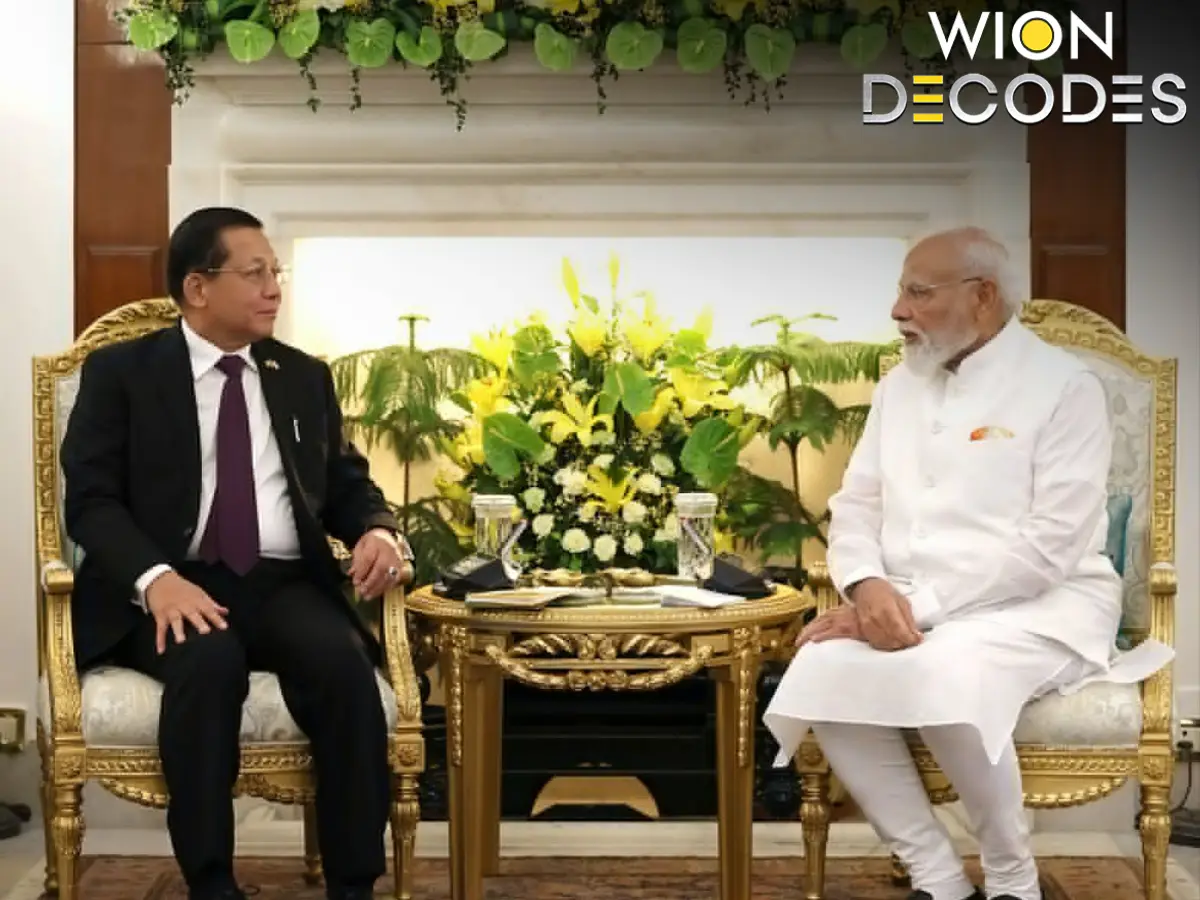
Myanmar President Min Aung Hlaing and Indian Prime Minister Narendra Modi Photograph: (ANI)
Myanmar President Min Aung Hlaing assured PM Modi that Myanmar's territory would not be used against India's security interests. The pledge comes amid concerns over Northeast insurgent groups operating along the Indo-Myanmar border: But what's the reality of this promise
Myanmar President Min Aung Hlaing met Indian Prime Minister Narendra Modi this week and assured that his country’s territory would not be used against India’s security interests. New Delhi responded with warmth and PM Modi underlined the importance of three of India's signature foreign policy doctrines - Neighbourhood First, Act East, MAHASAGAR (Mutual and Holistic Advancement for Security and Growth Across Regions) framework. The Indian PM also reaffirmed India's commitment to Myanmar's sovereignty and territorial integrity.
The language used by Myanmar reflected New Delhi's long-standing concern about insurgent groups operating along the porous India-Myanmar border, while India's wordings were carefully carved keeping in sight the current resistance faced by Myanmar military government across large stretches of its territory, including areas bordering India's northeast. The development also comes at a time when China is attempting to spread its influence in the world by portraying itself the most dominant power in the Southeast Asia.
Who controls the key border areas?
Experts argue the statement by Myanmar's president is not easy to implement as reality on the ground is complicated. Aishwaria Sonawane, Research Analyst at the Takshashila Institution, explains that Myanmar's military junta does not exercise effective control over several border regions and it is the ethnic armed groups that are in control. "This creates a security vacuum that could potentially facilitate insurgent sanctuaries and other illicit cross-border activities."
Trending Stories
&imwidth=280&imheight=210&format=webp&quality=medium)
&im=FitAndFill=(700,400)&imwidth=280&imheight=210&format=webp&quality=medium)
&imwidth=280&imheight=210&format=webp&quality=medium)
&imwidth=280&imheight=210&format=webp&quality=medium)
&imwidth=280&imheight=210&format=webp&quality=medium)
&imwidth=280&imheight=210&format=webp&quality=medium)
&imwidth=280&imheight=210&format=webp&quality=medium)
&imwidth=280&imheight=210&format=webp&quality=medium)
&imwidth=280&imheight=210&format=webp&quality=medium)
&im=FitAndFill=(700,400)&imwidth=280&imheight=210&format=webp&quality=medium)
&imwidth=280&imheight=210&format=webp&quality=medium)
&imwidth=280&imheight=210&format=webp&quality=medium)
&imwidth=280&imheight=210&format=webp&quality=medium)
&imwidth=280&imheight=210&format=webp&quality=medium)
&imwidth=280&imheight=210&format=webp&quality=medium)
&imwidth=280&imheight=210&format=webp&quality=medium)
&imwidth=280&imheight=210&format=webp&quality=medium)
&imwidth=280&imheight=210&format=webp&quality=medium)
&imwidth=280&imheight=210&format=webp&quality=medium)
&imwidth=280&imheight=210&format=webp&quality=medium)
&imwidth=280&imheight=210&format=webp&quality=medium)
&imwidth=280&imheight=210&format=webp&quality=medium)
&imwidth=280&imheight=210&format=webp&quality=medium)
&imwidth=280&imheight=210&format=webp&quality=medium)
&imwidth=280&imheight=210&format=webp&quality=medium)
&imwidth=280&imheight=210&format=webp&quality=medium)
&imwidth=280&imheight=210&format=webp&quality=medium)
&imwidth=280&imheight=210&format=webp&quality=medium)
&imwidth=280&imheight=210&format=webp&quality=medium)
&imwidth=280&imheight=210&format=webp&quality=medium)
&imwidth=280&imheight=210&format=webp&quality=medium)
&imwidth=280&imheight=210&format=webp&quality=medium)
&imwidth=280&imheight=210&format=webp&quality=medium)
&imwidth=280&imheight=210&format=webp&quality=medium)
&imwidth=280&imheight=210&format=webp&quality=medium)
&imwidth=280&imheight=210&format=webp&quality=medium)
&imwidth=280&imheight=210&format=webp&quality=medium)
&imwidth=280&imheight=210&format=webp&quality=medium)
&imwidth=280&imheight=210&format=webp&quality=medium)
Cchavi Vasisht, a senior research associate at Chintan Research Foundation, delves deeper and points out that the ethnic armed groups have been more active and powerful since Myanmar's military takeover. Large stretches of territory are now controlled by Ethnic Armed Organisations (EAOs), she says. EAOs are essentially anti-junta coalition of several groups with the pro-democracy People's Defence Force (PDF). "For decades, this border was managed through diplomatic engagement with Naypyidaw and bilateral security cooperation with the military. But now these borders are controlled by EAOs. And to secure its interests, India is engaging with both the military leaders and thereby the govt in power as well as EAOs who control these territories," Vasisht adds.
She notes that India's also engages with EAOs and that is not only driven by security concerns but also by strategic connectivity interests. "The Kaladan project's completion, for instance, depends not just on Naypyidaw's political will but on the Arakan Army's continued administrative stability over the corridor." This, she says, explains India's dual-track approach of maintaining ties with the Myanmar's political establishment while simultaneously engaging with EAOs. Sonawane says that though the threat is not acute for New Delhi at present, but it retains the potential to become a regional security concern given a severe vacuum of central authority in Naypyidaw and the Myanmar military's incapability to police these areas.
Involvement of foreign fighters?
In March, India's National Investigation Agency (NIA) arrested six Ukrainian nationals and one American (identified as Matthew VanDyke) on allegations of illegally entering India's northeastern border to train anti-junta ethnic armed organisations in Myanmar in drone warfare and combat tactics. Investigators alleged the group entered India on tourist visas, travelled to the border state of Mizoram without required permits, and used it as a logistics base and transit route to cross into Myanmar's Chin State. Referring to the case, Vasisht highlights how Myanmar's conflict is increasingly attracting foreign fighters and transnational networks. “Myanmar's civil war is now attracting foreign fighters, and arms supply networks that are using Indian territory as a transit corridor. Though arms supply has been a concern since 1960s, the involvement of foreign fighters is a new threat India is facing.”
Anti-India groups and drug trafficking
The anti-India groups Myanmar President Min Aung Hlaing was likely referring to are Indian Insurgent Groups (IIGs) that have been historically using Myanmar's soil for their activities. These are banned groups, mostly from Northeast India operate around the 1,643-km porous border between India and Myanmar. They have allegedly set up safe havens, training camps, and launchpads inside Myanmar's territory. The Ministry of Home Affairs (MHA) has repeatedly flagged these groups, noting that they utilis because these groups utilise the dense jungles of Myanmar's Sagaing Region and Chin State to recruit, train, stock black-market weapons, and traffic narcotics. They have also been known to retreat across the border following security crackdowns or attacks.
Sonawane highlights the factors that have historically enabled Indian insurgent groups to use Myanmar's territory as a sanctuary. She noted that Northeast states, particularly Nagaland, Mizoram and Manipur, share deep transnational ties with communities across the border. "These cross-border linkages, along with a rugged terrain, make the border highly porous and difficult to regulate for both New Delhi and Naypyidaw," she says. The combination of difficult geography, ethnic linkages and weak state control in some border regions has long created opportunities for insurgent groups to move across the frontier and establish networks on either side, she adds.
Since the 2021 coup, the Myanmar military has lost physical control of massive chunks of the Indo-Myanmar border to local anti-junta resistance groups. Independent intelligence and ground reports indicate that some regional elements of the Myanmar military have tactically tolerated—or even used—certain Indian insurgent groups to fight against Myanmar's local anti-junta rebels.
Beyond insurgency, Vasisht warns that narcotics trafficking and cybercrime networks remain a persistent concern. “Myanmar being the one of the largest opium producer and supplier and recent confiscations are just tip of the iceberg. Additionally, in recent times, Myanmar has become the global epicentres of cyber fraud. Indian youth are being actively recruited into scam operations," she says. Sonawane also points out that narcotics trafficking is on a rise because of the lack of effective control over many border regions by Myanmar's military junta.
What does the statement by Myanmar's president really means?
Vasisht says that Myanmar's President Min Aung Hlaing's assurances were welcomed in New Delhi, but she believes that the pledge must be viewed in the context of its fragmented political landscape. She says the commitment reflects the government's intent, but not necessarily its ability to enforce control across the entire border region. "Naypyidaw is only partially in a position to honour, given how much of the border territory it does not govern."
It must be remembered that India and Myanmar's engagement continued even during the most turbulent years following the 2021 military coup. While both the analysts say that New Delhi continued functional engagement with Myanmar's military authorities in order to avoid pushing it “towards China’s embrace”, Sonawane argues that Myanmar did not receive sustained attention in Indian security planning because New Delhi's military focus remains concentrated on Pakistan and China. Vasishtdiffers as she says that the relationship "was managed, sometimes minimally, sometimes actively, but it was never severed." However, she observs that even in the recent visit “not a single MOU was signed, and there was no announcement of any 'outcomes'.”
For India, Min Aung Hlaing's assurance is significant not only for what it promises on security but also for what it reveals about the state of bilateral ties. While analysts caution that Myanmar's fragmented political landscape may limit the junta's ability to fully deliver on the pledge, the statement underscores the continued engagement between New Delhi and Naypyidaw despite years of instability. At a time when India's strategic attention is heavily focused on China and Pakistan, Myanmar remains a crucial neighbour, making sustained engagement with the country an important element of India's broader neighbourhood strategy.

