Kurdistan's referendum won't lead to independence ? so why hold it?

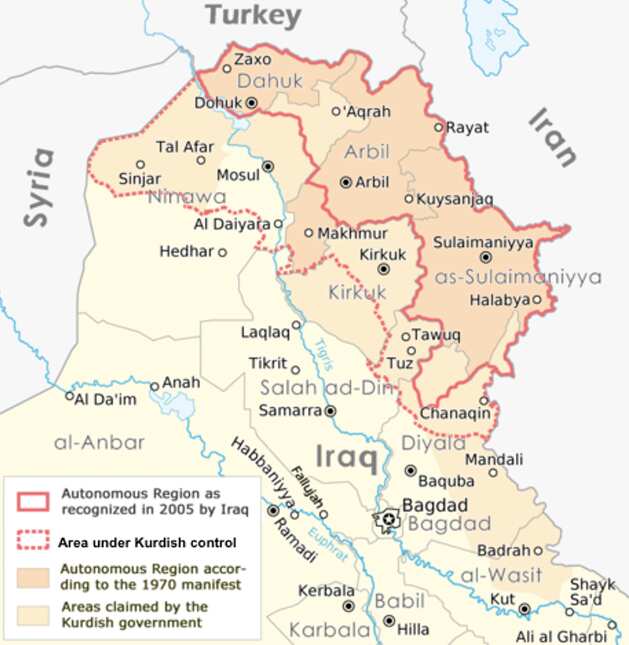
Kurdistan's referendum won't lead to independence ? so why hold i
Iraqi Kurds go for an independence referendum on 25th September. The independence may worsen the socio-economic situation in Iraq and the Kurdish region.
Iraqi Kurdish officials on September 25 of this year. The decision was widely anticipated, since Masoud Barzani, president of the Kurdistan Regional Government (KRG), had explicitly promised an independence referendum once ISIS were defeated.
Yet without any stamp of approval from Baghdad and the international community – or at least from the majority of permanent members on the UN Security Council – the referendum will not by itself make the Kurdish dream of statehood a reality. The Kurds are well aware of this.
Instead, the likely overwhelming vote in favour of independence could inflame Iran, on whose trade Erbil currently depends for survival as a separate entity. So if this independence vote could escalate tensions and will not confer statehood, why is the KRG holding it?

Political goals
First, oil revenues. Baghdad cut off federal disbursements following an acrimonious dispute over oil revenues in 2014. The Kurds retaliated by stopping crude oil deliveries to the central government, instead of selling oil directly to Turkey through a newly built pipeline.
)
Why asking questions could be more important than memorising answers
)
Osama Bin Laden ‘planned’ to target India, CIA reveals dozens of declassified documents
)
'Iran won't surrender': Pezeshkian sends blunt message to US while attending BRICS Summit in India
)
BRICS Summit 2026: Global leaders of BRICS nations attend main open session
)
Celine Dion makes emotional stage comeback after six years: 'I'm so delighted to see you'
)
PM Modi and China's Xi offered to help resolve Russia-Ukraine war: Kremlin
)
Why dehydration is the hidden cause of travel fatigue on long flights
&im=FitAndFill=(700,400))
Meet top 5 batters fastest to 3000 runs in T20Is
)
Top 5 places to visit in Goa beyond its famous beaches
)
'He is popular...': Malaysian PM Anwar Ibrahim's praise for PM Modi during bilateral meeting | WATCH
)
BRICS Summit 2026: PM Modi, Xi reach key consensus on ties, China to assume BRICS chairmanship in 2027
)
BRICS Summit 2026: Consensus on joint declaration, diplomatic win for India
)
Trump says Canada eager to reach a deal, it could come ‘fairly soon’ if Ottawa treats US farmers better
)
‘Partners, not rivals’: Xi outlines four point plan for stronger India-China ties
&im=FitAndFill=(700,400))
Why Chinese PL-15 air-to-air missiles use dual-pulse motors compared to European interceptors
)
Could staying indoors all day affect your health?
)
BRICS Summit 2026: PM Modi addresses Day 2 of 18th BRICS summit
)
Who is the smiling man beside Modi, Putin and Xi at BRICS Summit 2026?
)
800 million years old - Scientists discover 'fingerprints' of supercontinent Gondwana in ancient rocks
)
Why going digital does not always mean becoming more efficient
&im=FitAndFill=(700,400))
Why do air defence missiles explode near their target instead of hitting it?
)
War is making Russia stronger? How Ukraine is shaping Moscow’s next generation of weapons
)
Migration protests return to Portsmouth as rival demonstrations face off
)
From severe mobility problems to recovery: Madhuri the elephant’s journey of wildlife care
)
BRICS Summit day 1: New Delhi declaration adopted with full consensus, big diplomatic win for India
)
Did Iran President Pezeshkian touch feet of Hindu spiritual leader at Delhi event as shown in viral video?
)
9-year-old Chennai prodigy clears Cambridge IGCSE grade 10 exams
)
Why does your body need time to adjust after a long journey?
)
BRICS Summit 2026: PM Modi to hold bilateral with leaders of seven countries
)
Ramanathaswamy temple takes centre stage as PM Modi welcomes world leaders at BRICS
)
Houthis launch cross-border strike on Saudi Arabia as Yemen war escalates
)
BRICS Summit 2026: Chinese president Xi Jinping departs from New Delhi after attending BRICS summit
)
Why does your skin need protection from UV rays?
)
How does the loss of forests affect the way wildlife lives and moves?
)
IND vs AFG, 1st T20I: When and where to watch live streaming in India?
)
Why do wild animals need quiet places to survive?
)
Bigg Boss 20: Qazi Touqeer gets a special ‘rockstar’ moment from Salman Khan
)
Humans may lose control of AI: Anthropic CEO calls for slowdown, Altman, Musk back him
Negotiations with Baghdad have been on hold due to the military imperative of fighting ISIS. But with ISIS now close to defeat, oil sharing has come back to the fore. KRG officials may be hoping the referendum will increase their bargaining power, pressuring Baghdad into larger monthly disbursements. Erbil argues that, under the Iraqi constitution of 2005, it should receive roughly 17 per cent of federal revenues from oil exports, amounting to about US$1 billion (£785m) per month.
Kurdish officials may also have an eye on disputed areas that have fallen under their authority. ISIS previously northwestern Iraq, directly threatening oil-rich Kirkuk. The much acclaimed Kurdish armed forces, the “Peshmerga”, fronted the counterattack and have been in de facto control of Kirkuk since 2014. The Kurds recently raised their flag on municipal buildings – to vehement criticism from Turkey and the local Turkmen community.
If these disputed areas deliver a strong Yes vote in September, Kurdish rule could be legitimised. The vote could then confer further bargaining advantages with Baghdad in relation to revenue sharing, further devolution of power and the demarcation of KRG borders (as well as Kirkuk, Erbil claims authority over the contested areas of Makhmour, Shingal and Khanaqin).
Economics and realpolitik
The referendum might also divert attention from the dire economic situation in Iraqi Kurdistan since 2014. Along with losing federal disbursements, the fight against ISIS and the fall in oil prices have led the economy to the brink of collapse.
Kurdish officials and the wider population of around 5 million may have valiantly coalesced around the war effort against ISIS, but dissent is intensifying. With the local parliament suspended since 2015 following a row over Barzani’s decision to extend his term as KRG president, grassroots opposition has been gathering steam.
Cracks have fought bitterly in the past for political and military dominance.
With a growing array of disgruntled domestic actors, the Kurdish leadership may have calculated that the moment is ripe to rally the population around the independence struggle and buy precious time to begin “putting the house in order”.
In addition, the independence vote will help to cement an effective separation from Iraq that dates back to the 1990s. It sends a signal that, in the long run, nothing short of independence will placate the Kurds. The referendum also allows Kurdish politicians to gauge the potential for international recognition of an independent Kurdistan.
 So barring unforeseen events, the population will probably deliver an overwhelming Yes vote to independence on September 25. Since this is about the latest tactics in the continuation of the conflict between Erbil and Baghdad by other means, we can then expect a showdown with the KRG’s domestic and regional adversaries. Only time will tell whether Erbil has been correct to calculate that the benefits outweigh the political risks of going ahead.
This article was originally published on original article.