
&imwidth=800&imheight=600&format=webp&quality=medium "In 1957, three B-52 bombers flew around the entire world nonstop, in just 45 hours")
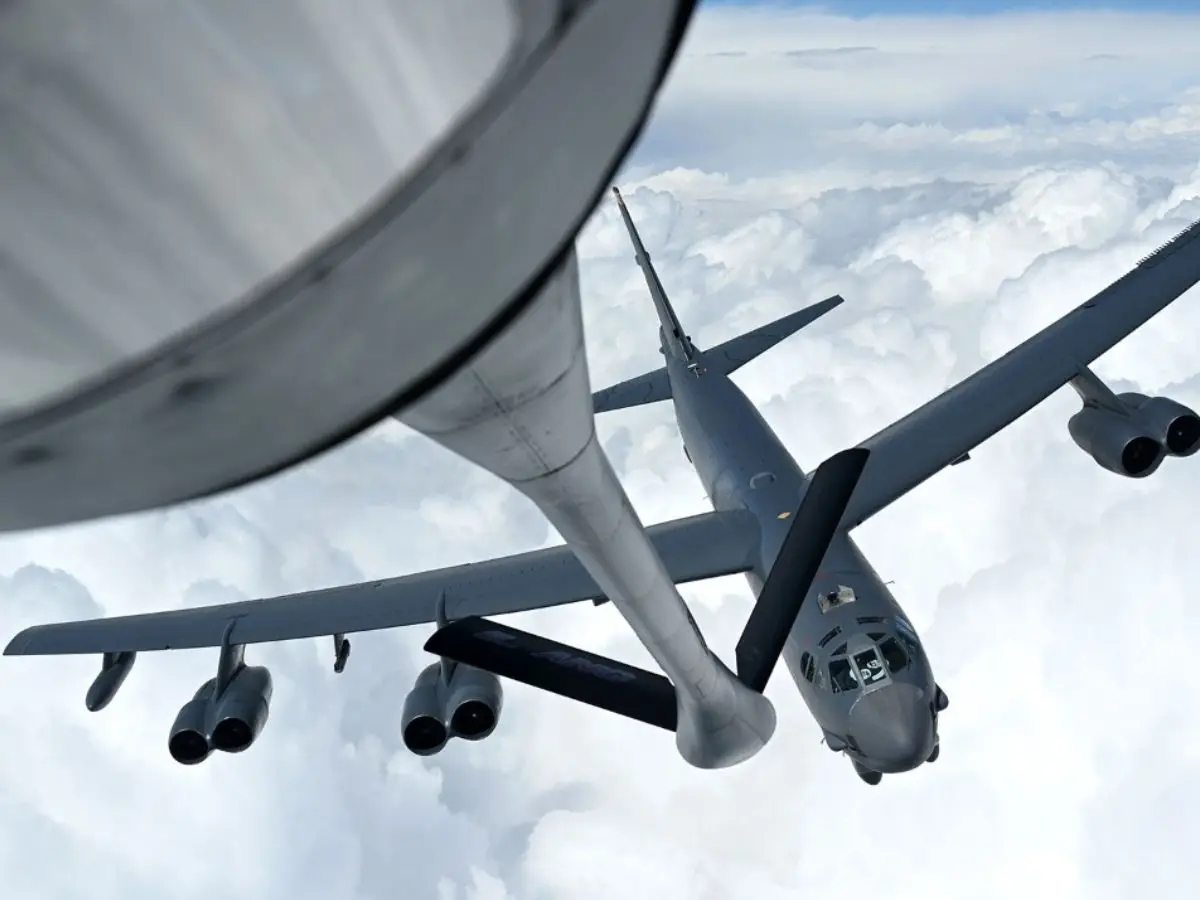
At 1:00 p.m. Pacific Standard Time on January 16, 1957, five Boeing B-52B Stratofortress bombers of the 93rd Bombardment Wing roared off the runway at Castle Air Force Base near Merced, California. Their mission, codenamed Operation Power Flite, was unprecedented: fly around the entire planet without landing, refuelling exclusively in the air, and return to the United States. The purpose was not scientific. It was strategic, a demonstration to the Soviet Union that the United States Air Force could deliver a thermonuclear weapon to any point on the globe.
24,325 Miles Without Touching The Ground
The B-52s flew westward from California, crossing the Pacific Ocean, then continuing over Southeast Asia, the Middle East, North Africa, the Atlantic Ocean, and back to the continental United States. The planned route covered approximately 24,325 miles — nearly the full circumference of the Earth. The aircraft were refuelled in the air by more than 100 KC-97 Stratofreighter tanker aircraft positioned at intervals along the route. Three of the five B-52s completed the full circumnavigation, landing at March Air Force Base in Riverside, California, on January 18, 1957 — 45 hours and 19 minutes after departure, at an average speed of 534 miles per hour.

Two Aircraft Diverted But The Mission Succeeded
Not all five bombers made it around the world. One B-52, La Victoria, commanded by Major George Kalebaugh, was unable to refuel in flight because ice had built up inside its aerial refuelling receptacle, blocking the fuel connection. It diverted to Goose Bay, Labrador. A second aircraft, designated as a spare, left the formation over North Africa and diverted to an air base in England as planned. The remaining three B-52s, led by the flagship Lucky Lady III, completed the mission without incident.
The Crew Behind The Mission
Trending Stories
)
Trump-Xi Summit: Trade, Taiwan and the red lines shaping US-China talks | Race To Power
)
US citizen injured in Illinois after ICE agents mistook him for fugitive, hospitalised
)
US judge questions Trump’s decision to ban CNN, MS NOW and Politico from White House
)
Afghan woman cyclist who disguised herself as a boy to escape Taliban, wins Asian Games medal
)
Italy hit by floods in the north, drought in the south
)
'There will be elections': Venezuela's interim leader Delcy Rodriguez makes big announcement at UN
)
Would you date an AI? South Korea’s My AI Partner: Strange Love sparks buzz on relationship and intimacy
)
'Arrogant parasites': Milei blasts UN over Falklands dispute, warns Argentina will ‘take matters into our own hands’
)
IIT Bombay CCTV footage emerges: Sahil Wakode seen looking at phone in examination hall
)
Cyclone Arnab: Landfall expected before midnight tomorrow as IMD issues orange alerts across six states
)
9 killed, several injured as tourist bus catches fire on Yamuna Expressway
)
NBA player Steven Adams shares hilarious GTA VI theory
)
WION Iconic Tourism Summit 2026: Union Minister Shekhawat on 'experiential travel', peace diplomacy
)
'AI got into my speech': Prince Harry jokes after teleprompter failure at event in New York
)
Scientists detect first radio signals directly from faraway planet
)
China to test supersonic jet that moves at Mach 2, double the speed of sound
)
WION Iconic Tourism Summit: 'Hanuman Ansh' Director on blockbuster success
)
'Partners rather than rivals': Xi Jinping's first message after landing in US for Trump summit
)
WION Iconic Tourism Summit: Is India's travel boom outrunning its airports, airlines and hotels?
)
IIT Bombay student suicide case: CCTV from the exam hall hours before suicide
)
2,000-foot tube, laser tests and more: China builds towns to expand nuclear arsenal, satellite images show
)
French court upholds decision to send PSG and Morocco footballer Hakimi to rape trial
)
WION Iconic Tourism Summit and Awards 2026: Key voices to discuss India’s tourism future
&im=FitAndFill=(700,400))
New OTT releases this week (September 21-27, 2026): Shaque: Trust No One, Hunkkaar, Don’t Be Shy- 5 new titles coming to Netflix, Prime Video and more
)
WATCH | China President Xi Jinping lands in US as Trump greets him ahead of high-stakes summit
)
Australian PM Anthony Albanese calls OpenAI AI incident 'unacceptable' after restricted data access
)
Claude Opus 5.5 is here: Anthropic claims it can finish a 680,000-line code migration in less than a day
)
'What kind of confession is this?': Pakistan PM Shehbaz Sharif’s 'terrorists would be roaming New York' remark goes viral, raises alarm online. Watch
)
WION Iconic Tourism Summit: How local tourism MSMEs must upskill for AI integration
)
Eight USS Abraham Lincoln sailors attempted suicide, Acting Navy Secretary says
)
Trump’s Board of Peace unveils $2.45bn Gaza plan,66 projects: But where’s the money?
)
EC appointment law: Why is the 2023 act controversial, and what happens next? WION explains
)
'Putin is patient zero': Zelensky slams Russian president at UNGA, accuses him of using fighters from 47 countries
&im=FitAndFill=(700,400))
National Film Awards 2026: Kartik Aaryan, Mammootty, Yami Gautam, Randeep Hooda and other key winners
)
El Niño 2026 heats up to become strongest in 1,000 years
)
Israeli envoy to US Yechiel Leiter’s son critically injured in West Bank ramming attack
&im=FitAndFill=(700,400))
Trump welcomes Xi Jinping in rare airport gesture: Photos from Chinese President's arrival in US
)
Xi-Trump meeting: China’s human rights red line and past protests explained
The flight was commanded by Major General Archie J. Old, Jr., who flew aboard one of the B-52s as the overall mission commander. The lead aircraft, Lucky Lady III, serial number 53-0394, was piloted by Lieutenant Colonel James H. Morris, a man who had been the co-pilot aboard Lucky Lady II when it became the first aircraft in history to circumnavigate the globe nonstop in 1949, flying a B-50 Superfortress on a journey that took 94 hours. Morris had already been part of the first-ever nonstop global flight and now he was leading the first jet aircraft to do it, in less than half the time.
The Message To Moscow
Operation Power Flite was not a routine training exercise. It was a calculated strategic demonstration at the height of the Cold War. By proving that B-52 bombers could fly around the entire world without landing, refuelling in the air at intervals, the United States was sending an unmistakable signal to the Soviet Union: there was no point on Earth beyond the reach of American nuclear-armed bombers. The three B-52s that landed at March Air Force Base on January 18 had proven that the bomber force could deliver a hydrogen bomb to any target, anywhere, at any time. All 27 crew members of the three completing aircraft were awarded the Distinguished Flying Cross by General Curtis LeMay, and the 93rd Bombardment Wing received the Mackay Trophy for the most meritorious flight of the year.
