G7 vows to work towards cleaner, renewable energy with no deadline

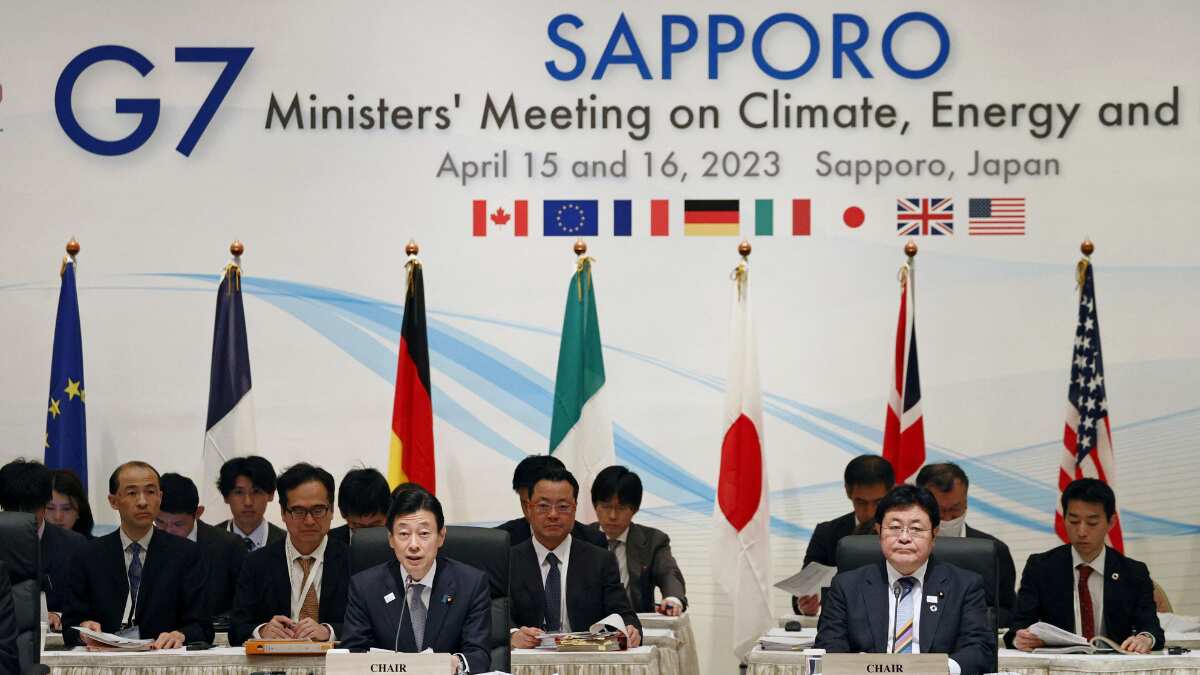
G7 environment ministers
The Group of Seven (G7) rich nations’ energy and environment ministers, on Sunday (April 16) vowed to ramp up efforts and work toward cleaner and renewable energy while also phasing out power plants using coal, in a statement, following discussions in the northern Japanese city of Sapporo. However, they could not decide on a deadline to achieve said goals.
The 36-page communique
After two days of discussions between the environment and energy ministers of the bloc, they released a 36-page statement outlining some of their commitments ahead of the G7 summit in Hiroshima set to take place next month.

“Recognizing the current global energy crisis and economic disruptions, we reaffirm our commitment to accelerating the clean energy transition to net-zero greenhouse gas (GHG) emissions by 2050 at the latest,” said the statement.
ALSO READ |Explained | Germany to end its decades-old nuclear power era. What now?
The countries have also pledged to contribute to “expanding renewable energy globally” and reaffirmed their commitment to “achieving a fully or predominantly decarbonised power sector by 2035.”
This includes phasing out domestic “unabated” coal power generation – plants that do not capture emissions and prevent them from escaping into the atmosphere and also encouraged other countries to follow suit.
&imwidth=180&imheight=135&format=webp&quality=medium)
Rahul Gandhi's plea against Election Commission delayed as Supreme Court registry flags 14 ‘defects’
&im=FitAndFill=(700,400)&imwidth=180&imheight=135&format=webp&quality=medium)
Navratri 2026: 9 days, 9 forms of Goddess Durga and 9 colours- Check the complete list
&imwidth=180&imheight=135&format=webp&quality=medium)
Korean peninsula tensions escalate as North Korea launches multiple ballistic missiles, PACOM says 'no threat to US personnel'
&imwidth=180&imheight=135&format=webp&quality=medium)
Trump weighs firing Kimberly Guilfoyle as US ambassador to Greece amid misconduct allegations: Report
&imwidth=180&imheight=135&format=webp&quality=medium)
Anti-SIR protest in Mumbai: Protestors wear black masks & ribbons in Mumbai
&imwidth=180&imheight=135&format=webp&quality=medium)
UK PM Andy Birnham renews claims of Russian meddling in Brexit vote
&imwidth=180&imheight=135&format=webp&quality=medium)
BCCI rejects venue shift reports, India vs Sri Lanka 1st ODI to remain in Delhi
&imwidth=180&imheight=135&format=webp&quality=medium)
'Absolutely disgusting': Australia slams US plan to livestream Nidal Hasan's execution; Mike Johnson raises concerns, warns of terrorist propaganda
&imwidth=180&imheight=135&format=webp&quality=medium)
1,500 drones illuminate Mumbai sky as Cordelia Cruises unveils second ship, Cordelia Sky
&imwidth=180&imheight=135&format=webp&quality=medium)
Houthis warns US of 'painful response' if Washington joins Saudi war in Yemen as airlines suspend flights to Saudi Arabia
&imwidth=180&imheight=135&format=webp&quality=medium)
Congress demands action against chief election commissioner
&imwidth=180&imheight=135&format=webp&quality=medium)
'Turn approver, resign, we'll forgive you': Rahul Gandhi claims receiving messages from CEC Gyanesh Kumar
&imwidth=180&imheight=135&format=webp&quality=medium)
'I will not be silenced': Ilhan Omar alleges political intimidation after federal officers search her Washington home
&imwidth=180&imheight=135&format=webp&quality=medium)
Robotic surgery, advanced treatment: What is coming to this small Gujarat town?
&imwidth=180&imheight=135&format=webp&quality=medium)
Pakistan's government blames PTI for rise of terrorism in Khyber Pakhtunkhwa
&imwidth=180&imheight=135&format=webp&quality=medium)
‘This is just the start’: Maaya Rajeshwaran on historic ITF title, confidence boost and future goals
&imwidth=180&imheight=135&format=webp&quality=medium)
I.N.D.I.A. Bloc lists 10 requests to Supreme Court
&im=FitAndFill=(700,400)&imwidth=180&imheight=135&format=webp&quality=medium)
How does a robot decide what to do next?
&imwidth=180&imheight=135&format=webp&quality=medium)
Trump says he 'may' meet North Korean leader Kim Jong Un during upcoming Asia trip
&imwidth=180&imheight=135&format=webp&quality=medium)
'Ouch!!! That must hurt': Kangana Ranaut hails Kamal Haasan's sharp reply to Elon Musk over Starlink row
&imwidth=180&imheight=135&format=webp&quality=medium)
Sidhu Moose Wala’s younger brother wins hearts by recreating late singer’s signature move at Toronto Hologram Show
&imwidth=180&imheight=135&format=webp&quality=medium)
Girl 'dead' for 8 hours wakes up at her own funeral, dad insists she wasn't breathing
&imwidth=180&imheight=135&format=webp&quality=medium)
UK school ditches technology, shifts from screen to pen and paper for learning
&imwidth=180&imheight=135&format=webp&quality=medium)
Opposition’s 10 demands in Supreme Court petition range from stay on SIR to audit of voter rolls
&imwidth=180&imheight=135&format=webp&quality=medium)
'I am thoroughly unamused': Judge slams Trump administration after 400 trees cut at Washington golf course
&im=FitAndFill=(700,400)&imwidth=180&imheight=135&format=webp&quality=medium)
New OTT releases this week (October 12-18, 2026): Sacrifice, Koffee with Karan S9, Roadies Rebirth- 6 titles coming on Netflix, JioHotstar and more
&imwidth=180&imheight=135&format=webp&quality=medium)
Delhi protest: CJI Surya Kant declines to meet India Bloc leaders
&imwidth=180&imheight=135&format=webp&quality=medium)
China’s gold rush puts billion in focus
&imwidth=180&imheight=135&format=webp&quality=medium)
India's Ajit Doval, Iran's Mohsen Rezaei hold talks amid escalating West Asia tensions, discuss 'issues of mutual interest'
&imwidth=180&imheight=135&format=webp&quality=medium)
'Almost certainly': UK Prime Minister Andy Burnham says Iran's IRGC behind RAF Fairford threat
&imwidth=180&imheight=135&format=webp&quality=medium)
Elon Musk pumps $276 million into Republican campaigns ahead of US midterm elections
&imwidth=180&imheight=135&format=webp&quality=medium)
'Never met' him: Melbourne Imam denies links to Flydubai co-pilot Hamam al-Hammami
However, the G7 ministers have not given a deadline for phasing out coal-fired power plants, which has been a long-standing issue as many countries including Japan still heavily rely on this method for generating power. Tokyo relies on coal for nearly one-third of its power generation.
ALSO WATCH |G7 Climate Talks: Meet seeks to reconcile world's heavy reliance on fossil fuels
The G7 nations which include countries like Canada, France, Germany, Italy, Japan, the United Kingdom and the United States,account for some 40 per cent of the world’s economic activity and are also responsible for nearly a quarter of global carbon emissions. The countries are also committed to ending plastic pollution and reducing additional plastic pollution to zero by 2040.
Investment in critical minerals
The G7 nations also acknowledged the importance of critical minerals for the transition to clean energy and reaffirmed the “need to prevent economic and security risks caused by vulnerable supply chains, monopolisation, lack of diversification of existing suppliers of critical minerals.”
In this context, they have also decided to boost the development of new mines and supply chains for critical minerals in a “responsible manner that promotes transparency and traceability” to keep up with demand. It added, “Currently $13 billion fiscal support that can be used for domestic and foreign projects is prepared across the G7 countries.”
ALSO READ |Himalayas have lost glacier mass equal to weight of 570 million elephants: Study
Indianenvironmentminister's address
Indian Minister for Environment, Forest and Climate Change, Bhupender Yadav also addressed the plenary session of the G7 ministers’ meeting in Japan and spoke about how economic development is the first defence against climate change. He also took to Twitter and wrote, “The global goal of reaching net zero by 2050 needs enhanced emission descaling by developed nations.”
(With inputs from agencies)
WATCH WION LIVE HERE
You can now write for wionews.com and be a part of the community. Share your stories and opinions with us here.