Explained | Germany to end its decades-old nuclear power era. What now?

Germany
After a decades-long dispute which had divided Germany, the country has finally decided that on Saturday (April 15), it will pull the plug on its last three nuclear power stations and there has been a range of reactions. Europe’s largest economy which is also one of its biggest emitters of carbon will, in the short term, go back to using coal.
A brief history
Germany began its commercial nuclear sector with the Kahl reactor in 1961 which was later joined by seven commercial plants in the early years and with the 1970s oil crisis it garnered public support.

Former West Germany has long supported the anti-nuclear movement even before the German unification where hundreds of thousands of mostly young people would take to the streets. As of 20 years ago, 19 nuclear power plant units supplied up to a third of the country’s electricity.
ALSO READ |Nuclear power phase-out: Germany switches off remaining three reactors permanently
It was not until the 1986 Chernobyl disaster in the then-Soviet Union that some of the warnings and dangers of nuclear power were confirmed. However, various governing parties in Germany like the Christian Democrats (CDU), the Social Democratic Party (SPD), and the Free Democratic Party (FDP) have still stood firmly behind the use of nuclear power for decades now.
)
Mushtaq Khan dies at 56: When Welcome actor opened up about his salary for iconic role Ballu
)
US Supreme Court backs Trump administration's use of SAVE database to check voter citizenship
)
Heart of the Beast review: Brad Pitt leads a gripping tale of survival and loyalty
)
Outrage erupts after 3-year-old is married to 60-year-old man in Pakistan, link to her sister's murder being probed
)
Pakistan deploys over 20,000 security personnel as PTI vows march for Imran Khan's release
)
Asian Games: Shooting spree continues as India win silver in women’s 50m rifle 3P team event
)
‘Not just a local tragedy’: Nepal PM Shah warns UN of growing climate threat, says Nepal floods were 'a warning to the world'
)
OpenAI AI Agents hacked 4 websites before Hugging Face, researchers reveal
)
Pentagon quietly adds 37 wounded troops to Iran war tally without explaining when or how
)
Asian Games 2026: India women’s kabaddi team edge Iran 37-34 to clinch 3rd gold medal
)
Saudi Arabia still harbours intent to develop nuclear weapons, reveals US intelligence: Report
&im=FitAndFill=(700,400))
New Friday OTT releases (September 25, 2026): Don’t Be Shy, Hunkkaar: The Roar, Mango Pachcha- 6 movies and TV shows on Netflix, Prime Video and more
)
Yemen's war escalates: Saudi-backed leader calls for general mobilisation against the Houthis
)
‘Attack on Mecca a red line for Pakistan’: Shehbaz Sharif warns Houthis at UN
)
Tesla is preparing something big for Optimus: new Gen 3 models surface in app
)
Bias or safety concerns? Bengaluru CEO says firm will not hire men from UP, Bihar, Rajasthan, MP. Here's why
)
Did Hitler kill his niece Geli Raubal? Newly found records reopen a 95-year-old mystery
)
Indian diplomat Petal Gahlot raises deteriorating situation in Pakistan-occupied Kashmir in right of reply at UN
)
Nigeria Navy moves to boost oil security, tackle crude theft and infrastructure threats
)
Scientists detect first radio signals directly from faraway planet
)
‘It is all possible’: Putin weighs next steps on Ukraine talks, rules out Europe conflict
)
10,000 gather in support of 87-year-old forcefully evicted from home of 71 years
)
Trump rejects Iran's 7-day ceasefire proposal as US weighs renewed bombing after midterms: Report
)
Red Sea crisis: Houthis promise not to target European ships; UNSC condemns Saudi attacks
)
Gaza's war turned environmental damage into second crisis
)
Saudi oil exports surge despite Iran war
)
Trump-Xi summit wrap: Big pageantry, Iran talks, few major developments and more meetings planned
)
'Making history': Xi Jinping praises Trump as US-China leaders dine at White House
)
India's UN Envoy slams Pakistan: 'They claim security by day, terrorism by night'
)
Jay-Z rape case: Accuser says allegations were false, never met rapper
)
Myanmar training camp case: US national, 6 Ukrainians allowed to meet their families abroad
)
'FIRST LOOK from inside Noah’s Ark': Researchers share video from inside mysterious mound in Turkey
)
Cindy Crawford’s son Presley Gerber cremated as death probe continues
)
WATCH | As Shehbaz Sharif claims Pakistan’s ‘victory’ during 2025 conflict, Indian diplomat R Srinivas laughs at UN
)
‘Goal is to win it’: Virat Kohli confirms 2027 ODI World Cup will be his final tournament for India
)
'A terrorist country is asking me that question?': Jaishankar hits back at Pakistani journalist at UN; flags attacks on commercial shipping
)
US court backs Pentagon's decision to exclude Anthropic over Claude AI restrictions
However, it is also worth noting that the governing SPD, Greens, and the FDP in their coalition agreement had decided to stick to former Chancellor Angela Merkel’s decision for Germany’s nuclear phase-out.
Why is this a big deal?
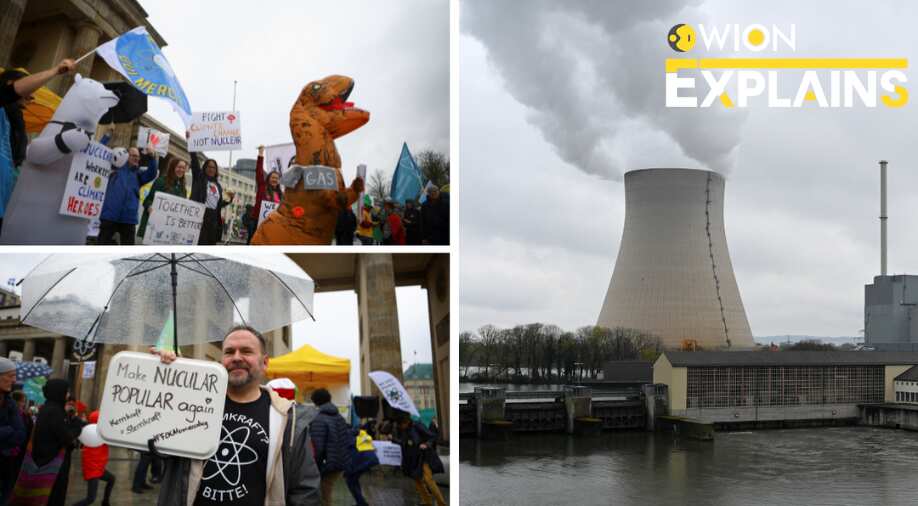
At midnight, Berlin would mark the six-decade programme which has witnessed some of the strongest protest movements in the continent. The smoking towers of Isar II, Emsland and Neckarwestheim II reactors will be shut as Germany will enact its plan for fully-renewable electricity generation by 2035.
The nuclear-phase out plan has been in motion since 2002 but gained momentum when Merkel was chancellor in 2011 and following the Fukushima nuclear disaster in Japan.
ALSO WATCH |Germany to shut down last three nuclear power plants; new plan to focus on renewable energy
Additionally, Germany’s strong anti-nuclear movement which still holds lingering fears from the Cold War conflict and nuclear disasters such as Chernobyl in Ukraine had pressured successive governments to end the use of a technology that critics have argued is unsafe and unsustainable.
What was the holdup?
The three plants were scheduled to be turned off by December 2022, however, due to the Russian invasion of Ukraine over a year ago, they received a brief extension. Europe’s largest economy like others was also grappling with the fallout of the Russian invasion of Ukraine and scrambled to find substitutes for Moscow’s cheap pipeline gas.
The government in Berlin, like the rest of Europe, was not sure if they would be able to power themselves through the winter. Notably, the situation in Germany was relatively stable when compared to others which can be attributed to the country’s natural gas buying spree and the firing up of old coal power plants.
ALSO READ |Climate crisis cost Germany at least 80 billion euros since 2018: Report
But given the uncertainty over power supply, incumbent Chancellor Olaf Scholz announced he would keep the nuclear plants going for three and a half more months, extending the initial December deadline to April 15.
Does everyone agree with this decision?
According to Deutsche Welle (DW), the shutdown also comes at the end of 22,596 days and plenty of heated debate. Many lawmakers across the political spectrum took to Twitter and expressed their views on the decision. “Goodbye nuclear power! Goodbye insecure, unclean, uneconomical energy policy!” said Scholz. While his party SPD on their official page showed an image of a collapsing nuclear power plant cooling tower.
ALSO WATCH |WION Climate Tracker: Germany's highest peak melts dramatically
On the other hand, the FDP leader and Finance Minister Christian Lindner took to the microblogging platform and said he was not happy with the decision. While agreeing that renewable energy is the future he said that “in the meantime we have to secure our supply until we have sufficient capacity,” adding that if it were up to him Germany would retain the last three power plants in reserve.
Environmental groups celebrate
Environmental groups marked the day with celebrations outside the three reactors and rallies in major cities, including Berlin. Greenpeace, an environmental NGO, organised a demonstration at the Brandenburg Gate on Saturday and said, “Finally, nuclear energy belongs to history!”. Meanwhile, Munich celebrated a “nuclear exit festival” which witnessed the presence of several hundred people to mark the milestone.
What next?
Germany’s government has previously agreed that in the short term, the country would have to rely on coal and natural gas to meet its energy needs. This comes as Germany aims to be carbon neutral by 2045 and has been ramping up its electricity production from solar and wind. As of last year, the three soon-to-be dismantled plants accounted for only six per cent of the country’s energy.
ALSO WATCH |Climate Activists clashes with police over coal mine expansion in Germany
Meanwhile, several nuclear power plants will undergo the costly process of dismantling while figuring out what to do with the highly radioactive material accumulated over six decades. Germany still needs to find a permanent repository for around 1,900 highly radioactive casks of nuclear waste by 2031.
“Nuclear power supplied electricity for three generations, but its legacy remains dangerous for 30,000 generations,” said Environment Minister Steffi Lemke, as per Euronews. He added that many risks of civilian atomic facilities were unconsidered, including their becoming targets during conflicts.
(With inputs from agencies)
WATCH WION LIVE HERE
You can now write for wionews.com and be a part of the community. Share your stories and opinions with us here.