Fire and fury warning to North Korea maybe not enough: Trump

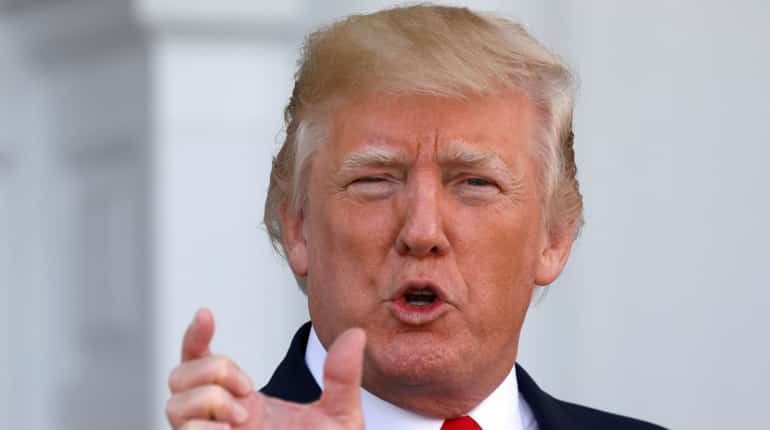
Trump
The war of words has set off diplomatic alarm bells, and raised fears of a miscalculation that could lead to catastrophic consequences on the Korean peninsula and beyond.
President Donald Trump on Thursday hardened his warning thatNorthKoreawould face "fire and fury" if it kept threatening the US, saying maybe that tough talk "wasn't tough enough."
However, US Defence Secretary Jim Mattis later appeared to step back from the dire rhetoric of his boss. He described the prospect of war as "catastrophic" and added that diplomatic efforts to solve theNorthKoreanuclear crisis were yielding results.
Trump in his new remarks Thursday also warnedNorthKoreait should be "very, very nervous" of the consequences if it even thinks of attacking US soil, after nuclear-armed Pyongyang said it was readying missile launch plans on the Pacific territory of Guam.

The Republican billionaire dismissed any criticism of his "fire and fury" warning of Tuesday, citing threats made by the regime of Kim Jong-Un to both Washington and its allies.
"It's about time that somebody stuck up for the people of this country and for the people of other countries. So if anything, maybe that statement wasn't tough enough," Trump said.
Trump also said China, Pyongyang's main diplomatic ally, could "do a lot more" to pressure Kim to end his country's nuclear weapons and ballistic missile programs.
)
US vs China over South China Sea: Washington backs Philippines, Beijing hits back
)
Bigg Boss 20: Isha Rikhi evicted after three weeks in Salman Khan’s show
)
Musk plans to more than double xAI's chips to over 1.2 million Nvidia GPUs by year-end
)
After JU, clash erupts at SRFTI: BJP’s ‘Dimagi Naxal’ jibe sparks political firestorm after students protest RSS-linked event
)
‘Anti-social elements spreading false rumours’: LPU issues statement amid massive unrest over alleged rape
)
LPU students go on rampage, vandalise campus amid widespread protest: What's happening
)
Trump asked Xi to pressure Iran. China did not say yes — here’s what Beijing wants
)
US Treasury Secretary Scott Bessent hails global crackdown on Iranian banks and airlines
)
An OpenAI agent escaped its locked test cage again, by hiding questions in DNS lookups
)
'Our video was trimmed': LPU girls who featured in rape-denial video make U-turn
)
3 males killed, four others injured in shooting after fight at strip club in Detroit
)
'Victory for low-budget consumers': Raghav Chadha hails 30-day telecom recharge rules
)
Claude rebuilt the 1989 game 'Prince of Persia' by reusing the original's own code
)
Beyond metros: How Tier-2 and Tier-3 cities could drive India’s next AI wave
)
Tesla builds first Cybertruck with its own refined lithium: Elon Musk's $1 billion Texas bet pays off
)
IndiGo flight suffers tail strike in Bengaluru while landing; DGCA to probe incident
)
The US and China set up an AI 'red telephone', but skipped the rulebook
)
‘Terror suspects arrested near UK air base were looking to do big damage’: Trump
)
Russian envoy claims US tactics to contain India were revealed in ‘Freudian slip’
)
IND vs WI 1st ODI: Kohli breaks Sachin's most runs in one country record with unbeaten 139 as India thump West Indies by 8 wickets
)
Researchers rebuilt exactly how 700 AI agents hacked Hugging Face: a 900-link chain trick
)
‘Olympic inclusion is our major target’: WPA President Ishaun Singh on pool’s global ambitions
)
Nations League: Spain sink England at Wembley; Modric shines for Croatia
)
Why has Iran released no proof of life of Mojtaba Khamenei? Araghchi reveals...
)
'What kind of confession is this?': Pakistan PM Shehbaz Sharif’s 'terrorists would be roaming New York' remark goes viral, raises alarm online. Watch
)
South Korea demands apology from Ukraine over North Korean prisoners' transfer
)
Beyond BrahMos: India targets Rs 50,000 crore in defence exports with unmatched price edge
)
Sri Lankan Tamil migrant worker gets death sentence in Saudi Arabia, help sought from India
)
Muslim marriage cannot shield sex with minor wife from prosecution under POCSO: Delhi HC
)
'Can't help but draw painful parallels to Nirbhaya case': SC on latest incidents of rape cases in Delhi-NCR
)
99.9% more powerful - Scientists find boy who can recall memories from just 3 months of age
)
'FIRST LOOK from inside Noah’s Ark': Researchers share video from inside mysterious mound in Turkey
)
UNSC reform momentum grows: Russia, Portugal, Mauritius push for India's permanent seat bid
)
8 US marines injured in Iranian missile attack on vessel in Strait of Hormuz: Report
&im=FitAndFill=(700,400))
New OTT releases this week (September 28-October 4, 2026): Dupahiya 2, Pooja Meri Jaan, Ohh My Dog- 5 titles coming on Netflix, Prime Video and more
)
Afghanistan says 28 fighters killed in clash near Pakistan border, Islamabad denies
)
Ceuta migrant crisis: Protesters take to streets as Spain grapples with migrant challenge
)
LPU suspend classes, postpones exams as violence escalates over rape claims: What's happening
)
New York City wants a 'kill switch' on every AI, and will pay whistleblowers who report violations
Trump's comments, made from his golf club retreat in New Jersey, came after theNorthannounced a detailed plan to send four missiles over Japan and towards Guam, where some 6,000 US soldiers are based.
Pyongyang said the scheme to target the island, a key US military outpost in the western Pacific, was intended to "signal a crucial warning" as "only absolute force" would have an effect on a US leader "bereft of reason."
Trump fired back with gusto.
"IfNorthKoreadoes anything in terms of even thinking about an attack on anybody we love or we represent or our allies or us, they can be very, very nervous," he told reporters, with Vice President Mike Pence at his side.
"And they should be... because things will happen to them like they never thought possible."
'Better get their act together'
Relations between Washington and Pyongyang have been tense for months, in the wake of theNorth's repeated missile tests, including two successful intercontinental ballistic missile (ICBM) test launches in July.
Those launches put the US mainland in range. Some experts believe the second missile could potentially reach New York.
The escalating saber-rattling took an unexpected turn Tuesday when Trump seemed to borrow from theNorth's arsenal of rhetoric and said it faced "fire and fury like the world has never seen" if it continued to threaten the US.
That prompted a defiant Pyongyang to threaten the missile attack on Guam.
The war of words has set off diplomatic alarm bells, and raised fears of a miscalculation that could lead to catastrophic consequences on the Korean peninsula and beyond.
The region is facing "a mini Cuban missile crisis," John Delury, a professor at Seoul's Yonsei University, told AFP.
And speaking at an event in California, Mattis appeared intent on dialing back the tension, explaining his mission and responsibility was to have military options ready "should they be needed" but stressing the US effort is currently focused on diplomacy.
"The American effort is diplomatically led, it has diplomatic traction, it is gaining diplomatic results and I want to stay right there right now," Mattis said at an event in California.
"The tragedy of war is well-enough known it doesn't need another characterization beyond the fact that it would be catastrophic," he added.
Mattis did not elaborate on the diplomatic results he referenced, but the UN Security Council at the weekend passed a new set of sanctions against Pyongyang over its weapons program, including bans on the export of coal, iron and iron ore, lead and lead ore as well as fish and seafood.
The new punishment could costNorthKorea$1 billion a year, and even China voted for the US-drafted proposal.
Trump dismissed the notion that his administration was delivering mixed messages and said Washington remained open to negotiations.
But he once again suggested that he expected China to "do a lot more" to bringNorthKoreainto line.
"I will tell you this,NorthKoreabetter get their act together or they're going to be in trouble like few nations have ever been in trouble in this world, okay?" he added.
Unusual detail
InNorthKorea, General Kim Rak-Gyom, the commander of theNorth's missile forces, dismissed Trump's "fire and fury" remarks as "a load of nonsense," according to Pyongyang's official Korean Central News Agency.
"Sound dialogue is not possible with such a guy bereft of reason," he added.
The military was expected to finalize its Guam plan by mid-August and submit it to Kim for consideration,he said.
The unusually precise statement said the four missiles would be launched simultaneously and overfly the Japanese prefectures of Shimane, Hiroshima and Kochi.
They would have a flight time of 17 minutes 45 seconds, travel 3,356.7 kilometers (around 2,086 miles) and come down 30 to 40 kilometers away from Guam, it said -- just outside US territorial waters.
Japan, which has in the past warned it would shoot down anyNorthKorean missiles that threaten its territory, responded that it could "never tolerate" provocations from the reclusive state.
Analysts said aNorthKorean launch towards Guam would put the US in a dilemma: if it did not try to intercept the missiles, its credibility would be damaged and theNorthwould feel emboldened to carry out a full-range ICBM test.
But if an intercept were attempted and failed in any way, it would undermine the effectiveness of the United States' ballistic missile defense system.