Explainer | North Korea set to launch 1st military spy satellite in June: What you should know

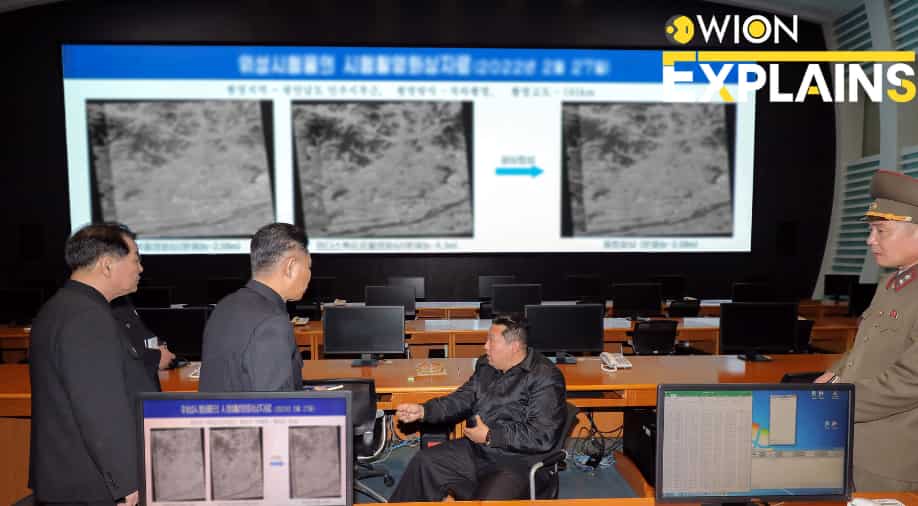
North Korea's 1st military spy satellite launch in June: What you should know
North Korea on Tuesday confirmed that it will launch a spy satellite by June 1. The country has said that the reconnaissance satellite is needed to monitor the military movements of the US and its allies in real-time.
The launch has spurred concerns from Seoul, Tokyo and Washington, which assert that this move by the country would transgress UN sanctions.
North Korean leader Kim Jong Un has made designing such a satellite the top military priority for his government. He has personally examined it, approving its future launch.

The North's state Korean Central News Agency cited Ri Pyong Chol, vice-chairman of the ruling party's central military commission, as saying the "military reconnaissance satellite No. 1" would be "launched in June".
The statement said that the satellite, along with "various reconnaissance means due to be newly tested, are indispensable to tracking, monitoring... and coping with in advance in real time the dangerous military acts of the US and its vassal forces."
North Korea informs Japan of its plan to launch satellite
)
No Pandya as Auqib Nabi earns maiden ODI call-up; Mayank returns for WI T20Is| check full squads
)
Trump praises India’s Opium crackdown, hails anti-drug efforts
)
Sydney Sweeney defends provocative ad choice, the internet is still not impressed
)
Former India player Diana Edulji wants Smriti Mandhana to replace Harman as skipper at the earliest
)
Trump calls Canada-EU associate membership plan ‘laughable’ and threatens 'very serious tariffs'
)
Protests erupt over migrant housing plan in Piddington
)
Shahzad Bhatti Network declared terrorist organisation under UAPA: Govt order
)
Europe wants a common playbook for security threats, seeks security beyond NATO
)
240-million-year-old bizarre 'pig with a tusk' creature creates new dilemma over origin of dinosaurs
)
Formula One reveals the 2027 race calendar; Monaco to host sprint race for the first time
)
All Indian goods to get duty-free access to New Zealand
)
Bigg Boss 20: Mahhi Vij reveals she lost Yuva role to Kareena Kapoor; 'didn’t work out in my favour'
)
Lionel Messi for 2026 Ballon d’Or over Mbappe and Yamal, says Diego Simeone
)
US House votes 417-3 to pass Ratepayer Protection Act targeting AI data center electricity costs
)
Hong Kong unveils 11 new measures to boost birth rates, offers higher cash bonuses and housing perks
)
Former OpenAI researcher warns of growing risks from Artificial Intelligence
)
Veteran actor Anant Nag honoured with Indian cinema’s highest award
)
Wildfire tears through forests in Spain's Valencia
)
AUS vs SA: Steve Smith still gets 'little flashbacks' from sandpaper gate
)
Pakistan naval vessel returns to harbour with 'severe damage' after collision with Indian warship in Arabian Sea
)
Fed raises rates for first time in 3 years, Kevin Warsh defies Trump as inflation mounts
)
Katrina Kaif’s postpartum weight is not the problem; your gaze is
)
Taiwan seeks deeper India ties as direct flights restart soon and chip projects advance
)
Daayra movie review: Kareena Kapoor, Prithviraj Sukumaran shine in Meghna Gulzar’s cop-versus-cop crime thriller
)
Saudi Vs Houthis: Yemeni military rebels clash with Houthis
)
Pak batter Rizwan's petition against being questioned by cyber crime agency rejected by court
)
US trade tariff: 100% tariff targets Russian buyers amid trade tensions
)
Pakistan: Imran Khan's sons Kasim & Sulaiman claim their father is 'tortured' in jail
&im=FitAndFill=(700,400))
New OTT releases this week (September 14-20, 2026): Lust Stories 3, Waiting Hai, Irumudi- 5 new titles coming on Netflix, Prime Video and more
)
Ebola outbreak: WHO sees encouraging signs in fight against Ebola outbreak
)
Trump gets new power to hit India, China with up to 100% tariffs as US Senate clears Russia sanctions bill
)
Prime Minister Narendra Modi's birthday: Italian PM Meloni sends birthday wishes
)
‘Imagine 50 AI fighters cornering one manned jet’: India’s mobbing doctrine eyes a new era of air warm
)
Saudi vs Houthis: Riyadh claims to have shot Houthi drone targeting Mecca
)
US Treasury rallies global financial institutions for Op Economic Outcast to isolate Iran
)
India breaks silence on US Russia sanctions bill, 100% tariff threat: ‘Committed to energy security’ for 1.4 billion
)
Want to get married within a year? Why 18 lakh people rush to Jaipur for ‘sacred henna’
)
Pakistan boycotts chess match against Israel at Olympiad
)
UN General Assembly 2026: What is veto power. Which countries have it and how does it work?
&im=FitAndFill=(700,400))
Suriya and Jyothika say ‘I do’ again after 20 years! See their dreamy wedding pics
)
Abhishek Sharma rises to No. 2 in T20Is; ENG’s Robinson 3rd after record Pakistan Tests
)
The Early Spring season 2 is happening, but fans have one request - 'don't change the actors'
North Korea, on Monday, informed Japan of its plan to launch what it calls a 'satellite' between May 31 and June 11, said a Japanese coast guard official.
As per the Japanese officials, the launch is set to involve a ballistic projectile, according to a tweet from the prime minister's office, that alludes to a "ballistic missile that it (Pyongyang) describes as a satellite."
Analysts believe that North Korea is launching its military 'satellite' in an attempt to improve its surveillance technology and advance its ability to strike targets whenever a conflict occurs.
In a tweet, the Japanese prime minister's office said that PM Fumio Kishida has issued instructions "on North Korea's notification about the launch of a ballistic missile that it describes as a satellite".
He further urged North Korea to abstain and said he would work closely with allies.
"We strongly urge North Korea to refrain from launching," the prime minister's office said on Twitter, adding it would cooperate "with relevant countries such as the USand South Korea".
Japan puts missile defences on alert
After North Korea notified Japan of its plan to launch the satellite, it put its ballistic missile defences on alert and also vowed to knock down any missile that threatens its territory.
"We will take destructive measures against ballistic and other missiles that are confirmed to land in our territory," Japan's defence ministry said in a statement.
The ministry said that the soldiers would be authorised to use Standard Missile SM-3 and Patriot Missile PAC-3 to destroy the missile in mid-air.
"Even if it's described as a satellite, a launch using ballistic missile technology would be a violation of United Nations Security Council resolutions and a serious problem that threatens the safety of people," PM Kishida told reporters.
South Korea, US 'closely monitoring' situation
On Tuesday, South Korea's military released a statement saying that it was closely working with USintelligence authorities for “a possible provocation” from North Korea’s satellite launch.
North Korea will launch its first military reconnaissance satellite in June to monitorUSmilitary activities, its state media reported on Tuesday.
“South Korea and the USintelligence authorities are closely monitoring related movements in close cooperation and monitoring a possible provocation of the so-called satellites claimed by North Korea,” said South Korea’s Joint Chiefs of Staff (JCS), Han Sung-Keun, during a regular news briefing at the defence ministry.
Launch to be a crucial element in advancing the country's nuclear programme: Analysts
According to analysts, North Korea's first spy satellite, which it announced it will launch in June, will be a critical component in expanding the country's nuclear programme.
“If there is no military reconnaissance satellite, it is like operating a missile without sight. It (the satellite launch) is very essential and very important to operate nuclear missiles," Reuters quoted Hong Min, a senior fellow at the South's Korea Institute for National Unification, as saying.
"(North Korea) is expected to participate in Hangzhou Asian Games hosted by China in September, so they are trying to strengthen nuclear forces in their own ways until the first half of the year," Yang Moo-jin, a professor at the University of North Korean Studies said on the timing of the launch.
North Korea banned from using ballistic projectile technology by UN sanctions
A barge of UN sanctions has banned North Korea from using any projectile technology, which also includes Kim Jong Un's administration to "not conduct any further nuclear test or any launch using ballistic missile technology".
Pyongyang, which regularly defies these regulations describing them as a breach of its liberation, has test-fired multiple intercontinental ballistic projectiles already this year.
Though the country never gives an advance warning of its missile tests, as per experts, since the country considers itself a law-abiding global power, it has chosen to informinternational authorities of planned satellite launches.
The issue is that the technology used for both satellite launches and ICBMs is "essentially the same," AFP quoted Choi Gi-il, professor of military studies at Sangji University, as saying.
Is this Pyongyang's first satellite launch?
According to the experts, North Korea does not have a functional satellite in space.
Pyongyang has launched five satellites since 1998, out of which, three failed immediately and two appeared to have been positioned into orbit.
Though, signals from the ones into orbit have never been independently detected, which indicates a possibility of those being in a non-functional state.
"Satellites launched by North Korea in the past were effectively ICBM tests disguised as normal satellites," An Chan-il, a defector-turned-researcher who runs the World Institute for North Korea Studies, told AFP.
"The upcoming launch is being advertised by Pyongyang as a state-of-the-art satellite," he said, adding it showed the North was eager to enter "the so-called 'military space era' before Seoul does".
Is this a race between the South and North?
Seoul's defence ministry told AFP that South Korea is yet to develop a satellite "specifically and solely for military purposes".
In response, "Kim Jong Un has likely increased pressure on his scientists and engineers to launch a North Korean spy satellite," Leif-Eric Easley, a professor at Ewha University in Seoul, told AFP.
It is doubtful North Korea "has the remote sensing technologies for a proper reconnaissance satellite. However, even a rudimentary eye in the sky could have military uses and would offer domestic political value for the Kim regime".
Will the launch be successful?
"North Korea is known to have failed a number of times," AFP quoted Choi of Sangji University as saying about ICBM's re-entry into the atmosphere.
However, "it is rumoured there was a transfer of know-how from Russia and China to the North, though it is not officially confirmed," he said.
"Even a failed satellite launch, like in 2016, shows North Korea's capability and intentions to develop longer-range ballistic missiles", the Washington-based Center for Strategic and International Studies said at the time.
"It is an attempt by Pyongyang to show it has the capability to keep Seoul's nuclear deterrent in check with a spy satellite. They are sending this message: 'We can see you through and strike anytime.'"
(With inputs from agencies)
WATCH WION LIVE HERE