Drone footage shows struggling killer whales trapped in ice off Japan's Hokkaido

Killer whales
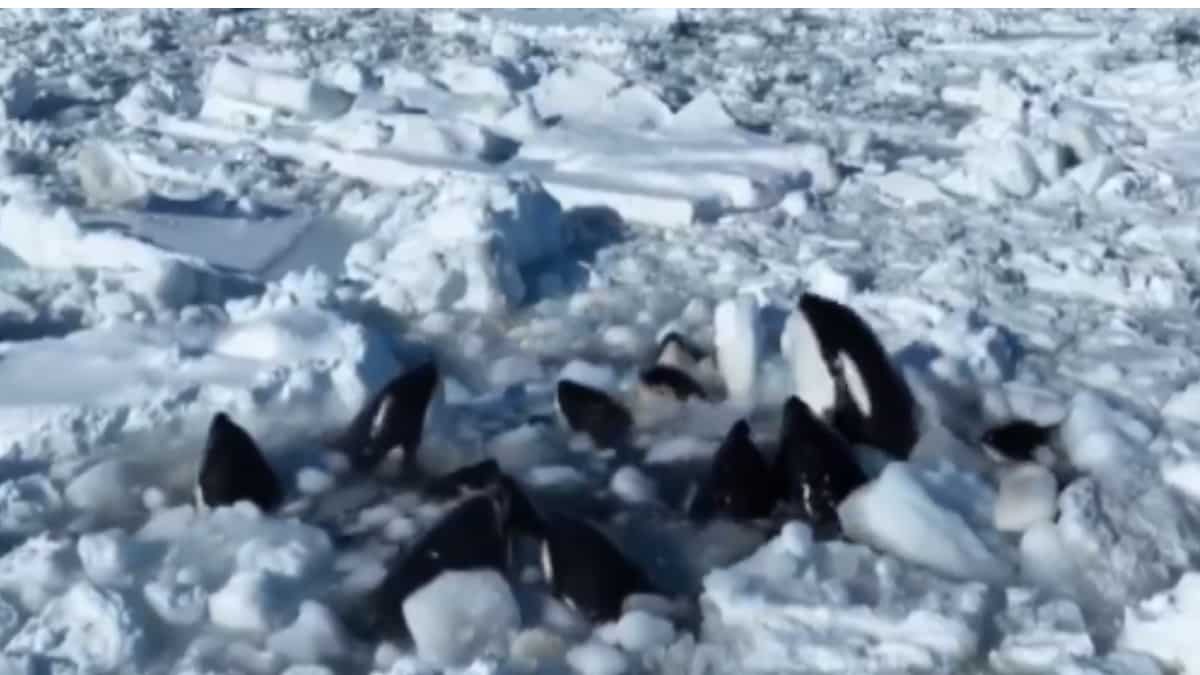
A pod of orcas, or killer whales, appeared to be trapped in drift ice off the coast of Hokkaido in northern Japan on Tuesday (Feb 6), causing concerns among authorities and environmentalists.
NHK, which is a Japanese public broadcaster, aired footage on Tuesday (Feb 6), which showed at least 10 orcas. The killer whales were seen poking out of a small gap in the surface. The drone footage was provided by the group Wildlife Pro.
They were spotted struggling in the water that is about 1 km off the coast of Rausu on the Shiretoko peninsula, which is a Unesco world heritage site famed for its abundant wildlife.

The killer whales were seen clustered together and appeared to be sticking their heads out of the water to breathe. The largest cetaceans can spend extended periods of time underwater, although killer whales typically stay submerged for only a few minutes.
As per a report in the Japanese Yomiuri newspaper, the drift ice had been moving southward and reached the coast of Rausu on Tuesday morning.
)
What’s in a name? Trump’s 'Lake America' move gets a tit-for-tat response from Canada
)
CNN, Politico and MS NOW back in White House after judge blocks Trump’s media ban
)
US judge questions Trump’s decision to ban CNN, MS NOW and Politico from White House
)
Italy hit by floods in the north, drought in the south
)
'We would all be dead': Netanyahu defends decision to strike Iran's nuclear facilities in his UN speech
)
Mumbai Indians appoint Luke Williams as head coach for Women’s Premier League
)
'There will be elections': Venezuela's interim leader Delcy Rodriguez makes big announcement at UN
)
IIT Bombay CCTV footage emerges: Sahil Wakode seen looking at phone in examination hall
)
Welcome actor Mushtaq Khan dies at 56 after battling cancer
)
Shah Rukh Khan is India's richest actor, Amitabh Bachchan is second: Hurun List 2026
)
Trump's welcome to Xi demonstrates 'attraction' to dictators: Chuck Schumer
)
WION Iconic Tourism Summit 2026: Union Minister Shekhawat on 'experiential travel', peace diplomacy
)
Property registration becomes faster, convenient as model sub-registrar offices open in Maharashtra
)
'AI got into my speech': Prince Harry jokes after teleprompter failure at event in New York
)
250-pound WWII bomb found in Falmouth harbour in England
)
Scientists detect first radio signals directly from faraway planet
)
What’s on the menu? Inside Trump’s lavish White House state dinner for Xi
)
China to test supersonic jet that moves at Mach 2, double the speed of sound
)
Xi Jinping's 'special plane' vs Trump's Air Force One: What's the difference?
)
Forget the smartphone: This tiny gadget could be Meta’s answer to the post-smartphone era
)
Hours before Xi-Trump meeting, US announces visa curbs targeting birth tourism: What is it?
)
'Partners rather than rivals': Xi Jinping's first message after landing in US for Trump summit
)
Yemen called Trump for US military support in fight against Houthis: Official
)
WION Iconic Tourism Summit: Is India's travel boom outrunning its airports, airlines and hotels?
)
2,000-foot tube, laser tests and more: China builds towns to expand nuclear arsenal, satellite images show
)
Meet Adrian Abraham: 9-year-old Indian-origin guitar prodigy aiming for a Guinness World Record
)
Trump-Xi state dinner 2026: Who is invited? Full guest list of tech CEOs, business leaders and officials
)
Australian PM Anthony Albanese calls OpenAI AI incident 'unacceptable' after restricted data access
)
'What kind of confession is this?': Pakistan PM Shehbaz Sharif’s 'terrorists would be roaming New York' remark goes viral, raises alarm online. Watch
&im=FitAndFill=(700,400))
Netanyahu at UN: Mass walkout, attack on Mamdani and Iran threats | In Pics
)
Russia likely to target Spain, France and Italy in drone attacks, warns CIA: Report
)
WION Iconic Tourism Summit: How local tourism MSMEs must upskill for AI integration
)
Trump’s Board of Peace unveils $2.45bn Gaza plan,66 projects: But where’s the money?
)
‘Both will lose in confrontation’: Xi says US and China should ‘coexist in peace’
)
For the first time, the UN Security Council sat US and Chinese AI makers at the same table
)
EC appointment law: Why is the 2023 act controversial, and what happens next? WION explains
)
Israeli envoy to US Yechiel Leiter’s son critically injured in West Bank ramming attack
)
'Fund people, not bombs': Hundreds take to New York streets as Netanyahu delivers speech at UN; dozens arrested
)
WATCH | China President Xi Jinping lands in US as Trump greets him ahead of high-stakes summit
)
Hamilton wants to race in Middle East despite not knowing 'what risk levels are'
The Yomiuri said that in 2005, nine killer whales died after getting trapped in drift ice off Rausu.
Watch the video here:
The coast guard had been alerted by a fisherman, but all the attempts to free the mammals have failed so far because the thick ice had made it impossible.
As quoted in reports, a Rausu official told NHK, "We have no choice but to wait for the ice to break up and for them to escape that way."
As mentioned in media reports, Seiichiro Tsuchiya, who is a marine life expert, told the station that he observed the pod while conducting research into the local sea lion population. He filmed the animals using a drone.
He said, "I saw about 13 killer whales with their heads sticking out of a hole in the ice. They seemed to be struggling to breathe, and it looked like they included three or four calves."
Every winter, drift ice blankets the sea off the eastern coast of Hokkaido, Japan's northernmost main island. The amount of ice has reduced in recent years as a result of rising water temperatures induced by the climate catastrophe.
(With inputs from agencies)