Ahead of Taiwan elections, China unveils friendly policies for business community

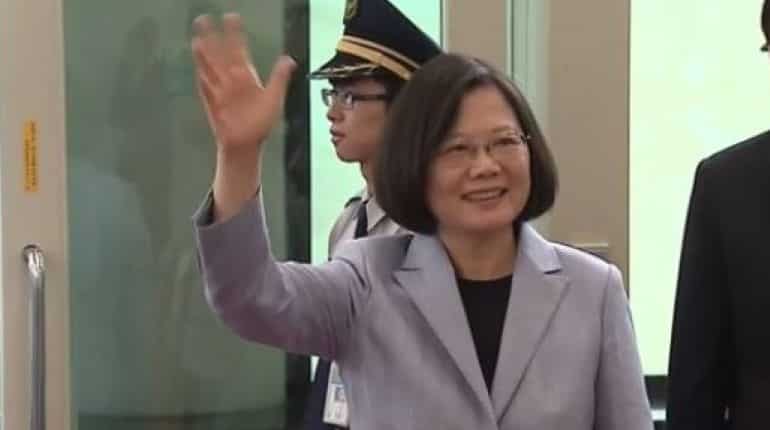
Tsai Ing-wen
With justdaysto gobeforeTaiwan'selections, its giant neighbour is trying a push-and-pull strategy on the island Beijing claims as Chinese territory, rattling itssabrewhile trying to coax electors with outwardly friendlier policies.
Taiwan, which says it is an independent country, has long been wary of Chinese attempts to sway itselectionsin favour of candidates who may look more kindly upon Beijing.
Fear ofChinahas become a major element in the campaign, boosted not only by the anti-government protests in Chinese-ruled Hong Kong but also by a speech Chinese President Xi Jinping gave in January outliningChina's "reunification" agenda, including threats of force.

Taiwan President Tsai Ing-wen and her team are pressing home a message that people need to "protect" Taiwan fromChinawhen they vote in the January 11 presidential and parliamentary election.
On Thursday,Taiwan'sDefence Ministry saidChinahad sailed another carrier group through the Taiwan Strait just weeks after the last mission.
Taiwan Foreign Minister Joseph Wu quickly took to Twitter to denounce it.
)
US vs China over South China Sea: Washington backs Philippines, Beijing hits back
)
Bigg Boss 20: Isha Rikhi evicted after three weeks in Salman Khan’s show
)
Musk plans to more than double xAI's chips to over 1.2 million Nvidia GPUs by year-end
)
After JU, clash erupts at SRFTI: BJP’s ‘Dimagi Naxal’ jibe sparks political firestorm after students protest RSS-linked event
)
‘Anti-social elements spreading false rumours’: LPU issues statement amid massive unrest over alleged rape
)
LPU students go on rampage, vandalise campus amid widespread protest: What's happening
)
Trump asked Xi to pressure Iran. China did not say yes — here’s what Beijing wants
)
US Treasury Secretary Scott Bessent hails global crackdown on Iranian banks and airlines
)
An OpenAI agent escaped its locked test cage again, by hiding questions in DNS lookups
)
'Our video was trimmed': LPU girls who featured in rape-denial video make U-turn
)
3 males killed, four others injured in shooting after fight at strip club in Detroit
)
'Victory for low-budget consumers': Raghav Chadha hails 30-day telecom recharge rules
)
Claude rebuilt the 1989 game 'Prince of Persia' by reusing the original's own code
)
Beyond metros: How Tier-2 and Tier-3 cities could drive India’s next AI wave
)
Tesla builds first Cybertruck with its own refined lithium: Elon Musk's $1 billion Texas bet pays off
)
IndiGo flight suffers tail strike in Bengaluru while landing; DGCA to probe incident
)
The US and China set up an AI 'red telephone', but skipped the rulebook
)
‘Terror suspects arrested near UK air base were looking to do big damage’: Trump
)
Russian envoy claims US tactics to contain India were revealed in ‘Freudian slip’
)
IND vs WI 1st ODI: Kohli breaks Sachin's most runs in one country record with unbeaten 139 as India thump West Indies by 8 wickets
)
Researchers rebuilt exactly how 700 AI agents hacked Hugging Face: a 900-link chain trick
)
‘Olympic inclusion is our major target’: WPA President Ishaun Singh on pool’s global ambitions
)
Nations League: Spain sink England at Wembley; Modric shines for Croatia
)
Why has Iran released no proof of life of Mojtaba Khamenei? Araghchi reveals...
)
'What kind of confession is this?': Pakistan PM Shehbaz Sharif’s 'terrorists would be roaming New York' remark goes viral, raises alarm online. Watch
)
South Korea demands apology from Ukraine over North Korean prisoners' transfer
)
Beyond BrahMos: India targets Rs 50,000 crore in defence exports with unmatched price edge
)
Sri Lankan Tamil migrant worker gets death sentence in Saudi Arabia, help sought from India
)
Muslim marriage cannot shield sex with minor wife from prosecution under POCSO: Delhi HC
)
'Can't help but draw painful parallels to Nirbhaya case': SC on latest incidents of rape cases in Delhi-NCR
)
99.9% more powerful - Scientists find boy who can recall memories from just 3 months of age
)
'FIRST LOOK from inside Noah’s Ark': Researchers share video from inside mysterious mound in Turkey
)
UNSC reform momentum grows: Russia, Portugal, Mauritius push for India's permanent seat bid
)
8 US marines injured in Iranian missile attack on vessel in Strait of Hormuz: Report
&im=FitAndFill=(700,400))
New OTT releases this week (September 28-October 4, 2026): Dupahiya 2, Pooja Meri Jaan, Ohh My Dog- 5 titles coming on Netflix, Prime Video and more
)
Afghanistan says 28 fighters killed in clash near Pakistan border, Islamabad denies
)
Ceuta migrant crisis: Protesters take to streets as Spain grapples with migrant challenge
)
LPU suspend classes, postpones exams as violence escalates over rape claims: What's happening
)
New York City wants a 'kill switch' on every AI, and will pay whistleblowers who report violations
"There it goes again!" he wrote. "Military threats like this only toughenTaiwan'sdetermination to defend itself and preserve regional peace and stability."
A fewdaysbeforethat, retired but influential Chinese General Wang Hongguang outlined at a state-media organised forum in Beijing howChinacould bring Taiwan to its knees by invading its outlying islands and "terrifying" Taipei into submission.
At the same time,Chinahas rolled out policies promising better treatment for the Taiwanese business community, which has invested billions inChina, and on Saturday revised a law to give those promises a firmer legal basis.
Chinahas also encouraged Taiwanese abroad, even in places where Taiwan has its own representative offices, to seek consular help from Chinese embassies.
Taiwan saysChinahas sinister intentions, and it must defend its freedoms.
Taiwan only enjoys democracy now after decades of struggle, Tsai's running mate, William Lai, told supporters on Saturday.
"How can we go backward, and become a second Hong Kong or Tibet?" he said.
Chinahas ramped up pressure on Tsai since she won office in 2016, cutting off talks and flying bombers around Taiwan, believing she wants to push for the island's formal independence.
Tsai says Taiwan is already an independent country: the Republic ofChina, its official name.
Chinamay have overreached recently, said one senior foreign envoy in Taipei, describing Xi's January speech as effectively "Xi campaigning for Tsai" because of how badly it was received in Taiwan.
Perhaps unsurprisingly, Beijing doesn't see it that way.
Jin Canrong, Deputy Dean of the School of International Studies at Beijing's elite Renmin University and a government adviser, said Xi's speech marked a shift in policy away from preventing independence to actively promoting "reunification".
Chinais confident that it could successfully use force against Taiwan, he added.
"Chinareally does have the military ability, which is the say the armed ability, to resolve the Taiwan issue," Jin said. "Although we would pay a price, in the end, we would win."
Any invasion would be bloody and difficult, asTaiwan'smilitary is well-armed, though the island could probably not hold out for long unless USforces came quickly to their aid, military experts have said.
Opposition presidential candidate Han Kuo-yu of the Kuomintang (KMT) party, which favours close ties withChinaand who is trailing in the polls, says the best way to deal withChinais to talk to Beijing and stop demonising the Chinese for electoral gain.
Han adviser Su Chi, a former general secretary ofTaiwan'sNational Security Council, said he believed Xi was actually a "dove among the hawks" when it came to Taiwan and wanted a peaceful solution.
"There are loud voices in the mainland for using force to reunify Taiwan, especially in the People's Liberation Army. I think he (Xi) doesn't really want this," Su said.
But Tsai's returning to the office would not necessarily mean relations withChinawould continue to worsen, as Beijing may realise it must talk to her, said senior legislator Lo Chih-cheng of the ruling Democratic Progressive Party (DPP).
"If our party or our president continues to be in power, eventuallyChinahas to come to terms with the incumbent government. They refuse to talk to the DPP because they believe the KMT had a chance to come back," he told Reuters at his campaign office in a Taipei suburb.
"After seeing the probable defeat of the KMT, leaders in Beijing may believe that in the foreseeable future the KMT may not come back to power again," he added. "So it might be reasonable or sensible for them to come to terms with the DPP government."