Cash-strapped Africa overwhelmed by COVID vaccine challenge

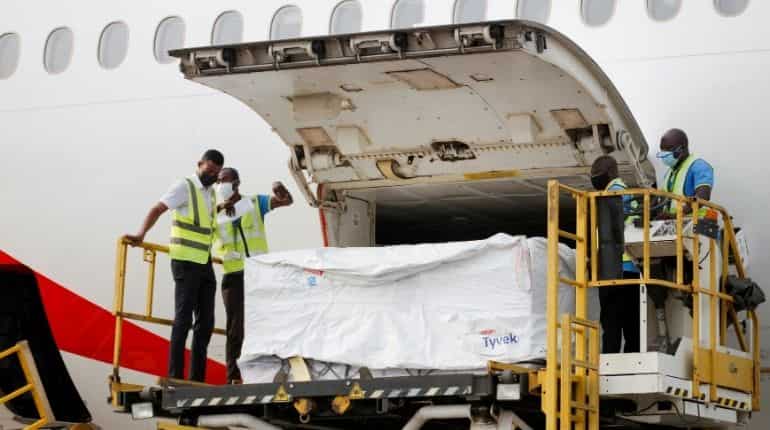
Workers offload boxes of essential medical supplies (Representative Image)
When Ghana received 50,000COVID-19vaccinedoses from India last month, it hit a frustrating roadblock: it had not trained enough staff to distribute them.
The country was still rolling out shots received in late February from the globalvaccine-sharing scheme COVAX, and didn't have the capacity to expand that operation, according to the head of Ghana's immunisation programme.
Rather than going straight into the arms of health workers, the additional doses were put in cold storage in the capital Accra, Kwame Amponsa-Achiano told Reuters, adding that his team had received two days' notice about the shipment.

"We were in the middle of the first campaign," Amponsa-Achiano said. "How do you plan for 50,000 when you already are doing another campaign?"
The problems faced by Ghana, one of sub-SaharanAfrica's more economically developed nations, illustrate how a continent with experience in battling deadly infectious diseases has found itself ill-prepared to inoculate people against this pandemic.
ManyAfrican countries, already facing a shortage of affordablevaccines, are being stunned by the unprecedented scale of the distributionchallengewhen doses do arrive.
)
New Zealand farms shift to carbon forests: Carbon credits fuel a land rush reshaping rural life
)
Report: Zelensky meets CIA chief Ratcliffe at Shannon airport, weeks after his secret Moscow trip
)
Samay Raina-Mukesh Chhabra controversy explained: What happened over girlfriend joke on India's Got Latent?
)
IND vs JPN one-off T20I: India survive scare from Japan to win five-over a side match by 2 runs
)
Explainer: Why rare-earth export licences and Board of Trade are US priorities ahead of Trump-Xi summit
)
Pilot recreates Mona Lisa in sky over Oklahoma and Arkansas in four-hour flight: VIDEO
)
Anti-AI activists storm summit, say 'incompetent' leaders are leading us into a disaster - 'We need a vote'
)
Putin's United Russia party wins 355 seats in Duma election; 4 other parties cross threshold to enter parliament
)
Saudi Arabia exits China-led mBridge digital currency platform amid Saudi-Houthi conflict
&im=FitAndFill=(700,400))
Anant Nag to recieve Dadasaheb Phalke Award: From Ankur to Nishant- Revisit his best films and iconic performances on OTT
)
$110 billion Warner Bros merger: Paramount reaches settlement with 12 US states
)
FIFA chief Infantino wants to reform governing body with consultation from federations
)
'Lot of things to learn from experienced players': Jayasuriya backs Rohit, Virat for 2027 ODI World Cup
)
From ‘communist’ to ‘great mayor’: Trump praises Mamdani after New York meeting, discusses immigration and housing
)
AI models chose to harm humans to stop ‘pain,’ alarming study raises fresh safety questions
)
Key accused in Bihar's Jamui molestation case, arrested after police shoot him in leg
)
UK PM Burnham agrees to 'defensive' military support for Saudi Arabia against Houthis
)
Who is Clavicular? The 20-year-old controversial 'Looksmaxxing' influencer charged with rape allegations
)
Microsoft executive called AI training the ‘largest theft of labour in human history’
)
J&K Assembly Session begins amid chaos: BJP, ruling alliance clash as statehood demand dominates
)
US and China vie for AI dominance as calls grow for regulation | Gravitas
)
'Needs time away from the international scene': England white-ball captain Brook on pacer Brydon Carse's future
)
Two infants die after fire breaks out at RIMS newborn care unit in Telangana's Adilabad
)
Trump's helipad event overshadowed by audio failure as major TV networks suspend pool coverage
)
IND vs JPN, one-off T20I: Japan captain Kendel on pushing India to the brink - ‘It was special’
)
Raaka creates history! Allu Arjun’s film secures Guinness World Record ahead of release
)
How Zaheer Khan came to be CSK's head coach of IPL 2027
)
40-foot waves crash into cruise ship in dangerous stretch near Antarctica. Watch
)
UK banks are rethinking financial crime detection because of algorithm
&im=FitAndFill=(700,400))
New OTT releases this week (September 21-27, 2026): Shaque: Trust No One, Hunkkaar, Don’t Be Shy- 5 new titles coming to Netflix, Prime Video and more
)
Asian Games 2026: India women's cricket team beats Sri Lanka by 147 runs for first gold
)
Oil slips to $98 as Saudi Arabia restarts East-West oil pipeline
)
India at UNGA81: Jaishankar warns global order under 'growing stress', pushes for ‘reformed multilateralism’
)
Jailer 2: Vidya Balan joins Rajinikanth's upcoming film as Kantha | Watch
)
Randeep Hooda arrives in Gujarat for his first National Film Award: ‘Very grateful’
&im=FitAndFill=(700,400))
National Film Awards 2026: Kartik Aaryan, Mammootty, Yami Gautam, Randeep Hooda and other key winners
)
Indonesian groups sue govt over wildfires as haze crosses borders, nearly 900,000 hectares burned
)
‘0% chance’: Nvidia CEO Jensen Huang dismisses AI extinction fears by 2030
)
US-Iran war, peace deals and more: What to expect from Trump's UNGA 2026 speech
Authorities do not have enough equipment like masks and cotton wool because of funding shortfalls that could total billions of dollars, according to more than a dozen health experts and some internal government documents seen by Reuters.
They also lack sufficient personnel and training to distributevaccines at short notice.
WhileAfricahas thus far been relatively unscathed byCOVID-19, some experts fear stuttering rollouts could draw out the outbreak in the region, potentially leading to more deaths and economically damaging restrictions in a continent that is already the poorest in the world.
Benjamin Schreiber, COVAX coordinator at the UNchildren's agency UNICEF, said logistical problems could mount in the coming weeks and months as countries tried to getvaccines to their general populations.
"As we start rolling out bigger quantities, we are going to start seeing more issues," Schreiber said.
"The gaps in the healthcare systems will be the gaps that hinder the rollouts," he added. "My worry is that we miss complete communities."
NEEDED: MILLIONS OF DOLLARS
Ghana, where the novel coronavirus has infected more than 91,000 and killed over 750, is considered one of the better-prepared countries inAfricato carry out a mass vaccination drive because of its political stability and economic development.
The government aims to initially inoculate 17.6 million people - about half of its population - at a cost of $51.7 million, according to a national plan seen by Reuters.
It hopes to cover $7.9 million of that money with a World Bank loan but is short of $43.8 million, described as a "funding gap" in the internal government document.
Immunisation chief Amponsa-Achiano said he was not aware that the situation had changed since the plan was formulated in February.
The Ghanaian finance and health ministries did not respond to requests for comment.
Ghana was the first country in the world to receive a shipment from COVAX, taking delivery of 600,000 doses of the AstraZeneca/Oxford Universityvaccine, manufactured in India, on Feb. 24.
It started itsvaccinedrive on March 1, and had vaccinated 599,000 people by April 7.
While that vaccination rate is better than many of itsAfrican peers - Ivory Coast vaccinated just over 53,000 people between March 1 and April 6 - it is far behind the fastest countries globally. Britain, for example, administered doses to about 2 million people in roughly the first month of its drive.
NEEDED: FRIDGES, COTTON WOOL
The Ghanaian national plan shows how even relatively prosperousAfrican nations lack vital equipment.
Money is needed across the board, including $1.5 million for 11 walk-in cold rooms and over 650 fridges to keepvaccines at between 2 and 8 degrees Celsius.
About $25 million is needed for supplies and waste management, including 33,600 boxes of face masks, 240,000 bottles of hand sanitizer, and nearly 55,000 rolls of cotton wool, the plan says. About $21 million is needed to train over 171,000 health workers and volunteers.
To add to Ghana'schallenge, its next COVAX shipments, expected in April and May, have been delayed until June, because India suspended major exports ofvaccines manufactured there.
In its 2021 budget, outlined in mid-March, the Ghanaian government allotted 929,296,610 cedis ($160 million) forvaccineacquisition and deployment.
Amponsa-Achiano said, though, it was not clear how much would go towards distribution, or when the funds would materialise.
It is a common problem inAfrica, UNICEF's Schreiber said.
"The question is at what point will this funding hit the ground? Will it be in time?"
CONGO EBOLA OUTBREAKS
SomeAfrican authorities are familiar with deadly contagions. Since 2018, Congo has contained four Ebola outbreaks with avaccinewhich must be stored at between -60 and -80 degrees Celsius.
But the scale of theCOVID-19 vaccination drive is new.
COVAX - the donor scheme co-led by the World Health Organisation (WHO) - has delivered over 18 million doses to 41African countries, according to Reuters data.
That's the first wave in a drive expected to deliver 600 million doses toAfricathis year, enough to vaccinate 20 per cent of their populations. Russia, China and India have also donated some of theirvaccines.
Funding is only one issue delayingvaccinerollouts.
Another is patchy record-keeping in many public health systems, which experts say make it difficult to identify people who should be prioritised because of age or co-morbidities.
Demand for shots is also weak in some countries due to mistrust of health authorities, lack of education about thevaccines and worries about potential side effects.
Spotty electricity and poor transport links in some places add to thechallenge, while medical teams will have to negotiate safe passage across parts of Democratic Republic of Congo, Mali, Somalia and other places where insurgencies rage.
VACCINATING UNTIL END-2022?
John Nkengasong, who heads theAfricaCentres for Disease Control and Prevention, says it could take until the end of 2022 to vaccinate 60 per cent of the continent's 1.3 billion people.
Take the task facing Mali, an impoverished country fighting an Islamist insurgency. It needs $14.7 million to deployvaccines, including for gasoline,vaccinestorage and training, according to an internal government vaccination plan seen by Reuters.
The government will need funding support from the WHO, UNICEF, the GAVIvaccinealliance and the World Bank, the plan says. Those organisations are all looking to provide funding toAfrican nations facing shortfalls.
South Sudan, still racked by violence after a civil war ended in 2018, has seenCOVID-19 infect at least 10,300 people and kill more than 100.
It began distributing 132,000vaccinedoses from COVAX on April 7. However, authorities won't start administering shots outside the capital Juba and its surrounding county until May at the earliest, said Kawa Tong, a member of aCOVID-19 steering committee that advises the government.
"The key reason is the lack of funds for a rollout outside Juba. The transport ofvaccines, training of health workers, community outreach - all these are tied to funding," Tong told Reuters.
Adding to the difficulties, by May the rainy season will be well underway, cutting off transport links to large parts of the country, she said. The vast majority of the 11 million-strong population live outside Juba county.
Atem Riek Anyom, director general for primary healthcare at South Sudan's health ministry, said the government had requested World Bank funding, adding thatvaccines would soon be deployed across the country.
"There's nochallengein regards to thevaccinerollout," he added.
The World Bank, which has a $12 billion fund to help developing countries around the world buy and distributevaccines, said it was reviewing requests from Mali and South Sudan.
The bank said it has approved $2 billion to 17 countries, including seven inAfrica: Ethiopia, Cape Verde, Ivory Coast, Eswatini, Tunisia, Rwanda and Gambia.