'What a journey': Artemis II astronauts splash down in the Pacific Ocean after record-breaking moon mission

&imwidth=600&imheight=450&format=webp&quality=medium "'What a journey': Artemis II astronauts splash down in the Pacific Ocean after record-breaking moon mission")
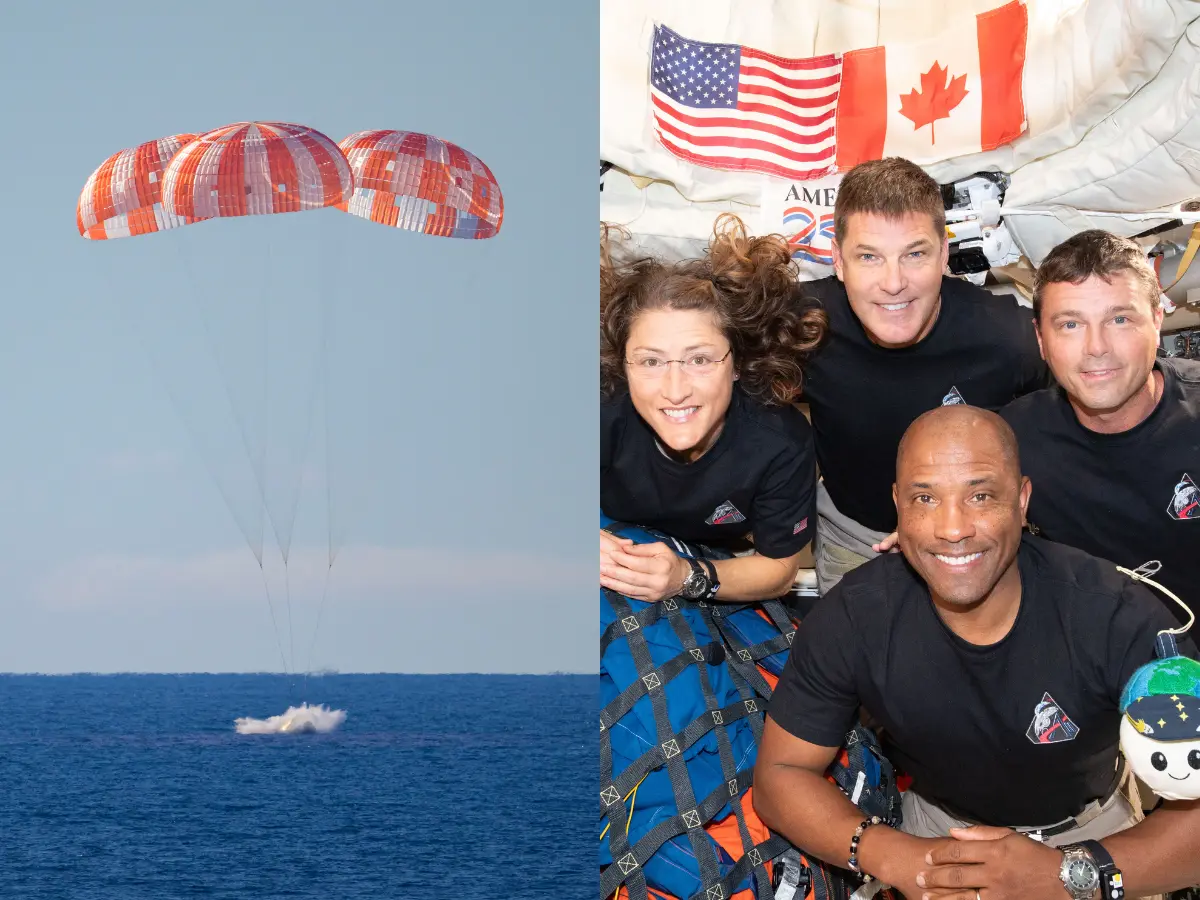
This handout photo released by NASA shows NASA’s Orion spacecraft with Artemis II crewmembers NASA astronauts commander Reid Wiseman, pilot Victor Glover, mission specialist Christina Koch and CSA (Canadian Space Agency) astronaut mission specialist aboard Jeremy Hansen, as it lands in the Pacific Ocean off the coast of California, on April 10, 2026. Photograph: (Combination created using images from AFP)
NASA pulls off its first crewed Moon mission in decades. The Artemis II crew safely splashed down after a historic 10-day journey, marking a major milestone for NASA. All you need to know.
Artemis II returns to Earth:Four astronauts touched down safely in the Pacific Ocean on Friday (Apr 10), as NASA successfully executed a historic moon mission, the first of its kind in more than half a century. The Orion capsule hit the water off the California coast near San Diego right on schedule, capping a 10-day mission that began with a launch from Florida on April 1. Mission commander Reid Wiseman confirmed the crew - Christina Koch, Victor Glover, Jeremy Hansen and Reid Wiseman - was doing well almost immediately after the nail-biting communications blackout that comes with every high-speed atmospheric re-entry. "Houston. Integrity. We have you loud and clear," he said. Moments later, he reported the crew was "stable" and "green."
Astronauts in great condition
"We have you loud and clear," mission commander Wiseman said following a communications check. "What a journey," he added. "We are stable." Rob Navias, the NASA public affairs officer who narrated the Artemis II crew's return on the agency's livestream, reported that they were "in great condition".
"This was a textbook entry and a textbook touchdown," he noted.
Also read | FACT CHECK: Did Macron post a video of Jeffrey Epstein kissing Melania Trump? Truth behind the viral clip
Trending Stories
)
)
)
)
)
)
)
)
)
)
)
)
)
)
)
)
)
)
&im=FitAndFill=(700,400))
)
)
)
&im=FitAndFill=(700,400))
)
&im=FitAndFill=(700,400))
&im=FitAndFill=(700,400))
)
Crucial heat shield passes a make‑or‑break test
However, the touchdown wasn't free of nerve-racking moments. The capsule hit peak speeds exceeding 30 times the speed of sound during re-entry, with temperatures climbing to roughly half that of the Sun's surface. These conditions put enormous stress on the heat shield that protects everyone inside.
According to reports, that shield had been a source of genuine concern. During the uncrewed Artemis I test flight in 2022, it eroded in ways nobody had anticipated, drawing uncomfortable comparisons to the Challenger and Columbia space shuttle disasters of 1986 and 2003, respectively, when astronauts died after warning signs were set aside. This time, NASA adjusted the re-entry trajectory, keeping it steeper and shorter to reduce the risk. It worked.
Record-breaking feats by the Artemis II crew
The mission itself was historic by almost any measure. Wiseman, Christina Koch, Victor Glover and Canadian astronaut Jeremy Hansen flew further from Earth than any humans in history, reaching 252,756 miles — surpassing the record set during the Apollo program. Glover became the first person of colour to travel around the Moon. Koch was the first woman. Hansen was the first non-American.
During the voyage, the crew witnessed a solar eclipse from deep space, photographed meteorite strikes on the lunar surface that left scientists back on Earth stunned, and amassed thousands of images that circulated widely online throughout the mission.