


A glacial lake outburst flood (GLOF) at Shintaphu Lake in Bhutan has raised concerns over a sudden surge of water flowing downstream into India, prompting the Government of India to issue a special advisory for parts of West Bengal and Assam, warning that water levels could rise sharply along the Sankosh River.
The outburst was reported on Thursday (Oct 29) evening at Shintaphu Lake, located below Wakila Mountain in Lungo, Laya Gewog, in Bhutan's Gasa district. Sirens were sounded to alert people living near riverbanks, while residents in the affected area were reportedly moved to safer ground.
Besides Assam's Dhubri district, alerts have been issued across parts of North Bengal, including the Darjeeling hills and Alipurduar, Jalpaiguri and Cooch Behar districts.
Shintaphu Lake is among Bhutan's 17 potentially dangerous glacial lakes. An official from the National Centre for Hydrology and Meteorology (NCHM) said a water-level monitoring station was located at Taktsimakhang, but no alert had been triggered there at the time of the initial reports. The extent of the outburst and its downstream impact remained unclear.
Also read | Cyclone Arnab makes landfall on Andhra coast
What is a glacial lake outburst flood?
Trending Stories

'EPIC TROLLING': Chinese glass firm cashes in on France riots with viral break-in video | Watch

Prasidh Krishna ruled out of New Zealand ODIs as BCCI pick replacement

Ranbir Kapoor’s Ramayana sparks buzz in Karachi as Pakistani Hindus demand film's release in the country

All votes counted, Netanyahu’s Likud emerges as biggest party with 27 seats; majority eludes both blocs

From Kyiv to Beijing: Why the world is watching US midterm elections 2026

Watch: Fans pull off costly $12,000 QR code prank on US streamer during Japan trip

India's Bihar museum among top 10 in the world, beats Paris's Louvre

Unclassified report reveals clearest photo of China's secret spaceplane Shenlong

Israel election results: Final vote tally made public; new Knesset to be sworn in on Nov 10. How did Netanyahu fare?

Charging points in Indian trains to be switched off between 11pm to 5am. Here's why

Hindu population in Pakistan declines from 14.6% to less than 2%: Report

Retirement planning made simple: How Kwala Intel AI helps you build a financial roadmap

'Donald Trump is an idiot': Michigan candidate Abdul El-Sayed tears into Trump, calls JD Vance 'soulless' and Pete Hegseth a 'bully'

US midterms 2026: Trump says Black and Jewish voters supporting Abdul El-Sayed are 'crazy' | WATCH

Four dead, several injured after EU peacekeeping helicopter crashes in Bosnia during routine training

Police called after 3-year-old scores 10 goals in 12 minutes at Florida youth soccer game

IND vs PAK, Hong Kong Sixes: When and where to watch live streaming in India?

Nvidia dismisses report alleging Chinese executive tied to CEO Jensen Huang passed intel to Beijing

'Icepick': Private info of over 41,000 DHS personnel, including ICE agents, leaked by hackers

'Make s**t houses great again': Norway hits back at Trump's insult with genius level toilet humour

‘People will celebrate’: Piyush Goyal says India will have ‘strong comparative advantage’ after US trade deal

Anil Agarwal returns to Bengal: Vedanta plans ₹60,000 crore power unit, 10,000 jobs, as industrial policy drops Nov 5

Viral video shows Delhi’s new footpath design. Spoiler alert: Internet isn’t impressed!

‘Very high risk of violence’: France to deploy 70,000 police ahead of Halloween protests

Benjamin Netanyahu's party accuses Arab Parties of 'stealing' Israeli election, alleges widespread fraud

Doomsday warning? Why governments are warning people to stockpile emergency supplies for 72 hours

'You are disgusting. Put yourself in shape. You look like hell!': Trump explodes at reporter after question about cancelling Kansas rally

From Shilpa Shetty to Priyanka Chopra: How B-Town stars celebrated Karva Chauth 2026

SA vs AUS, 3rd Test: Protea opener Ackerman questions continuing play as SA lose advantage

WATCH | Barack Obama’s slow-motion mic toss sends internet into a frenzy: ‘That man’s got swagger’

Dallas man's iPhone Duo gets stuck and breaks minutes after unboxing

Binance under cyberattack? Crypto giants freeze more than $2.5 billion as Bitcoin drops over 3%. What's happening?

Iran says US ‘carrot-and-stick’ approach will not work as Tehran receives Vance’s letter amid push for talks
A GLOF occurs when water stored in a lake formed by melting glaciers is suddenly released, often after a natural barrier fails or is breached. The resulting surge can travel rapidly through mountain valleys, carrying debris and damaging settlements, roads, bridges and farmland.
Shintaphu Lake lies within Bhutan's Punatsangchhu River basin. The river is known as the Sankosh after it enters India, making a sudden release of water a potential concern for downstream communities.
India issues special flood advisory
In response to the situation, India has warned that a flash flood in the upper reaches of the Punatsangchhu River could trigger a sudden rise in water levels in Alipurduar district of West Bengal and Dhubri district of Assam.
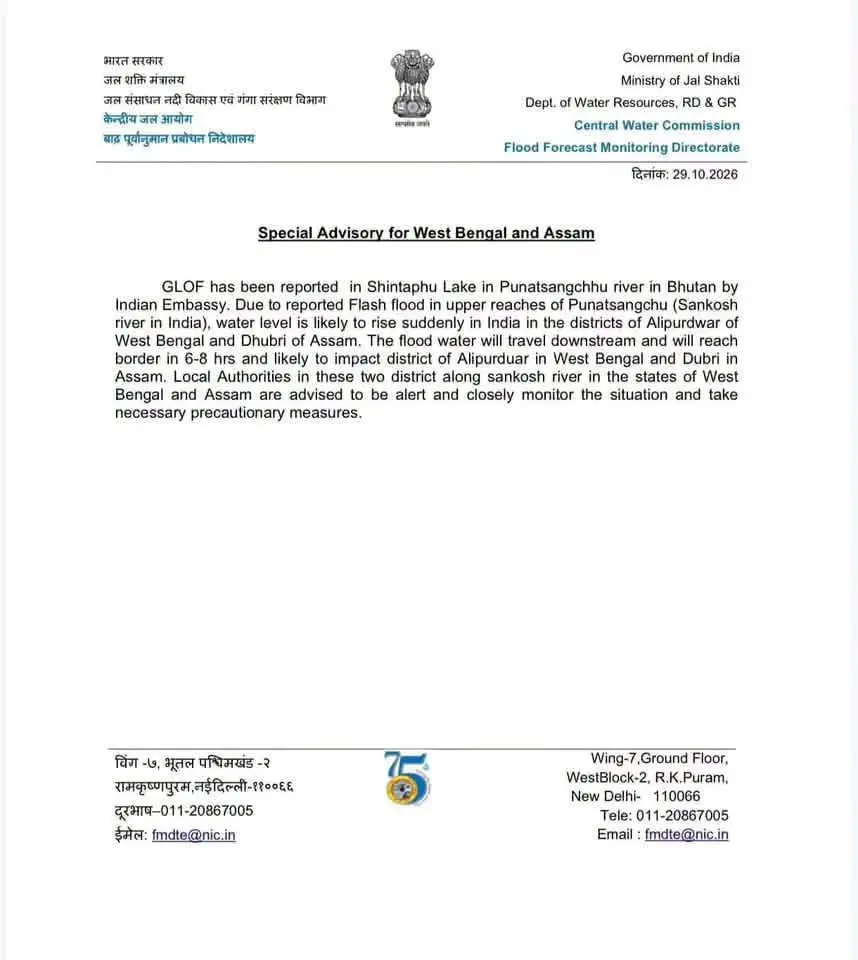
Authorities have issued alerts across parts of North Bengal, including the Darjeeling hills, Alipurduar, Jalpaiguri and Cooch Behar districts. NDRF and SDRF teams have been deployed in Tufanganj and Boxirhat in West Bengal's Cooch Behar district, along the Sankosh River near the Assam border, while residents are being alerted about the potential threat.
Meanwhile, BJP MP from Darjeeling, Raju Bista, also issued a critical public safety alert for residents living along the Sankosh River. In a post on X, Bista wrote, "A glacial lake outburst flood (GLOF) has been reported at Lemthang in Bhutan. The overflowing water from the lake is flowing downwards through the Mofu River towards the Sunkosh River. Therefore, everyone living in the catchment areas of the Sunkosh River and all its connected tributaries have been informed to move to a safe distance immediately to protect their lives."
According to the advisory, floodwater was expected to reach the India-Bhutan border within six to eight hours. Authorities in both districts have been urged to closely monitor the situation and take necessary precautionary measures.
West Bengal minister urges evacuation
West Bengal Forest Minister and Kumargram MLA Manoj Kumar Oraon urged residents living along the Sankosh River in Alipurduar district to move to safer locations.
In a video message posted on Facebook, Oraon warned that a surge of water could reach the river in Kumargram within the next one to one-and-a-half hours. He appealed to residents to evacuate as a precaution and cooperate with the administration.
"Everyone in our Darjeeling hills, Terai and Dooars region are requested to stay alert," he also added.
The Sankosh flows from Bhutan into India and supports communities across parts of northern West Bengal and adjoining Assam. A sudden rise in its water level could threaten riverside settlements, livestock, farmland and infrastructure. Authorities are monitoring the situation as they assess the movement of floodwater and the potential risk to downstream communities.
A history of devastating GLOFs
In October 1994, Bhutan witnessed one of the most devastating Glacial Lake Outburst Flood (GLOF) disasters along the Punatsang Chhu Valley, Punakha. The partial outburst or collapse of the moraine dam at Lugge Tsho (Luggye Lake), located in the Lunana region of Gasa Dzongkhag, triggered the flood. Roughly 18 million cubic meters (about 18 billion litres) of water rushed down into the river system, cascading down the Pho Chhu and Punatsangchhu valleys, travelling about 100 kilometres to reach Punakha in under five hours.
At least 21 people were killed in the surge that swept away homes, livestock (yaks and cattle) and extensive agricultural land. The historic Punakha Dzong fortress also suffered severe structural damage when the floodwaters undermined its perimeter walls.

