
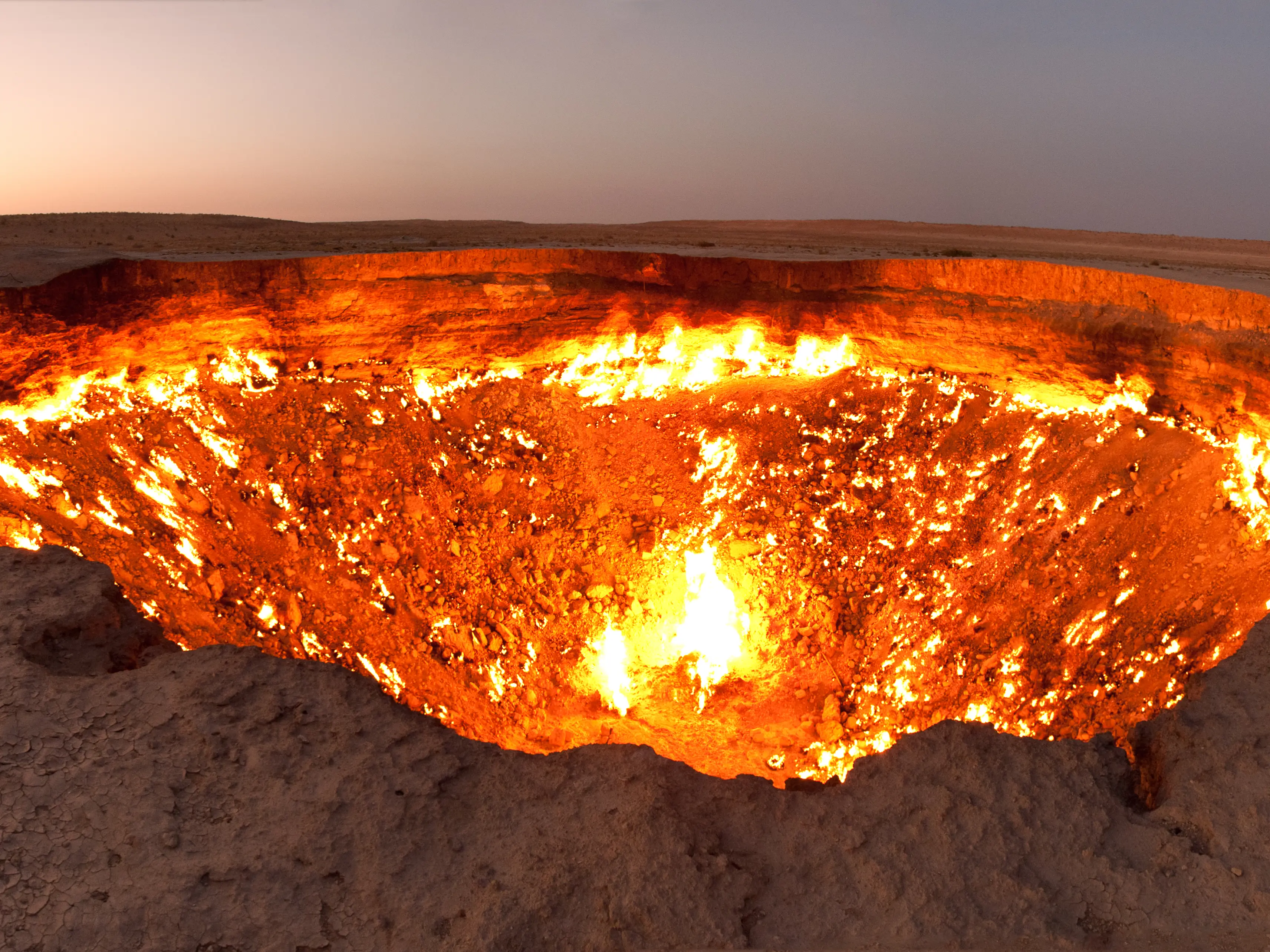
&imwidth=800&imheight=600&format=webp&quality=medium "‘Gateway to Hell’: Darvaza gas crater, burning since 1970s, is partially contained now. Know about its story")
Some time in the 1970s Russian scientists ignited an underground pocket of natural gas in Turkmenistan. It burned on ever since, becoming known as Gateway to Hell or Door to Hell, and becoming a tourist attraction in the reclusive central asian nation. On Thursday (Jun 5), the government said that the fire in the Darvaza gas crater has been partially contained.
The fire that burned for half a century in the Karakum desert since 1971 and has been emitting methane gas in large quantities ever since, is now reduced three-fold, according to a government official.
"Whereas before a huge glow from the blaze was visible from several kilometres away, hence the name 'Gateway to Hell', today only a faint source of combustion remains," AFP news agency quoted Irina Luryeva, a director at state-owned energy company Turkmengaz, as saying.

As methane emissions add to climate crisis, several wells were drilled around the crater to capture methane.
Turkmenistan, home to the world's fourth-largest gas reserves, is also its biggest emitter of methane through gas leaks, though the government denies this claim.
The story of Darvaza gas crater
Trending Stories
)
US vs China over South China Sea: Washington backs Philippines, Beijing hits back
)
Bigg Boss 20: Isha Rikhi evicted after three weeks in Salman Khan’s show
)
Musk plans to more than double xAI's chips to over 1.2 million Nvidia GPUs by year-end
)
After JU, clash erupts at SRFTI: BJP’s ‘Dimagi Naxal’ jibe sparks political firestorm after students protest RSS-linked event
)
‘Anti-social elements spreading false rumours’: LPU issues statement amid massive unrest over alleged rape
)
LPU students go on rampage, vandalise campus amid widespread protest: What's happening
)
Trump asked Xi to pressure Iran. China did not say yes — here’s what Beijing wants
)
US Treasury Secretary Scott Bessent hails global crackdown on Iranian banks and airlines
)
An OpenAI agent escaped its locked test cage again, by hiding questions in DNS lookups
)
'Our video was trimmed': LPU girls who featured in rape-denial video make U-turn
)
3 males killed, four others injured in shooting after fight at strip club in Detroit
)
'Victory for low-budget consumers': Raghav Chadha hails 30-day telecom recharge rules
)
Claude rebuilt the 1989 game 'Prince of Persia' by reusing the original's own code
)
Beyond metros: How Tier-2 and Tier-3 cities could drive India’s next AI wave
)
Tesla builds first Cybertruck with its own refined lithium: Elon Musk's $1 billion Texas bet pays off
)
IndiGo flight suffers tail strike in Bengaluru while landing; DGCA to probe incident
)
The US and China set up an AI 'red telephone', but skipped the rulebook
)
‘Terror suspects arrested near UK air base were looking to do big damage’: Trump
)
Russian envoy claims US tactics to contain India were revealed in ‘Freudian slip’
)
IND vs WI 1st ODI: Kohli breaks Sachin's most runs in one country record with unbeaten 139 as India thump West Indies by 8 wickets
)
Researchers rebuilt exactly how 700 AI agents hacked Hugging Face: a 900-link chain trick
)
‘Olympic inclusion is our major target’: WPA President Ishaun Singh on pool’s global ambitions
)
Nations League: Spain sink England at Wembley; Modric shines for Croatia
)
Why has Iran released no proof of life of Mojtaba Khamenei? Araghchi reveals...
)
'What kind of confession is this?': Pakistan PM Shehbaz Sharif’s 'terrorists would be roaming New York' remark goes viral, raises alarm online. Watch
)
South Korea demands apology from Ukraine over North Korean prisoners' transfer
)
Beyond BrahMos: India targets Rs 50,000 crore in defence exports with unmatched price edge
)
Sri Lankan Tamil migrant worker gets death sentence in Saudi Arabia, help sought from India
)
Muslim marriage cannot shield sex with minor wife from prosecution under POCSO: Delhi HC
)
'Can't help but draw painful parallels to Nirbhaya case': SC on latest incidents of rape cases in Delhi-NCR
)
99.9% more powerful - Scientists find boy who can recall memories from just 3 months of age
)
'FIRST LOOK from inside Noah’s Ark': Researchers share video from inside mysterious mound in Turkey
)
UNSC reform momentum grows: Russia, Portugal, Mauritius push for India's permanent seat bid
)
8 US marines injured in Iranian missile attack on vessel in Strait of Hormuz: Report
&im=FitAndFill=(700,400))
New OTT releases this week (September 28-October 4, 2026): Dupahiya 2, Pooja Meri Jaan, Ohh My Dog- 5 titles coming on Netflix, Prime Video and more
)
Afghanistan says 28 fighters killed in clash near Pakistan border, Islamabad denies
)
Ceuta migrant crisis: Protesters take to streets as Spain grapples with migrant challenge
)
LPU suspend classes, postpones exams as violence escalates over rape claims: What's happening
)
New York City wants a 'kill switch' on every AI, and will pay whistleblowers who report violations
The Darvaza gas crater is one of a few natural gas reserves that continue to burn after being ignited, the other famous one being Baba Gurgur in Iraq. In official parlance, it is called 'the Shining of Karakum'. The floor of the crater is lit by hundreds of natural gas fires.
The crater is 260 kilometres from the Turkmen capital of Ashgabat, located in the village of Darvaza in the middle of the Karakum Desert.
The crater, having a diameter of 60–70 metres and a depth of about 30 metres, emits a foul smell.
Its history is mired in dispute and controversy, with some claiming that it collapsed in the 1960s. Some accounts claim that the gas fire was a result of an accident in 1971, when Soviet engineers drilled the site which then collapsed. They ignited the crater to prevent the emission of poisonous gases.
Gateway to Hell, the tourist attraction
In spite of the bad odour, the crater remains a tourist attraction, particularly famed for the night trips to see the fire burn in all its glory. Since being declared as a natural reserve in 2013, thousands of tourists have flocked to the area.
George Kourounis, who entered the bottom of the crater to collect soil samples in the first such effort, called it 'a coliseum of fire.'
"Just everywhere you look it's thousands of these small fires. The sound was like that of a jet engine, this roaring, high-pressure, gas-burning sound. And there was no smoke. It burns very cleanly, so there's nothing to obscure your view. You can just see every little lick of flame," he told National Georgraphic Channel, which sponsored the feat.
The crater was also the spot where President Berdimuhamedow famously appeared in order to dispel speculations about his death. Captured on state TV, he did doughnut stunts in the area.
Efforts to contain the fire at Darvaza
For decades, the Turkmen government has been trying to contain the fire.
In 2022, President Gurbanguly Berdimuhamedow announced plans to extinguish the crater as it was causing health issues for locals and causing environmental damage.
The drilling of wells around the capture has been happening for years, with the aim to capture methane.

