China to test supersonic jet that moves at Mach 2, double the speed of sound

&imwidth=600&imheight=450&format=webp&quality=medium "China to test supersonic jet that moves at Mach 2, double the speed of sound")
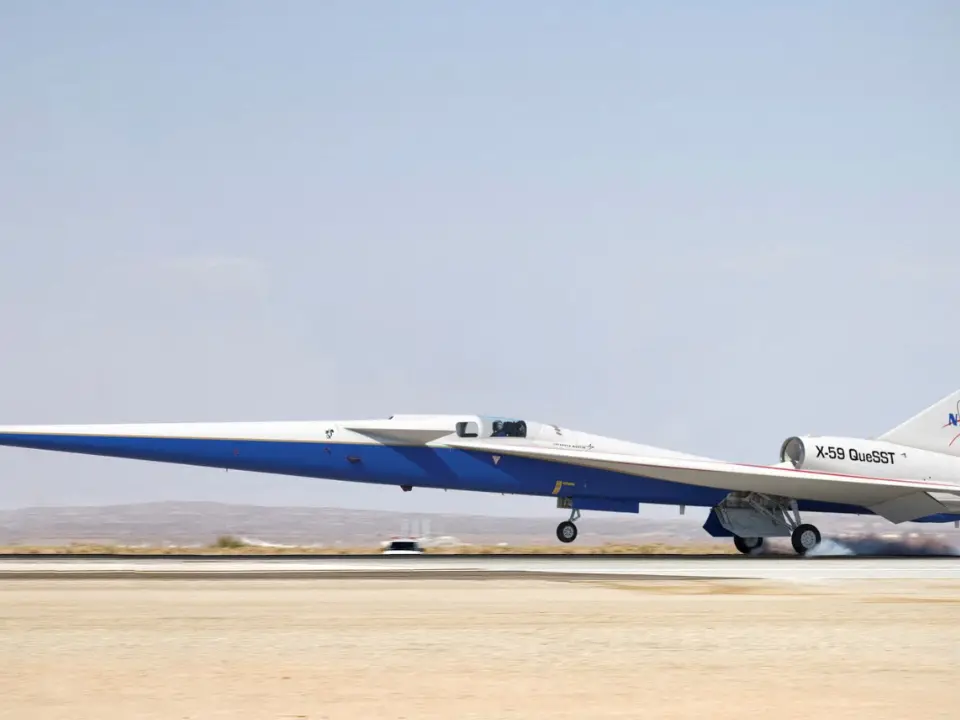
NASA's X-59 can travel at Mach 1.4 while China's supersonic jet can fly at Mach 2. Photograph: (AFP)
China is getting ready to test its supersonic aircraft that can travel at Mach 2, double the speed of sound. Instead of dampening the sonic boom, it aims to dissipate it. NASA is also testing a supersonic jet which moves at Mach 1.4.
China is developing a supersonic passenger aircraft that can travel at twice the speed of sound without the accompanying sonic boom, at least not as loud. Global Times reported that the TMS-10 demonstrator plane is in the final assembly phase and a test flight is planned for the end of the year. It is only an experimental aircraft but will act as the base for a future supersonic aircraft that can carry 10 to 15 passengers. The aim is to develop a passenger jet that can reach Shanghai from Beijing in just 30 minutes as opposed to two hours, the current flying time.
NASA is also developing a supersonic jet that can fly at speeds of Mach 1.4, a little less than China's TMS-10 that flies at Mach 2. The X-59 is undergoing test flights. The space agency wants to reduce the loud sonic boom to a gentle "sonic thump."
The TMS-10 demonstrator plane is being developed by the Chinese aerospace research institution Tianmushan Laboratory in collaboration with Beihang University. Like the X-59, China's supersonic plane is also working to reduce the sonic boom. When an object moves faster than the speed of sound, loud noise is generated. With TMS-10, China wants to reduce the boom. It also aims to lower the aerodynamic drag while delivering high-speed performance.
The key difference between NASA's X-59 and TMS-10 is that while the former is trying to dampen the sonic boom, China is working to scatter it. The aircraft has been designed to manage the shock waves around the aircraft’s nose and wings to prevent them from merging to form a powerful wave. Its rear design will also work to redistribute and weaken the waves.
Top speed of China's supersonic aircraft
At Mach 2, the aircraft can travel at a top speed of 2,470 kilometres per hour. It can also move at subsonic speeds around Mach 0.95, covering 1,173 kilometres in an hour.
Trending Stories
)
)
)
)
)
)
)
)
)
)
)
)
)
)
)
)
)
)
)
)
&im=FitAndFill=(700,400))
)
)
)
)
)
)
&im=FitAndFill=(700,400))
)
)
)
)
)
)
)
)
The first flight is expected to take off soon after certain key parameters are cleared. Aerodynamic wind-tunnel testing has been completed, and flight-control design and airframe manufacturing are also over. A smaller version completed a low-speed test flight below Mach 0.2 last year.
In its latest flight, developers will determine the sonic boom generated by pushing the aircraft through the sound barrier, besides evaluating other parameters. Applying the technology to larger passenger aircraft will have its own challenges, including high costs and a better design.

