
&imwidth=800&imheight=600&format=webp&quality=medium "500-year-old Leonardo da Vinci sketch of a flying machine can solve a major drone issue")
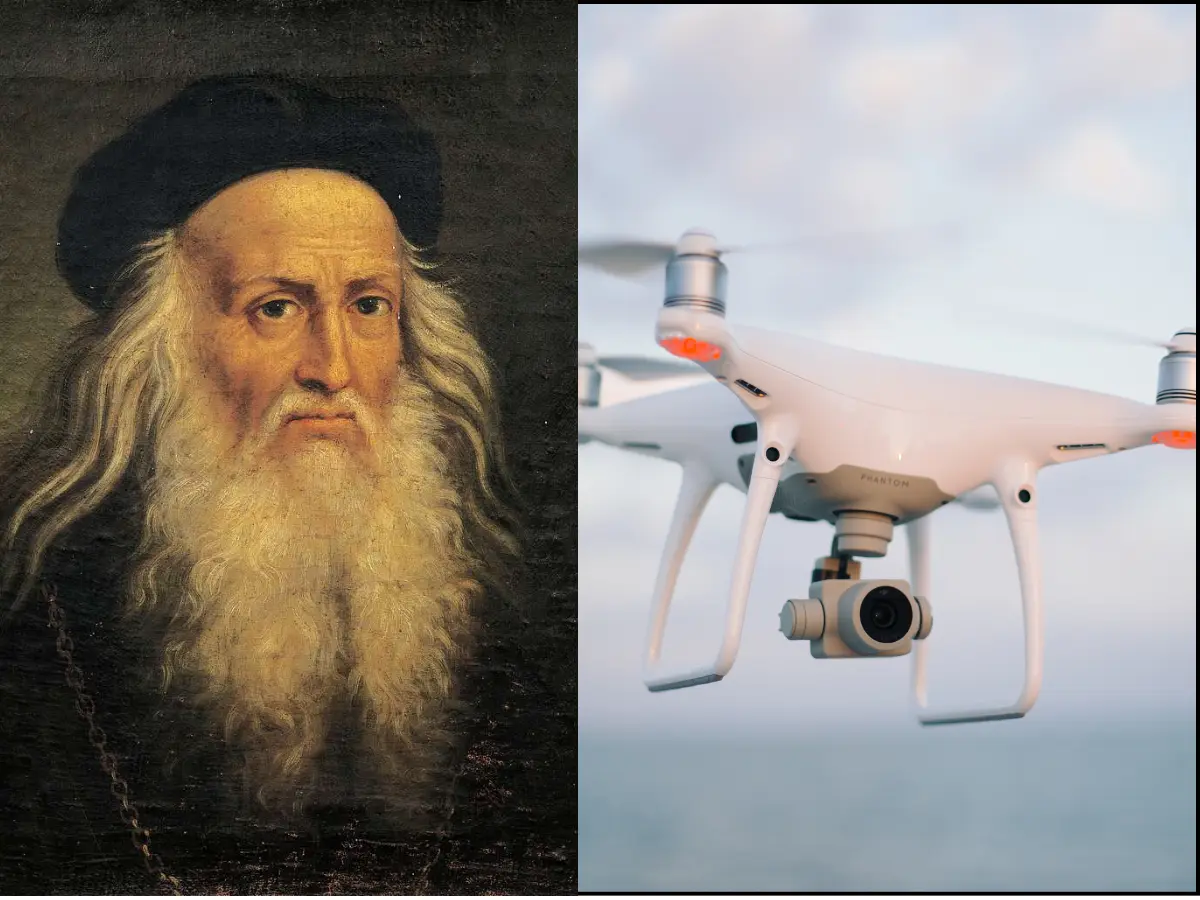
Leonardo da Vinci was not just a painter. He was also a sculptor, an architect, and even an engineer and a scientist. In fact, one of his scientific sketches hides the secret to better drones. Da Vinci made drawings of machines that didn't exist at the time and were only invented years later. His innovative ideas included vehicles that could fly, go underwater and some amazing weapons. A team of scientists has uncovered that they are not merely sketches but offer a lot more for today's modern machines. IFLScience reported that a new paper by the Department of Mechanical Engineering at Johns Hopkins University states that a sketch of a flying machine made by da Vinci in the 15th century holds clues to creating quieter drones that are more efficient. It features an aerial singular corkscrew propeller, which needed to be spun by men at its base, resulting in it taking off. The authors of the study wrote, “Leonardo da Vinci’s aerial screw, conceived in the 15th century, represents one of the earliest conceptualisations of lift-generating rotary flight." Also Read: Scientist flags a clue in ancient Egyptian mine that hints the Bible was true and Moses was real
Noisy drones can't be used in populated areas
The researchers say little attention has been paid to this design by da Vinci, which can be applied to machines made today. They specifically point to "the aerodynamic and aeroacoustic performance of this rotor". The latter can be used to make better drones, and can let them enter fields where they have yet to make a mark. The researchers say that one of the reasons drones are now widely used in populated areas is the noise they make. PhD student Suryansh Prakhar, one of the authors of the paper, told the publication, “While food and parcel delivery using drones is growing, the aeroacoustic noise remains one of the issues preventing it." He says da Vinci's design can be used to remove this problem. Also Read: Fungus in King Tutankhamun’s tomb killed dozens. It could now cure cancer

Da Vinci's aircraft design can make drones quieter
The Johns Hopkins team created a modernised simulation of da Vinci's aerial screw design and analysed the aerodynamic forces and acoustic emissions "across a range of Reynolds numbers". Upon comparing their data with the two-bladed rotor that is used to make modern drones, the researchers noticed that even though Leonardo’s aerial screw "has a lower lift coefficient" as compared to the traditional design, the aerial screw works with much less mechanical power, and the acoustic intensity for the same net lift is significantly lower. This is because of "the screw’s large wetted area and lower rotational speed", they added. However, da Vinci's design has not been found optimal when it comes to real-world performance. The paper authors state that the design highlights "the potential benefits of unconventional rotor geometries for noise-sensitive applications." However, they don't advise changing all two-blade rotor drones to match Da Vinci's design.

