

&imwidth=800&imheight=600&format=webp&quality=medium "What is Nvidia building beyond chips, and why does it matter now?")
Nvidia has been known for its powerful graphics processing units (GPUs). These chips have become central to artificial intelligence. However, the company is now building much more than chips, and this shift is becoming increasingly important.
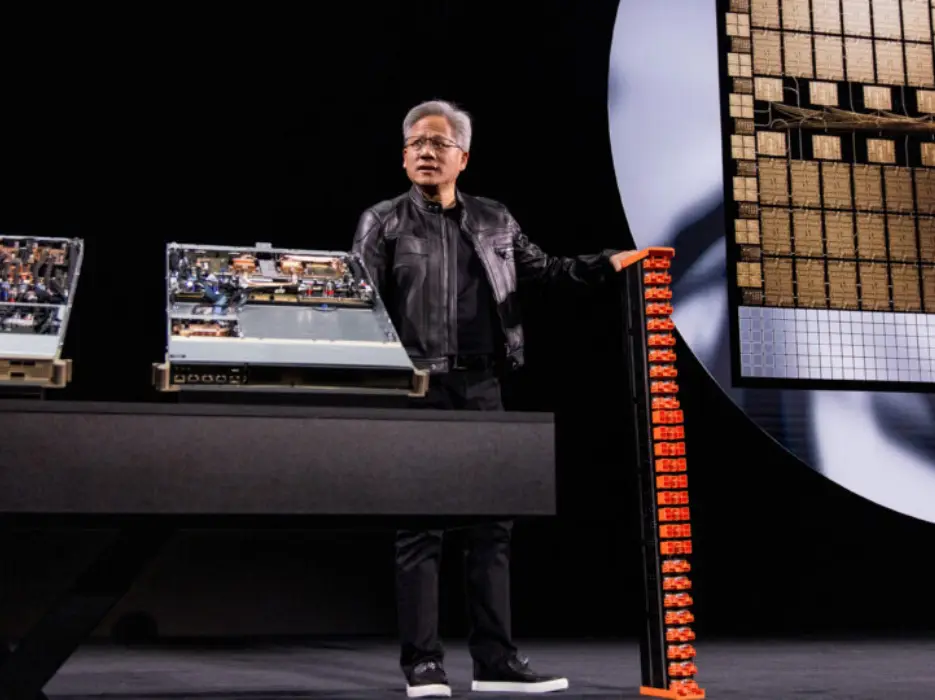
Under CEO Jensen Huang, Nvidia has expanded into networking, infrastructure and full-stack AI systems that power modern data centres.
Nvidia’s second-biggest business: Networking
Nvidia’s networking division has quietly grown into one of its largest revenue drivers.
According to the company’s latest earnings:
$11 billion revenue in a single quarter
Trending Stories
&imwidth=180&imheight=135&format=webp&quality=medium)
Nobel laureate Machado, who dedicated prize to Trump, confirmed as Venezuela opposition leader
&imwidth=180&imheight=135&format=webp&quality=medium)
India moves to buy 10,000 more AI chips for a national compute pool open to startups
&imwidth=180&imheight=135&format=webp&quality=medium)
MI5 is opening an AI threat centre, and OpenAI just told MPs the worst isn't over
&imwidth=180&imheight=135&format=webp&quality=medium)
'We are not sitting in ivory towers, we are aware': SC issues notice to Rahul Gandhi, Akhilesh Yadav
&imwidth=180&imheight=135&format=webp&quality=medium)
'It's a joy to see the makers bring it on such a grand scale': SS Rajamouli on Ramayana
&imwidth=180&imheight=135&format=webp&quality=medium)
China responds to Trump's Press Secretary Katie Zacharia after toilet remark: 'Visit China more often'
&imwidth=180&imheight=135&format=webp&quality=medium)
Tiger Shroff attacked by three gunmen in Mumbai, actor safe, two injured
&imwidth=180&imheight=135&format=webp&quality=medium)
Why France looks the most fragile in the G7 amid protests and budget deadlock
&imwidth=180&imheight=135&format=webp&quality=medium)
Lizard people? Ex-US Army sniper claims soldier killed by 'reptilian beings' in battle near Area 51
&imwidth=180&imheight=135&format=webp&quality=medium)
Anirudh Ravichander-Kavya Maran wedding: Telangana CM reveals Chennai reception date
&imwidth=180&imheight=135&format=webp&quality=medium)
Tiger Shroff shows injuries after Juhu firing incident; Eknath Shinde says Mumbai won’t tolerate gang wars
&imwidth=180&imheight=135&format=webp&quality=medium)
Elon Musk features on Lucknow's 'anti-India' Ravan poster alongside Rahul Gandhi, Akhilesh
&imwidth=180&imheight=135&format=webp&quality=medium)
'Those who have destroyed must pay': Macron says France feels 'anger and shame' over protest violence
&imwidth=180&imheight=135&format=webp&quality=medium)
Cattle-feed bran in biscuits, detergent in milk: FSSAI acts against 3 companies
&imwidth=180&imheight=135&format=webp&quality=medium)
Anthropic’s public benefit plan: What its 5% share commitment means for AI’s future
&imwidth=180&imheight=135&format=webp&quality=medium)
Tiger Shroff firing incident update: All three shooters arrested from Kota railway station
&imwidth=180&imheight=135&format=webp&quality=medium)
2.5 lakh cap, 4-passenger limit: What is Delhi's new e-rickshaw draft policy
&imwidth=180&imheight=135&format=webp&quality=medium)
4 killed, 19 critically injured in grass fire at Canada's largest military base
&imwidth=180&imheight=135&format=webp&quality=medium)
Brendan Taylor overtakes Andy Flower to become Zimbabwe’s leading ODI run-scorer
&imwidth=180&imheight=135&format=webp&quality=medium)
Flying car race: Alef Aeronautics welcomes Tesla Roadster '11 years' later, but are the two models the same?
&imwidth=180&imheight=135&format=webp&quality=medium)
Researchers name newly discovered Andean plant after Argentina legend Lionel Messi
&imwidth=180&imheight=135&format=webp&quality=medium)
Priest dies after crucifix falls on his head during livestreamed Mass in Ecuador | VIDEO
&imwidth=180&imheight=135&format=webp&quality=medium)
Putin seeks Trump-Xi summit on Ukraine war, proposes talks alongside APEC: Report
&imwidth=180&imheight=135&format=webp&quality=medium)
WATCH | iPhones, luxury perfumes floating in Hormuz? Iranian fishermen make bizarre discovery
&imwidth=180&imheight=135&format=webp&quality=medium)
No Ravindra Jadeja, Yashasvi Jaiswal in India’s 2027 ODI World Cup plans: Report
&imwidth=180&imheight=135&format=webp&quality=medium)
After Kennedy Center and reflecting pool disputes, Trump turns to Washington golf course plan amid legal battle
&imwidth=180&imheight=135&format=webp&quality=medium)
US to review Russia sanctions waiver within 60 days as Rubio cites India’s ‘substantial’ Russian energy imports
&im=FitAndFill=(700,400)&imwidth=180&imheight=135&format=webp&quality=medium)
Tesla Roadster engineering: The hidden hardware behind its flying demonstration
&imwidth=180&imheight=135&format=webp&quality=medium)
No Kings' Instagram suspended during early-voting campaign
&imwidth=180&imheight=135&format=webp&quality=medium)
NFl 2026/27 - Saints vs Steelers to go ahead in Paris next week despite protest
&im=FitAndFill=(700,400)&imwidth=180&imheight=135&format=webp&quality=medium)
5 technologies that could make the Tesla Roadster one of the most unusual cars ever built
&imwidth=180&imheight=135&format=webp&quality=medium)
Cattle feed found in biscuits of Indian company, FSSAI sends legal notice
&imwidth=180&imheight=135&format=webp&quality=medium)
'We feel like Mr India': Gujarat’s undercover SHE team guard garba nights at Navratri
&imwidth=180&imheight=135&format=webp&quality=medium)
Kylie Jenner makes Victoria’s Secret debut in $50 million diamond-encrusted design as Timothée Chalamet cheers
&imwidth=180&imheight=135&format=webp&quality=medium)
Lawrence Bishnoi gang claims responsibility for firing at Tiger Shroff over ties to Salman Khan
267 per cent year-on-year growth
Over $31 billion annual revenue
This makes networking Nvidia’s second-largest segment after compute. Analysts say this growth is directly linked to rising demand for AI infrastructure.
Kevin Cook, a strategist at Zacks Investment Research, noted that Nvidia’s quarterly networking revenue is now comparable to what some traditional networking companies generate in a full year.
What exactly is Nvidia building?
Nvidia’s networking business focuses on connecting thousands of GPUs inside data centres.
Key technologies include:
NVLink: connects GPUs within servers
InfiniBand switches: enable high-speed data transfer
Spectrum-X: Ethernet platform designed for AI workloads
Photonics switches: improve speed and energy efficiency
These tools ensure that AI systems can process massive amounts of data quickly and efficiently.
Instead of working as separate parts, these technologies are designed to function together as a single system.
The idea of an ‘AI factory’
Nvidia describes modern data centres as “AI factories”. These are facilities designed to train and run AI models at scale.
In this setup:
GPUs act as the computing engine
Networking acts as the backbone
Storage and software complete the system
Nvidia’s strategy is to provide all these components as an integrated package.
This approach allows companies to build large-scale AI systems more efficiently.
Mellanox acquisition: The turning point
Nvidia’s expansion into networking began with its acquisition of Mellanox in 2020 for $7 billion. Mellanox, an Israeli company, specialised in high-performance networking.
At the time, the move did not attract much attention. However, it has since become a key part of Nvidia’s growth.
Industry experts say the acquisition helped Nvidia turn its GPUs into a complete solution by adding the missing networking layer.
Full-stack strategy: Why it matters
Unlike companies that sell individual components, Nvidia is focusing on a full-stack approach.
This means it offers:
Hardware (GPUs and networking)
Software tools
Integrated systems
The company also works through partners to deploy these systems globally.
According to Nvidia executives, this integrated model gives the company an advantage, as AI workloads require tight coordination between compute and networking.
New announcements at GTC
At its recent GTC conference, Nvidia announced several updates to strengthen its AI infrastructure:
New Rubin platform for AI supercomputing
Improved Spectrum-X networking systems
Inference memory storage solutions
These developments aim to make AI systems faster and more efficient.
Why this matters for the AI race
The global AI race is no longer just about building better models. It is also about building the infrastructure that powers them.
AI models require:
Massive computing power
High-speed data transfer
Efficient system integration
Nvidia’s networking business addresses these needs.
Experts say the company’s success lies in understanding that networking is not just a support function it is central to how AI systems operate.
The bigger picture
Nvidia’s shift shows how the AI industry is evolving. Companies are moving from standalone tools to complete ecosystems. While GPUs remain critical, networking and infrastructure are becoming equally important. As demand for AI continues to grow, the ability to build and manage large-scale systems may define the next phase of the industry. Nvidia’s strategy suggests that the future of computing is not just about chips it is about how everything connects.
