University of Sydney scientists solve quantum computing challenge using a single atom

&imwidth=600&imheight=450&format=webp&quality=medium "University of Sydney scientists solve quantum computing challenge using a single atom")
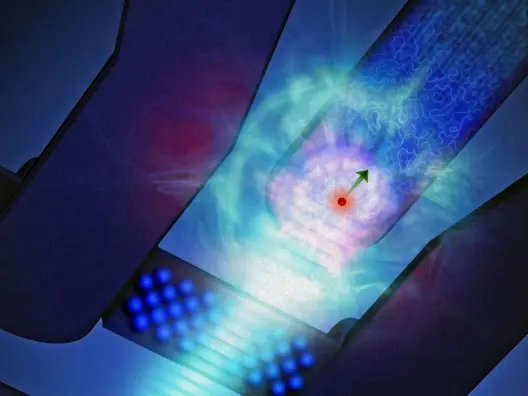
University of Sydney scientists solve quantum computing challenge using a single atom Photograph: (University of Sydney)
Researchers at the University of Sydney have made a breakthrough in quantum computing by controlling and reading quantum information with a single atom. This could solve the scalability problem, making future quantum computers more stable, affordable, and practical for real-world use.
Scientists at the University of Sydney have found a way to control quantum data using a single atom. This breakthrough could simplify quantum computing, making powerful machines easier to build and paving the way for advances in medicine, cybersecurity, and climate research.
Quantum computers promise to revolutionise technology by solving problems too complex for today’s fastest supercomputers. However, building practical, large-scale quantum computers has been extremely challenging.
Researchers at the University of Sydney, in a study published in Nature Physics, have announced a major breakthrough. They discovered how to control and read quantum information using just a single atom, a step that could make future quantum machines more stable and easier to build.
Lead researcher Professor David Reilly explained that this is a critical step in solving what experts call the “scalability problem”. Until now, managing thousands of delicate quantum bits, or qubits, has been one of the biggest hurdles in the field.
How the Breakthrough Works
In traditional quantum computers, qubits must be kept at extremely low temperatures and controlled with complex hardware. This makes the machines expensive and unstable.
According to the University of Sydney team, they developed a method where one atom acts as a precise control point for many qubits. This discovery works like a “Rosetta Stone” for quantum systems, simplifying how information is read and transmitted.
Trending Stories
)
)
)
)
)
)
)
)
)
)
&im=FitAndFill=(700,400))
)
)
)
)
)
)
)
)
)
&im=FitAndFill=(700,400))
)
)
)
)
)
)
)
)
)
)
)
)
)
)
)
The research team compared it to translating a language that has been impossible to understand, making it a key step toward reliable quantum processors.
Why This Matters
If scaled up, this technology could pave the way for practical quantum computers. These machines could help design new medicines, improve cybersecurity, and even model climate change with unmatched accuracy.
The study’s findings are already being explored by leading technology companies. Experts believe this breakthrough could reduce the cost and complexity of quantum machines, making them accessible for wider use in the next decade.
As Professor Reilly stated in the University of Sydney press release, “We now have a clearer roadmap for building quantum systems that can work at scale.”