&imwidth=800&imheight=600&format=webp&quality=medium "Google accidentally reveals COSMO, an AI assistant that can think and act for users without commands: Here’s what it can do")
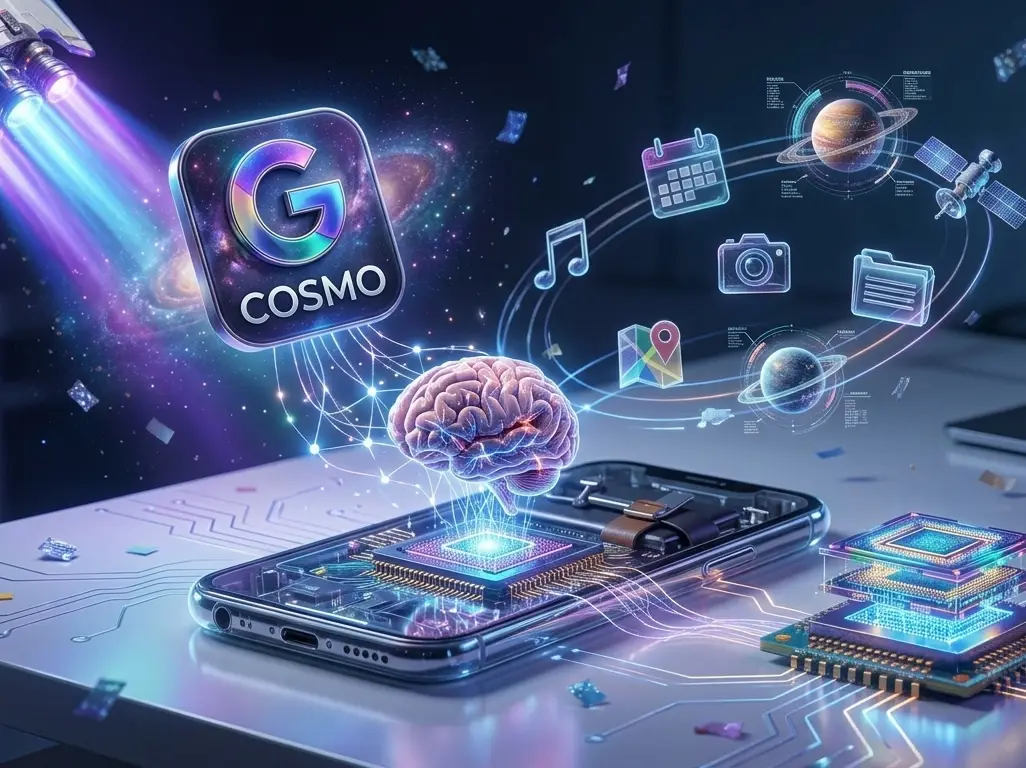
Google has accidentally revealed details of its upcoming AI assistant, COSMO, after an experimental app briefly appeared on the Play Store. The app, which was around 1.13 GB in size, was uploaded on May 1, 2026, and quickly downloaded and analysed before being removed. The leak comes just weeks before Google I/O 2026, where the company is expected to showcase its latest AI developments. According to reports, the listing was not meant for public release, but it has already given a clear idea of Google’s next direction in AI assistants.
What is Google COSMO and how is it different?
COSMO appears to be very different from AI assistants. Instead of waiting for user commands, it is designed to act as a system that can understand context and assist users automatically. In simple terms, it works like an AI layer inside the device that can observe what the user is doing and offer help when needed. This marks a shift from reactive assistants, which respond only when asked, to proactive systems that can anticipate actions. The goal is to reduce the need for manual inputs and make everyday tasks easier.

Powered by on-device and hybrid AI system
One of the key aspects of COSMO is its ability to run directly on the device. It uses Gemini Nano, which allows it to function locally on Android devices without depending fully on the internet. This means faster responses and better privacy in certain cases. At the same time, COSMO also uses a hybrid system that can switch to cloud-based processing for more complex tasks. This combination of local and cloud AI helps balance speed, accuracy and performance, making the assistant more flexible in real-world use.
Real-time screen awareness and smart assistance
Trending Stories
)
Trump-Xi Summit: Trade, Taiwan and the red lines shaping US-China talks | Race To Power
)
US citizen injured in Illinois after ICE agents mistook him for fugitive, hospitalised
)
US judge questions Trump’s decision to ban CNN, MS NOW and Politico from White House
)
Afghan woman cyclist who disguised herself as a boy to escape Taliban, wins Asian Games medal
)
Trump signs Greenland security deal with Denmark, paving way for two new US military bases
)
IND vs JPN T20I: How an overturned wide became point of difference between India's win and a tie
)
IIT Bombay CCTV footage emerges: Sahil Wakode seen looking at phone in examination hall
)
Cyclone Arnab: Landfall expected before midnight tomorrow as IMD issues orange alerts across six states
)
NBA player Steven Adams shares hilarious GTA VI theory
)
TMC revives impeachment push against CEC Gyanesh Kumar after report of internal dissent
)
WION Iconic Tourism Summit 2026: Union Minister Shekhawat on 'experiential travel', peace diplomacy
)
ICC plans T20I expansion and fewer ODIs in 2027–2031 FTP cycle: Report
)
'AI got into my speech': Prince Harry jokes after teleprompter failure at event in New York
)
WION Iconic Tourism Summit: Seychelles envoy says India partnership is important for Seychelles
)
Scientists detect first radio signals directly from faraway planet
)
China to test supersonic jet that moves at Mach 2, double the speed of sound
)
WION Iconic Tourism Summit: 'Hanuman Ansh' Director on blockbuster success
)
Open AI, Anthropic CEO urges caution over rapid AI development at UN Security Council, call for 'extreme care'
)
Bomb scare in New York amid UNGA: Suspicious suitcase found near UN headquarters
)
Hours before Xi-Trump meeting, US announces visa curbs targeting birth tourism: What is it?
)
WION Iconic Tourism Summit: Is India's travel boom outrunning its airports, airlines and hotels?
)
WION Iconic Tourism Summit and Awards 2026: Key voices to discuss India’s tourism future
)
Trump-Xi state dinner 2026: Who is invited? Full guest list of tech CEOs, business leaders and officials
)
American manufacturing is reshoring faster than its factory floors can absorb
&im=FitAndFill=(700,400))
New OTT releases this week (September 21-27, 2026): Shaque: Trust No One, Hunkkaar, Don’t Be Shy- 5 new titles coming to Netflix, Prime Video and more
)
WATCH | China President Xi Jinping lands in US as Trump greets him ahead of high-stakes summit
)
Australian PM Anthony Albanese calls OpenAI AI incident 'unacceptable' after restricted data access
)
'What kind of confession is this?': Pakistan PM Shehbaz Sharif’s 'terrorists would be roaming New York' remark goes viral, raises alarm online. Watch
)
WION Iconic Tourism Summit: How local tourism MSMEs must upskill for AI integration
)
Elephants hide behind trees, stage surprise attack on poachers targeting rhinos in South Africa
)
'Putin is patient zero': Zelensky slams Russian president at UNGA, accuses him of using fighters from 47 countries
&im=FitAndFill=(700,400))
National Film Awards 2026: Kartik Aaryan, Mammootty, Yami Gautam, Randeep Hooda and other key winners
)
El Niño 2026 heats up to become strongest in 1,000 years
)
Israeli envoy to US Yechiel Leiter’s son critically injured in West Bank ramming attack
&im=FitAndFill=(700,400))
Trump welcomes Xi Jinping in rare airport gesture: Photos from Chinese President's arrival in US
)
Anne Hathaway to run in supporting race for Nolan's epic
)
Xi-Trump meeting: China’s human rights red line and past protests explained
Another important feature of COSMO is its ability to understand what is happening on the user’s screen. By using Android system tools, the assistant can analyse content in real time and provide relevant suggestions. For example, it can recognise conversations, detect tasks, and offer help without the user needing to ask. This level of awareness allows COSMO to assist in a more natural way, making interactions smoother compared to earlier AI tools.
Key features revealed in the leak
The leaked version of COSMO shows several practical features that highlight its capabilities. It can suggest calendar events when it detects plans being discussed, find photos based on user references, and help write or summarise documents. It can also provide summaries of conversations and compile information from multiple sources for research tasks. Another notable feature is browser automation, where the assistant can perform actions on websites instead of just providing answers. These features suggest that COSMO is designed to complete tasks, not just respond to queries.
What the leak suggests about Google’s AI strategy
The accidental release of COSMO gives insight into Google’s broader AI strategy. The company appears to be focusing on assistants that are more deeply integrated into devices and capable of taking action. This includes combining on-device intelligence with cloud systems and building assistants that understand context better. Industry trends also show a similar direction, where AI tools are becoming more proactive and useful in daily workflows rather than just being conversational tools.
It is still unclear how Google will officially introduce COSMO. The assistant may launch as a standalone product or become part of existing services like Gemini. Since the leaked version appears unfinished, changes are likely before any public release. However, one thing is clear: the future of AI assistants is moving towards systems that can understand users better, act independently, and help complete tasks efficiently. With Google I/O 2026 approaching, COSMO has already set expectations for what could be announced next.
What is Google COSMO and how is it different?
COSMO appears to be very different from AI assistants. Instead of waiting for user commands, it is designed to act as a system that can understand context and assist users automatically. In simple terms, it works like an AI layer inside the device that can observe what the user is doing and offer help when needed. This marks a shift from reactive assistants, which respond only when asked, to proactive systems that can anticipate actions. The goal is to reduce the need for manual inputs and make everyday tasks easier.
Powered by on-device and hybrid AI system
One of the key aspects of COSMO is its ability to run directly on the device. It uses Gemini Nano, which allows it to function locally on Android devices without depending fully on the internet. This means faster responses and better privacy in certain cases. At the same time, COSMO also uses a hybrid system that can switch to cloud-based processing for more complex tasks. This combination of local and cloud AI helps balance speed, accuracy and performance, making the assistant more flexible in real-world use.
Real-time screen awareness and smart assistance
Another important feature of COSMO is its ability to understand what is happening on the user’s screen. By using Android system tools, the assistant can analyse content in real time and provide relevant suggestions. For example, it can recognise conversations, detect tasks, and offer help without the user needing to ask. This level of awareness allows COSMO to assist in a more natural way, making interactions smoother compared to earlier AI tools.
Key features revealed in the leak
The leaked version of COSMO shows several practical features that highlight its capabilities. It can suggest calendar events when it detects plans being discussed, find photos based on user references, and help write or summarise documents. It can also provide summaries of conversations and compile information from multiple sources for research tasks. Another notable feature is browser automation, where the assistant can perform actions on websites instead of just providing answers. These features suggest that COSMO is designed to complete tasks, not just respond to queries.
What the leak suggests about Google’s AI strategy
The accidental release of COSMO gives insight into Google’s broader AI strategy. The company appears to be focusing on assistants that are more deeply integrated into devices and capable of taking action. This includes combining on-device intelligence with cloud systems and building assistants that understand context better. Industry trends also show a similar direction, where AI tools are becoming more proactive and useful in daily workflows rather than just being conversational tools.
It is still unclear how Google will officially introduce COSMO. The assistant may launch as a standalone product or become part of existing services like Gemini. Since the leaked version appears unfinished, changes are likely before any public release. However, one thing is clear: the future of AI assistants is moving towards systems that can understand users better, act independently, and help complete tasks efficiently. With Google I/O 2026 approaching, COSMO has already set expectations for what could be announced next.