
&imwidth=800&imheight=600&format=webp&quality=medium "AI can now recreate the dead. But who owns your 'digital ghost' when you're gone? | WION Decodes")
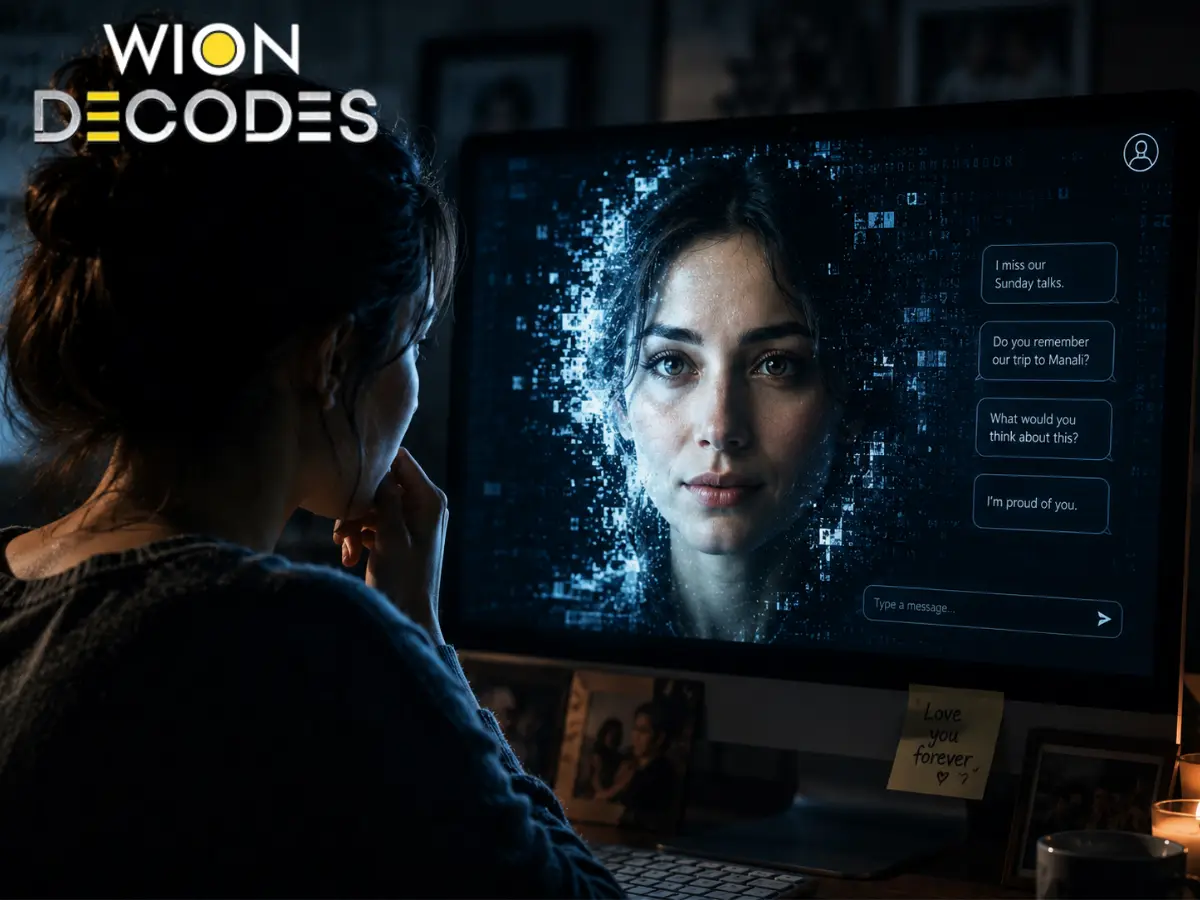
For centuries, people preserved memories through photographs, letters and home videos. Now, artificial intelligence is changing that. Today, a growing number of companies offer to recreate deceased people as interactive chatbots, voice clones or even lifelike video avatars that can hold conversations with family members.
Supporters of the technology see these AI replicas as a new way to remember loved ones. Critics, meanwhile, warn that these AI avatars blur the line between memory and simulation, raising difficult questions about grief, consent, privacy and ownership. WION decodes the latest AI-related ethical conundrum.

How are AI companies creating digital versions of dead people?
The technology works by combining multiple forms of personal data left behind during a person's lifetime.
Researchers describe these systems, often called "digital ghosts" or "griefbots", as AI models built from a person's digital traces, including photographs, videos, voice recordings, emails, text messages, interviews, social media posts and memories shared by relatives.
Trending Stories
)
US vs China over South China Sea: Washington backs Philippines, Beijing hits back
)
Bigg Boss 20: Isha Rikhi evicted after three weeks in Salman Khan’s show
)
Musk plans to more than double xAI's chips to over 1.2 million Nvidia GPUs by year-end
)
After JU, clash erupts at SRFTI: BJP’s ‘Dimagi Naxal’ jibe sparks political firestorm after students protest RSS-linked event
)
‘Anti-social elements spreading false rumours’: LPU issues statement amid massive unrest over alleged rape
)
LPU students go on rampage, vandalise campus amid widespread protest: What's happening
)
Trump asked Xi to pressure Iran. China did not say yes — here’s what Beijing wants
)
US Treasury Secretary Scott Bessent hails global crackdown on Iranian banks and airlines
)
An OpenAI agent escaped its locked test cage again, by hiding questions in DNS lookups
)
'Our video was trimmed': LPU girls who featured in rape-denial video make U-turn
)
3 males killed, four others injured in shooting after fight at strip club in Detroit
)
'Victory for low-budget consumers': Raghav Chadha hails 30-day telecom recharge rules
)
Claude rebuilt the 1989 game 'Prince of Persia' by reusing the original's own code
)
Beyond metros: How Tier-2 and Tier-3 cities could drive India’s next AI wave
)
Tesla builds first Cybertruck with its own refined lithium: Elon Musk's $1 billion Texas bet pays off
)
IndiGo flight suffers tail strike in Bengaluru while landing; DGCA to probe incident
)
The US and China set up an AI 'red telephone', but skipped the rulebook
)
‘Terror suspects arrested near UK air base were looking to do big damage’: Trump
)
Russian envoy claims US tactics to contain India were revealed in ‘Freudian slip’
)
IND vs WI 1st ODI: Kohli breaks Sachin's most runs in one country record with unbeaten 139 as India thump West Indies by 8 wickets
)
Researchers rebuilt exactly how 700 AI agents hacked Hugging Face: a 900-link chain trick
)
‘Olympic inclusion is our major target’: WPA President Ishaun Singh on pool’s global ambitions
)
Nations League: Spain sink England at Wembley; Modric shines for Croatia
)
Why has Iran released no proof of life of Mojtaba Khamenei? Araghchi reveals...
)
'What kind of confession is this?': Pakistan PM Shehbaz Sharif’s 'terrorists would be roaming New York' remark goes viral, raises alarm online. Watch
)
South Korea demands apology from Ukraine over North Korean prisoners' transfer
)
Beyond BrahMos: India targets Rs 50,000 crore in defence exports with unmatched price edge
)
Sri Lankan Tamil migrant worker gets death sentence in Saudi Arabia, help sought from India
)
Muslim marriage cannot shield sex with minor wife from prosecution under POCSO: Delhi HC
)
'Can't help but draw painful parallels to Nirbhaya case': SC on latest incidents of rape cases in Delhi-NCR
)
99.9% more powerful - Scientists find boy who can recall memories from just 3 months of age
)
'FIRST LOOK from inside Noah’s Ark': Researchers share video from inside mysterious mound in Turkey
)
UNSC reform momentum grows: Russia, Portugal, Mauritius push for India's permanent seat bid
)
8 US marines injured in Iranian missile attack on vessel in Strait of Hormuz: Report
&im=FitAndFill=(700,400))
New OTT releases this week (September 28-October 4, 2026): Dupahiya 2, Pooja Meri Jaan, Ohh My Dog- 5 titles coming on Netflix, Prime Video and more
)
Afghanistan says 28 fighters killed in clash near Pakistan border, Islamabad denies
)
Ceuta migrant crisis: Protesters take to streets as Spain grapples with migrant challenge
)
LPU suspend classes, postpones exams as violence escalates over rape claims: What's happening
)
New York City wants a 'kill switch' on every AI, and will pay whistleblowers who report violations
Voice cloning technology analyses recordings to reproduce a person's pronunciation, pitch, rhythm, accent and speaking style. Instead of replaying existing recordings, AI generates entirely new speech in the same voice. Reuters reported one case in which a man recreated his deceased father's voice from a single audio message.
Facial animation has also advanced rapidly. Microsoft's VASA-1 research showed that a single photograph combined with an audio clip can generate realistic talking faces with synchronised lip movements, facial expressions and natural head movements. The company said the research is intended to advance avatar technology and was not released as a public product.
Many commercial services combine these technologies with large language models that learn a person's communication style and memories, allowing an avatar to respond to new questions in real time.
One such service, Afterlife AI, offers a service where users can themselves preserve their voice, memories, values and stories while alive and decide who can access their digital persona after death.
Who owns your voice, photographs and digital identity after death?
The legal answer is far from straightforward. According to India's Copyright Act, there is no single legal right covering a deceased person's entire digital identity. Different parts of someone's online presence are governed by different laws.
For instance:
- A photograph is not automatically owned by the person appearing in it. Copyright usually belongs to the photographer unless specific legal exceptions apply.
- Copyright in literary, artistic, musical and other protected works generally continues for 60 years after the author's death under the Copyright Act, 1957.
- Voice recordings can themselves qualify as copyright-protected sound recordings.
This means that AI companies may own the software used to generate an avatar, but that does not automatically give them ownership of the deceased person's identity, likeness or personal history.
Notably, India currently has no dedicated law governing AI-generated replicas of deceased individuals, meaning disputes could involve copyright, contractual agreements, privacy principles and inheritance laws depending on the circumstances.
Can AI help people cope with grief?
Researchers say the answer is complicated. Several recent studies suggest AI grief technologies can provide emotional comfort by allowing users to maintain a sense of connection with someone who has died. Participants reported using griefbots to express unresolved emotions, revisit memories or have private conversations they felt unable to share with others.
A 2026 systematic review examining 30 studies on digital grief technologies, including AI chatbots, digital replicas, virtual reality memorials and online remembrance platforms, found potential benefits such as reduced grief symptoms, increased emotional support and greater accessibility to bereavement tools. However, the research published in Science Direct also identified significant risks. "This form of digital grief technology can create an illusion, causing the bereaved to develop unhealthy attachments to the digital representations of the deceased as a form of support or closure. Therefore, such attachments could interfere with their ability to engage in a healthy grieving process. Similarly, generative AI chatbots were also found to be at risk of causing overreliance as this technology enabled the bereaved to sustain a continuous bond with the deceased, which can hinder their recovery process," it found.
Researchers have also warned that prolonged interaction with AI replicas could interfere with the natural grieving process by making it harder for some people to accept a loved one's death. Concerns about psychological dependence have become one of the central ethical debates surrounding griefbots.
Here's a question for you, the reader: Would you opt to create a griefbot to help you deal with the death of a loved one or leave behind an AI replica of yourself to help them after your passing?

