EXCLUSIVE | Who is Sanjay Singh? A close ally of Leander Paes & guiding light of Luisa Stefani-Hayley Carter

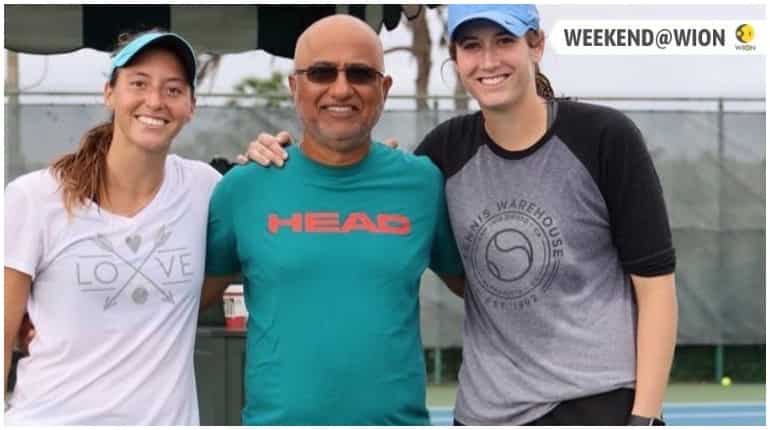
Sanjay Singh on Paes, his two students and much more about state of tennis in India.
Not often does one get to make a living out of his, or her, passion. Moreover, not many manage to don, and perform, various roles while following their passion at a professional level. Coach Sanjay Singh has done it all. From starting as a player to turning into a physio and honing his skills as an international coach, Mr. Singh has ticked several boxes while staying relevant in the field of tennis for years.Above all, his childlike passion remains infectious.
Such has been his success story that Mr. Singh has taken Indian tennis into uncharted territory. After all, howoften do we see Indian coaches being active in WTA or ATP tours? Also, have we often heard about Indian coaches for elite non-Indian tennis players? The answer to both the queries would have been in the negative if not for Sanjay Singh. However, Mr. Singh is one such personality who hassingle-handedly kept Indian tennis' flag high with his presence as a coach of Brazilian youngster Luisa Stefani and American star Hayley Carter.

In an exclusive interaction with WION news' Aditya Sahay, Sanjay Singh dwelled upon many aspects of his career, the several role transformations, satisfying journey with Luisa and Carterso far, the camaraderie with Indian tennis great Leander Paes and the state of affairs with regard to tennis in the cricket-crazy country. EXCERPTS:
Like mentioned, not often do we see Indian coaches for foreign players. You have changed it all in many ways. How did it all happen?
(Laughs) Well, I was a player initially. I was playing in Orissa Open. It so happened that I was playing in one court and the other player had a cramp. Because I used to work as the helper, I was asked to chip in and help. I assisted him and came back to play my match. At that time, I thought we don't have focus on working on players' fitness in India. So, I thought to take this up. That's where I started as a physiotherapist. During Davis Cup tie, Ramesh Krishnan's trainer didn't turn up, hence, they called me and I worked with him. When his trainer came back, Leander asked me to join him.
&imwidth=180&imheight=135&format=webp&quality=medium)
'My name has always been Ilhan Omar': Congresswoman hits back at Trump, calls him a 'creep'
&imwidth=180&imheight=135&format=webp&quality=medium)
Gravitas | US attack could trigger WW III: Russian planes in Tehran, Israeli jets, US warships in action
&imwidth=180&imheight=135&format=webp&quality=medium)
Viral video shows cross falling on Colombia priest, no official confirmation | WATCH
&imwidth=180&imheight=135&format=webp&quality=medium)
US Navy, Marine Corps boards defy Trump's transgender military ban, vote to retain troops
&imwidth=180&imheight=135&format=webp&quality=medium)
Will the US attack Iran this weekend? Trump's envoy says, 'absolutely'
&imwidth=180&imheight=135&format=webp&quality=medium)
Fauzi teaser out: Prabhas takes on the British Empire in patriotic avatar | Watch
&imwidth=180&imheight=135&format=webp&quality=medium)
India-China face-off continues near Arunachal’s Taksing, reveals ITBP chief in first official confirmation of tensions
&imwidth=180&imheight=135&format=webp&quality=medium)
Nairobi building collapse: Several feared trapped after 16-storey structure crumbles; rescue operation underway
&imwidth=180&imheight=135&format=webp&quality=medium)
Pakistan airline PIA unveils new crew uniforms, faces online criticism
&imwidth=180&imheight=135&format=webp&quality=medium)
Did Neha Bora call for Bangladesh-like GenZ protest, 'anarchy' in India? WION Fact-checks viral claim
&imwidth=180&imheight=135&format=webp&quality=medium)
'Already tired of his 9-to-5': Baby born with a moustache becomes internet sensation, video goes viral | Watch
&imwidth=180&imheight=135&format=webp&quality=medium)
Horrific video shows the moment 18-year-old fell to her death from Mexico amusement park ride
&imwidth=180&imheight=135&format=webp&quality=medium)
'Black triangle' UFO flying at 1,800mph spotted over sensitive US site: Latest Trump admin UFO file dump
&imwidth=180&imheight=135&format=webp&quality=medium)
IND-W vs ZIM-W, 1st ODI: Rawal, Charani star in India’s nine-wicket win over Zimbabwe
&imwidth=180&imheight=135&format=webp&quality=medium)
Massive 7.2 magnitude quake off Vanuatu triggers tsunami warning for coasts within 300 km
&imwidth=180&imheight=135&format=webp&quality=medium)
French Open: PV Sindhu storms into final with win over Hina Akechi
&imwidth=180&imheight=135&format=webp&quality=medium)
Google Fitbit Air’s new health guardian feature tracks trends: How it works
&imwidth=180&imheight=135&format=webp&quality=medium)
US midterms 2026: Trump revises Canada tariffs as Susan Collins faces tight re-election race in Maine
&imwidth=180&imheight=135&format=webp&quality=medium)
US midterms 2026: Viral video claims Lindsey Graham paid underage men for sex; clip released weeks before his sister's Senate race
&imwidth=180&imheight=135&format=webp&quality=medium)
IND vs NZ 2nd T20I: Shreyas Iyer on brink of breaking Rohit Sharma’s record
&imwidth=180&imheight=135&format=webp&quality=medium)
AI deepfakes are spreading online: Why is removing them so difficult?
&imwidth=180&imheight=135&format=webp&quality=medium)
China's dancing robot turns violent bodyguard, lifts cars and fights intruders - Watch
&imwidth=180&imheight=135&format=webp&quality=medium)
Global cybersecurity alert: PHP flaws trigger website shutdowns as hack attempts surge into millions
&imwidth=180&imheight=135&format=webp&quality=medium)
'You’re a horrible little reporter, aren’t you?': Trump snaps at NBC reporter questioning his support for Ramaswamy's campaign ad
&imwidth=180&imheight=135&format=webp&quality=medium)
Chemical warehouse explosion in Mexico: Several injured in multiple blasts, 1,000 evacuated in León
&imwidth=180&imheight=135&format=webp&quality=medium)
US charges two former FBI officials with lying to Congress about Hunter Biden probes. 'Politically motivated' Trump grievance or something else?
&im=FitAndFill=(700,400)&imwidth=180&imheight=135&format=webp&quality=medium)
How smart robots and AI assemble vehicles in 20 hours
&im=FitAndFill=(700,400)&imwidth=180&imheight=135&format=webp&quality=medium)
New Friday OTT releases (October 23, 2026): Gajab Raat, Dorothy, Chaar Yaar- Watch these 6 new movies and TV shows on Netflix, Prime Video and more
&imwidth=180&imheight=135&format=webp&quality=medium)
Anthropic security chief issues grim cyberattack warning: ‘It’s going to get a lot worse’
&imwidth=180&imheight=135&format=webp&quality=medium)
Tu Hai Meri Kiran film review: Sonakshi Sinha and Zaheer Iqbal's thriller gets tangled in its own twists
&imwidth=180&imheight=135&format=webp&quality=medium)
First Lady Melania Trump secures ceasefire between Russia, Ukraine in Oleshky: White House
&imwidth=180&imheight=135&format=webp&quality=medium)
Negotiators from Ukraine, Russia, United States to meet in Abu Dhabi: Zelensky
&imwidth=180&imheight=135&format=webp&quality=medium)
Farooq Abdullah says Pakistan’s raising of Kashmir issue keeps pressure on Delhi
&imwidth=180&imheight=135&format=webp&quality=medium)
Emmanuel Macron calls Paris suburb shooting a 'racist terrorist attack' after one killed, several injured
There is no end to learning. You learn from small kids also. In India, they think they know everything. They don't respect others. Among Indian players, only few are travelling abroad for training and all. You need to have awareness and the learning ability within you. Always!.
In one of your interviews, you rightly pointed out how India is a country where people like to stay in their own preconceived views or opinions. Many labelled you as 'one who gives massages to Leander Paes'. Was it a conscious effort to revamp your image or you never paid heed to all such claims?
Before I started off, I was a tennis player. Since there was no bodylooking after the players' body, their demands off the court and their suffering, I started working on this aspect. With Leander, I used to work with him. But since my knowledge of tennis was always there, hekept me involved asking 'Dadda (brother), what to do, did I mess it up?' I never had to tell people what I was doing with Leander. We both knew where we were heading and that's what mattered. End of the day 'let the racket talk'. It (criticism) never bothered me as it was all behind my back.
Hence, many talented players' careers are now over. They stop working on themselves after a bit of initial success. It is sad. Many didn't want to learn that often. Leander always tries to grasp more in every scenario. Unlike in India, I get much more respect in Florida. For our Prime Minister, they still call him as 'the chaiwala (tea-seller)' but one doesn'tsee, or acknowledge,his journey and development. We need to respect each other and see one's growth.
Coming to Luisa Stefani and Hayley Carter! Both are different individuals and, hence, have different styles, strengths and weaknesses. While Stefani is the first Brazilian woman to feature in the WTA's Top 10 and occupies the ninth rank in doubles, American star Carter has also come a long way to sit at the 25th spot in doubles rankings. How did your association begin with the duo? What defines them of both? Can you highlight few areas where they have shown vast improvement under your watchful eyes?
When I used to travel with Leander, my base was in Florida. During my off-season, I used to train at Saddlebrook Tennis Academy. Back then, I was asked if I can train this young girl called Luisa Stefani. I saw her and was floored by her talent and skills. I was like 'wow, this girl has fire, she is fast and comes to the net'.
Since she wanted to be pro, she had to change her visa. She couldn't get the visa initially and, thus, went back. In 2018, she returned. Then we started playing and practicing. There was one month of intense training. Her parents then asked me to travel with her. So I started in April 2019. In May, she won the Italy Championship in England. Thus, she had a chance to enter the Wimbledon but she was alternate, hence, couldn't get in. The same fate followed in the US Open.
On the other hand, Hayley was looking for a partner. Luisa asked me and I told her play with Hayley. They won the Uzbekistan Championship (i.e. Tashkent Open) in 2019 and then they lost the third round in Australian Open 2020. Luisa has a big serve whereas Hayley attacked the net more often. Only drawback was the overhead shot. That was the area we were lagging behind. But we started combining well and then after that Hayley got hurt in Wimbledon this year. Then we got Gabriela Dabrowski with Luisa. We reached the final of Cincinnati 2021 and semi-final of US Open.
During the pandemic, we weren't training. We used to be in the bubble. We were getting tested. RT-PCR tests and being confined inside was the new normal. Mentally it was very tough and, hence, many players are now burning out. The only time they opened up little bit was during the Cincinnati (Open). Life was tough. We couldn'tgo out. One had to resort to Uber Eats. We used to have a table downstairs in the lobby where the food was kept by the Uber guy and then we had to take it.It was all about dealing with the bio bubble life and surviving (sighs).
The world of sports knows a lot about Leander Paes. He remains the face of Indian tennis. Share your equation with him. How did it start and where is it at present? How has he helped in your transformation from being a physio tocoach?
See, it was during the Davis Cup tie in New Delhi when I met him. I used to work in the hotel as a helper supervisor. In 1996, it was tough for me to manage work and my tennis stuff. So I left my job and came on board with Paes. He wanted me to learn everything because he never trusted anyone else. Let me tell you, I used to travel with a stringing machine as he was playing so much. Everyday 7-8 rackets were used.
But, Leander has always encouraged me. He used to ask me to interact with people, observe others and share inputs. He alwaysbelieved in me. I used to be his brother, buddy and everything. He says he wants to retire in Wimbledon 2022. Let's see. He tells me 'Dadda, you will get me ready for Wimbledon'.We both call each other 'Dadda'. That sums up the whole equation, doesn't it?(smiles).
ALSO READ |EXCLUSIVE | Dark clouds of struggle have a 'silver' lining for Mirabai Chanu's coach Vijay Sharma
Lastly, thoughts on tennis in India. From Paes, Mahesh Bhupathi, Rohan Bopanna, Sania Mirza to Sumit Nagal, the sport has come a long way in the country but there obviously remains hugescope forimprovement andparticipation among the youth. Your views regarding the status of the game in the country at present?
In India, they should have a team who knows about the game firstly. Mr Sundar Iyer (Secretary of the Maharashtra Lawn Tennis Association (MSLTA) and Manager of Indian Davis Cup Team) is doing great in getting tournaments in India. He's doing very well. See, if youngsters play more tournaments, sponsor them. Work for the players. Give them their due by supplying resources and everything that matters to build their careers. Even a peonis getting an India jacket. Give it to people who need it more. They need to sponsor juniors so that they can play tournaments outside India. It helps in building their games at a young level. For the unversed, inBrazil there are 7-8 juniors playing on tours. How many in India? Hardly!
For players, they should learn from Leander. If they do good in one game, they get complacent. Their collars go up after one good win. They don't know next week is a new week. Nowadays, we tend to go for shortcuts. Leander was never like this. Now I'm in states, when I see things there, players never have to worry about tennis court. Here, staff ask for INR 100 as court fees. Wherever you play, they will be charging you. How can a youngster manage all this, who is just trying to come up the ranks?
Unless and until they change the entire system, nothing will happen. Hence, many players move abroad to train and manage themselves. Here for everything, they will charge and stillnot provide all facilities.
They've to change a lot. We have to be player-friendly and not administration-friendly. India is such a great country. We have everything. But we face so many problems unnecessarily. Base has to change. Believe me, we have such great potential and that we can do wonders. But youngsters don't get support. In abroad, players get full support.
Outside India, the association is taking care of players and coaches. In Brazil, association are paying for trainers who are travelling with players. Unimaginable. It cannot even be expected in India.Even such thinking is missing in the country.
Luisa won the first medal for Brazil (bronze in women's doubles in Tokyo 2020). Their government called and felicitated me. As a foreign coach, they are calling and honouring me. This doesn't happen in India. The coach can give you the idea, but who will bring you to the court -- a trainer. If you have a Ferrari but the engine doesn't work properly, it is as good asa showpiece. Hence, a lot needs to change. Be more player-friendly, focus on coaches and trainers, give them their due and build youngsters' careers from the junior level itself.